by Aaron Keebaugh
Published November 30, 2025
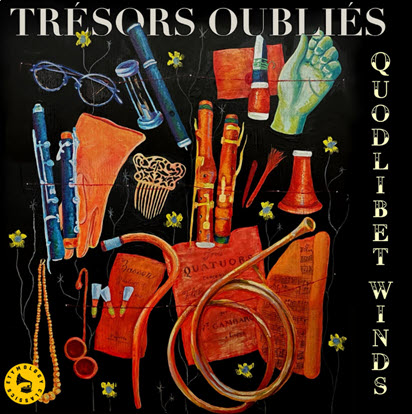
Trésors Oubliés. Wind Quartets by Gebauer, Eler, and Gambaro. Quodlibet Winds. Etymology Classics. Available on Bandcamp and major streaming services.
Music that’s a study in character as well as color
Music for wind instruments was so prevalent in Paris during the early decades of the 19th century that long-forgotten pieces are still turning up in online repositories and dusty archival shelves. This sort of repertoire often brings to mind the work of Anton Reicha, whose wind quintets combined colorful sonorities with Haydnesque whimsy. A little more digging uncovers music further afield by composers as distinct as Francois Devienne, Giovanni Rozelli, and Johann Joachim Quantz, who pressed against the boundaries of divertissement and military spectacle.
But the members of the New York-based, period-instrument Quodlibet Winds have shed light on the very darkest corners of musical history with their debut album, Trésors Oubliés. Their outstanding performances not only make a strong case for wind quartets by François-René Gebauer, André-Frédéric Eler, and Vincenzo Gambaro, they suggest that the genre may be a true hidden gem of Parisian musical life after all — one that’s typically not considered a vehicle for a vivid musical imagination.
All three composers, in their own ways, contributed to the life of the Paris Conservatoire just as Classical elegance was giving way to Romantic excess. Gebauer came from a prominent musical family, several of whom performed in the band of the Swiss Guard in their native Versailles. François-René, a bassoonist, and his oboist older brother Michel went on to perform in the orchestra of the Imperial Chapel under Napoleon. Service even cost Michel his life — he died during Napoleon’s retreat from Moscow in 1812. But François-René eventually moved to a role as professor in the Conservatoire. Many of his bassoon concertos and chamber works for winds were composed for student performances.
At the time, Gebauer was likely acquainted with the work of Eler, who also taught at the Conservatoire from 1797 until his death in 1821. Eler possessed vast experience as a pedagogue and music librarian. He built a solid reputation as a composer for wind instruments.
Similarly, Vincenzo Gambaro, who settled in Paris following his upbringing in Genoa, Italy, turned to composing for winds to put his stamp on contemporary musical styles. Though remembered primarily as a music publisher, Gambaro’s pieces for clarinet and wind quartets were popular among students at the Conservatoire.
Despite being written for educational purposes, the wind quartets by these composers are in no way pedantic or overly academic. Sure, these pieces adhere to strict forms. But there’s still a sense of freedom and spontaneity that invites listeners inside the music.
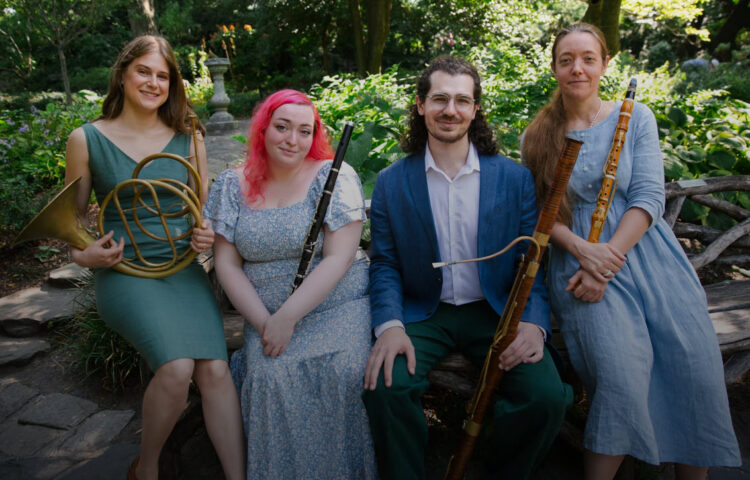
The Quodlibet Winds gives these works stellar advocacy. Dotted rhythms, played with ear-stinging precision, inject vitality into the stately opening phrases of Gebauer’s Quatuor, Op. 41. Each musician takes a turn in the limelight. Elise Bonhivert’s clarinet sings soulfully against the fluttered delicacies of Kelsey Burnham’s flute. Rachel Nierenberg’s horn sounds bold and assured to complement bassoonist Aaron Goler’s oaken resonance. Their playful verve frequently steps into the harmonic shadows, yet the tension resolves with satisfying panache. Those effects make the Rondo bubble like champagne, the music light and crisp. But there’s a brooding depth just beneath the surface; this music is a study in character as well as color.
By contrast, Eler’s Trois Quatuor, Op. 6 paints a portrait of Sturm und Drang grit. The horns cry out in the onset of the Allegro, each musician trading phrases with burning conviction. But even here there are fleeting moments of levity. The theme and variations skitter and dance as the upper voices mirror the lower ones in style as well as substance. Clarinet and flute melodies flow over the dark harmonic thickets supplied by horn and bassoon in a captivating mix of humor and deep reflection.
Gambaro’s Trois Quatuor, Op. 4, No. 2 offers a similar play between carefree fancy and emotional gravitas. Here, the instruments don’t mix so much as clash, a sonic salad rather than stew. Yet the players keep the musical conversation from riding comfortably on the surface. Their lines move easily between gentle grace and emotional richness. The rest of the piece seesaws between those extremes. The Menuetto bounds with bucolic fervor. The Finale barrels headlong into the darkness. But humor ultimately wins out through the ensemble’s sense of camaraderie. This is music of cooperation rather than competition. And the album, true to its title, offers treasures ripe for wider rediscovery.
Aaron Keebaugh has written for The Classical Review, Corymbus, The Musical Times, The Boston Musical Intelligencer, and The Arts Fuse, for which he is a regular Boston critic. For EMA, he recently reviewed Christoph Graupner from Musicians of the Old Post Road.