As a teacher, administrator, director, and advocate, Jody Miller makes everything run smoothly for all sides of the workshop: the faculty, the staff, and especially the participants.
Jody Miller’s green thumb: At Mountain Collegium, ‘everything grows’
Intrigued by the recorder? Does a viol have your name on it? Is the crumhorn calling you? Jody Miller is the guy to see. This Atlanta-based educator, conductor, and recorder player wants everybody to enjoy early music, whether it’s as a teacher, a listener, or — best of all — a player.
Whether he’s teaching, directing, administrating, or advocating, Miller refuses to let obstacles get him down. At the 2023 EMA Summit in Boston, he attended a panel on community engagement where, he recalls, “What I found was so much despair over getting people involved.”
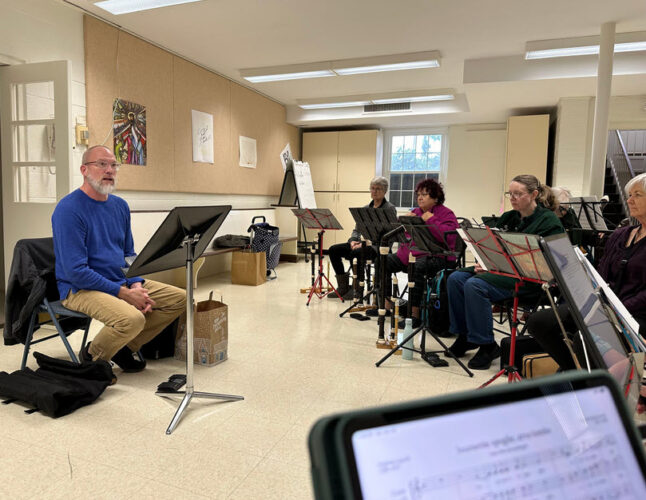
He suggests an alternative, urging his colleagues to think outside a box that we’ve created. What we call early music “was part of worship and part of entertainment and basically what we would call ‘Muzak.’ But [today] we expect that concertizing is the way we’re going to reach everybody. I would encourage us all to explore solutions that work for the type of music that we’re dealing with.”
Miller started his musical life on trumpet. While at the University of Southern Mississippi, his piano and harpsichord professor, Dana Ragsdale, opened his ears to early music, and to the recorder in particular. Ragsdale connected him with recorder virtuoso and editor Steve Rosenberg. Miller occasionally flew to Charleston for lessons with Rosenberg.
In the early 1990s, when he landed a job as the band director at McCleskey Middle School in Marietta, an Atlanta suburb, Miller’s early-music stars began to align, with notable musicians Aldo Abreu, Frances Blake, and Tish Berlin suddenly all in Atlanta. There was no lack of inspiration. Soon he also became an adjunct recorder instructor at the all-female Agnes Scott College, with opportunities to perform. He wanted to share his positive experience in early music: “What can I do in my life to bring people into this world?”
Miller’s administrative talents quickly revealed themselves. In the mid-1990s, he became president of the Atlanta Recorder Society, turning it from a casual social gathering into an organization that produced two concerts a year. He started an annual Consort Day, a “collage concert” where members can bring their ensemble or play a solo. By the end of the decade, he became director of Emory University’s Early Music Ensemble (“Consort” at the time). The group was just six or eight amateur players from the community. But under Miller, everything grows: He quickly built the program up to about 30 members — with a third of them students.
The U.S. economic crash, in 2009, prompted Emory to cut the Early Music Ensemble, along with Miller’s faculty position. But he had already established a fierce loyalty among amateur players that remains his trademark. The early-music community got together to form a nonprofit, Lauda Musicam. “It also allowed us to grow a lot more because we had more autonomy about where we met, where we gave concerts,” Miller recalls.
Now Lauda does two full-ensemble concerts annually plus another for smaller groups, involving capped reeds, viola da gamba, Renaissance flute, and brass. And they recently launched a Baroque orchestra, which includes “a few professional folks who have retired.” Miller takes an imaginative approach to repertoire. Recent Lauda concerts have included works by Juan del Encina (1468–c. 1529), Juan Gutiérrez de Padilla (1590–1664), and Pierre Manchicourt (c. 1510–1564).
The small ensembles are member-driven, says Joanne Mei, one of those loyal amateurs from Emory and current board president of Lauda Musicam. “We get together and rehearse on our own, but we also play for Jody. Then he makes the final decision as to whether or not the small ensemble is ready to perform.” She has her eye on the flute ensemble. “Right now, we are four people, but the coach found a few more people who might be interested in learning Renaissance flute,” which Lauda will provide. (Its replica instrument collection includes violas da gamba, recorders, sackbuts, cornetti, shawms, crumhorns, cornamuses, flutes, dulcians, and more.)
Despite his full career as a teacher, conductor, and administrator, Miller has never stopped performing with some of the best local ensembles such as Sol Divino, Amethyst Baroque, and New Trinity Baroque. In 2021, he retired after 30 years as a middle-school band director. But the skills needed for that job remain useful. “You taught everyone who signed up to be in band,” he says. He had to learn “how to meet people where they are and how to utilize people’s talents.” In Lauda, he encourages less confident members to “do all of the rehearsals, and then for the last two rehearsals just attend as a spectator so we can hear it without you.” Or he’ll have “a few folks sit out a piece or two because it’s beyond what they feel comfortable playing.”
As a school band director, he learned ‘how to meet people where they are’
Mei says Miller inspires “individual members to get to work and try to fix what’s wrong with their individual playing.” As longtime Lauda member Barbara Stark puts it, Miller “is very good at expressing what he’d like to hear in a way that people can understand and therefore do. He’ll say, ‘OK, now everybody play this line of music, and we can work through it together.’ Not only is that less boring for everybody; it also helps you understand your line and how it interrelates.”
Admired for his gentle manner, Miller usually stays in control during rehearsals. But the middle-school band director can still make an appearance. “Sometimes, when the group is unruly,” says Mei, “I can see him getting a little bit red in the face. When the hubbub has died down, he will say, ‘I can answer questions at the end, but right now these are the directions you need to follow.’” She adds, “I think it’s his experience with dealing with 12-year-olds for so many years.”
“Usually he’s endlessly patient with us,” agrees Lauda’s vice president, Mickey Gillmor, “except when somebody does something that he’s told us 12 times not to do. Like recorders playing while the strings are trying to tune.” Mei is also impressed by the background Miller provides for their repertoire. “I’ve never had a music history class. I’m a chemist by training. I rely on Jody for all the details that I don’t know. I love learning about this stuff.”
‘The amateur early-music world is fraught with people who doubt their musical knowledge’
Miller thinks Lauda continues to grow — membership is now around 70 people — because players feel welcome. “The amateur early-music world is fraught with people who doubt their musical knowledge,” he says. “I require an audition if I don’t know you. We actually don’t maintain the strictest of performance level of individual performance. Instead, we just know that people will improve once they are in the ensemble.” As always, Miller is thinking about how to get this music heard and appreciated; everything doesn’t have to be a professional concert.
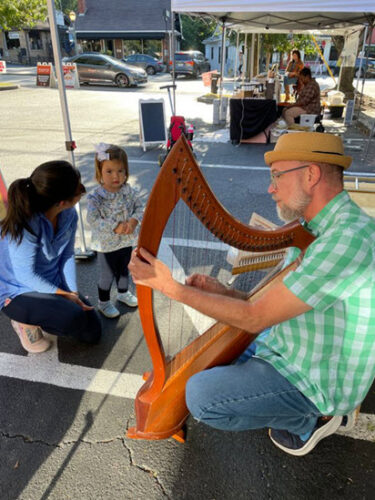
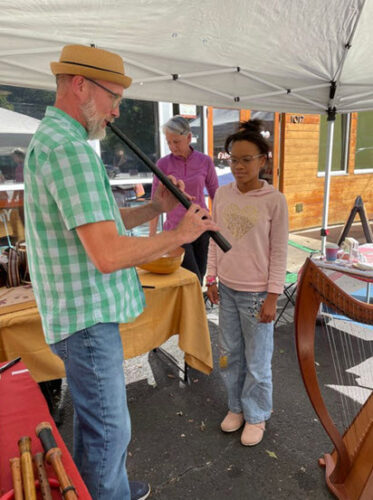
Lauda has a mandate for “education on recorders and early instruments in early music,” says Gillmor, “so we started doing things beyond our concerts. We go to the local farmers market, set up a booth, and play music.” They conclude their formal concerts with an instrument petting zoo, says Miller. “We’ll have people come up and meet the members, and they can see the instruments up close.” Their typical concert audience is 200-300 people. COVID’s effect on Lauda was unusually positive. During lockdown, Miller pivoted to Zoom, determined to make the experience rewarding. “Jody encouraged people to send in recordings of them playing the pieces that we were rehearsing,” Mei remembers, “and then he edited them into one recording, so it was almost like we did a little virtual concert.”
In 2022, they resumed in-person rehearsals on Mondays, and continued an online component on Tuesdays, allowing for a hybrid setup. “We have folks from all over the country who sign in,” says Mei. “They practice the same music that Lauda would perform.” Miller records every part. “If you’re doing a five-part piece,” Mei explains, “you can rehearse with your individual line and with all of the parts together.”
Setting the Tone at Mountain Collegium
Historical sackbut player and trombonist Erik Schmalz, a member of Philadelphia’s esteemed Piffaro, notes another organization that benefited from Miller’s handling of the COVID crisis: the annual early- and folk-music summer workshop Mountain Collegium, in North Carolina, where Miller has been director since 2011. Schmalz says Miller handled the return to in-person meetings by providing orange bracelets for people who wanted to maintain social distancing: “It was simple, respectful, and effective.”
“It’s family,” says Barbara Stark about Mountain Collegium (MC), where she is treasurer. “I hear other workshops talk about how their enrollment was down, whereas after the pandemic we just rebuilt.” She credits Miller for instigating the American Recorder Society’s North American Virtual Recorder Society program, keeping everyone connected. When Miller took over the directorship of the Collegium, it had three main components: recorders, viols, and folk music. They’ve since added brass, capped reeds, and open reeds, with a student capacity of 100.
He notes that “there’s no audition process. We don’t have elite programs. People get to self-rank their ability,” although he will help students figure out where they belong. When Miller started, there were never more than 10 faculty members; there are now 18 that teach full-time. Finding the right faculty is key. “I’ve tried to give teaching opportunities to upcoming early-music teachers,” Miller says.
One of those was Anne Timberlake, a celebrated performer and teacher who returns to MC most years and has gone on to teach at ARS, Oberlin, Virginia Baroque Academy, and elsewhere. When Miller first invited her to the Collegium in 2010, she says, “That was my first real workshop teaching job. It really launched my teaching career, so I am forever grateful to him.”
Schmalz, too, got a break at MC. Although he had been performing for a decade, “my teaching experience was limited to private students and the occasional college masterclass. Jody took the chance and made me feel completely comfortable from day one.” That access to classroom time, says Schmalz, is “something that no university or conservatory can adequately provide.”
‘Jody took the chance and made me feel completely comfortable from day one’
“Everything is run so smoothly for both sides of the workshop: faculty/staff and participants,” says Schmalz of the Collegium. Timberlake believes Miller “has helped shepherd Mountain Collegium to be an incredibly successful, warm, welcoming dynamic week-long workshop. Honestly, he sets the tone for that workshop, and he’s also incredibly organized. All these people feel seen and heard and valued.”
“He’s very collaborative as an administrator,” says Stark, although he does have an issue with delegating. At a recent meeting of ARS in Atlanta, she recalls, Miller was determined to take care of every detail himself. “You’ve just got to push back. You don’t want Jody to get burnt out. He’s too valuable.”
Everyone has a place at Mountain Collegium. “We have an emerging recorder and emerging viola da gamba track for people who are really new to the instrument,” Miller says, “so you can come to Mountain Collegium and be merely a beginner.” He’s not aware of any other early-music workshop with such an offering. “At a lot of workshops, you just get kind of thrown in if you’re a more beginning player,” says Timberlake, “and this program allows a lot of people to be met in a group at a more comfortable level.” She adds, “Beginners to any instrument — those are our lifeblood.”
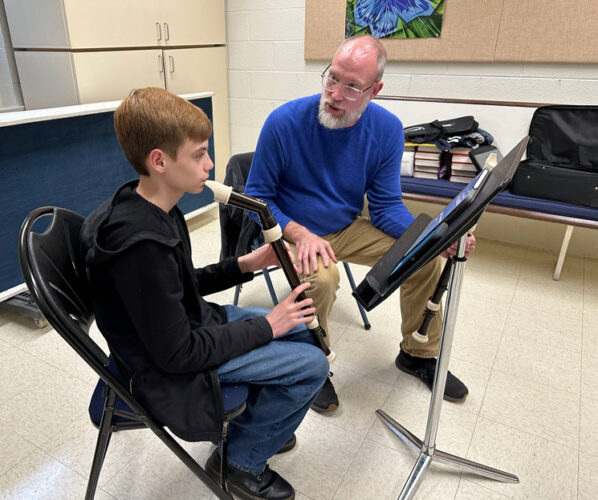
Miller sees no downside to letting in beginners. “We can still have advanced classes. I don’t think it’s realistic to expect a small community that functions at a very high level. We can have a large community that represents a wide array of levels.” Miller admits that he often has to remind older colleagues “that they cannot be demanding in the same way they could be 20 years ago.”
He believes that his popularity as an ensemble leader isn’t so much about his musicianship. “It’s that I work really hard not to make anybody feel bad about what they’re trying to do.” Many amateurs, of course, are of retirement age. “You don’t get a lot of people in prime earning and family years, particularly if they have children,” says Timberlake. “But it is wonderful to be able to come back to music when you have a little more space in your life.” However, Miller is determined to “reach out to more young people. One of the accomplishments he’s proudest of, in fact, is the formation of a middle-school recorder ensemble. “We went to the Boston Early Music Festival and played three times. I still hear from the kids who participated in that ensemble.”
He hopes to attract not only high school and college, “but also people in their 20s.” Recently, members of Lauda played The Mandalorian with the Atlanta Philharmonic, a student and community ensemble. “I was able to have a conversation with this entire orchestra full of lots of young people,” says Miller. He advises “getting out and being seen in places where this target audience is located.” Although Lauda does not (yet) offer classes, Miller says he’s “wishing we had a Lauda Junior for teenagers.”
Connie Kotis, a Lauda member and one of Miller’s recorder students, has close ties with University of North Carolina at Greensboro, and used her connections to help make just such an initiative thinkable: For the first time, UNC’s summer youth music camp will offer recorder (taught by Miller) as a limited trial. “He’ll do a recital then teach a class to see what the interest is,” says Kotis, who shares Miller’s enthusiasm for introducing young people to that instrument. “If anybody could be the pied piper, it would be Jody Miller.”
Anne E. Johnson is EMA Books Editor and frequent contributor to Classical Voice North America. She teaches music theory, ear training, and composition geared toward Irish trad musicians at the Irish Arts Center in New York and on her website, IrishMusicTeacher.com. For EMA, she recently wrote about Hearing the Ancestors Sing, a new wave in musicology.