A versatile bowed-strings player considers putting old music into a new context
A really good arrangement brings out new qualities in the original
This article was first published in the September 2025 issue of EMAg, the Magazine of Early Music America
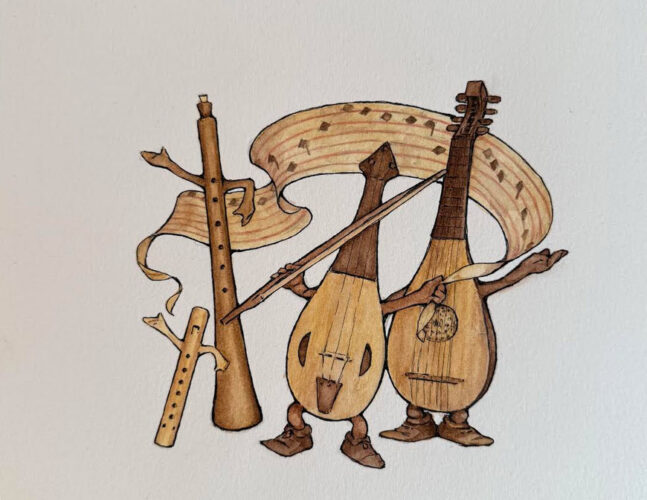
Early musicians often do wildly creative things with old music. A favorite pastime: taking music originally written for one or more instruments or singers and repurposing it for another by transcribing, arranging, adapting, orchestrating, re-composing, or transposing it.
After speaking with some 30 musicians, I confess that didn’t expect that everyone’s take on the topic would be so different. What they shared was a passionate conviction that what they were doing was exactly the right thing to do. And they were the right person to do it.
Affinity groups began to emerge. Group 1 does this because they love music and the rhetoric of music. Group 2 loves to play a particular instrument, like they’d love a new boyfriend whom they want the whole family to meet. Group 3 loves both music and instruments in different proportions. Group 4 loves working inside the music; they like to get under the hood.
Some of these people are famous, others are unknown beyond their local recorder chapter. Why are so many people on the lookout for more music? Isn’t there enough of it already?
Well, no.
So I start with Larry Rosenwald. “Ken Cooper once played two Scarlatti harpsichord sonatas,” he tells me, “and afterwards announced, ‘Dominico Scarlatti wrote more great sonatas for harpsichord than all the good music written for recorder in the whole of the 18th century.’”
That explains Annette Bauer’s take: “As a recorder player, borrowing is pretty much what we do exclusively. I’m exaggerating, of course, because there is specific recorder repertoire. But when teaching, I feel like I’m on the lookout for pieces to arrange that have nothing to do with that original repertoire.”
Bauer just used a loaded word: “borrow.” You’ll see why if you look at the Dictionary.com definition: “to take or obtain with the promise to return the same or an equivalent” — implying prior ownership and temporary use — or “to use, appropriate, or introduce from another source or from a foreign source.” It comes with negative synonyms, “plagiarize” and “pirate.”
Frances Feldon speaks to that: “I suppose a composer imagines a certain piece of music for certain instruments; he has a sound picture and wants the things that instrument can do. But that doesn’t negate the situation where you make a new sound picture, perhaps with the same materials. That’s very Renaissance. A Dowland lute song can be reinvented as treble divisions, keyboard variations, or a polyphonic galliard.”
You can make a new sound picture, perhaps with the same materials. That’s very Renaissance.
Angela Mariani describes how her teacher, Thomas Binkley, used “borrow” in this context. “He would talk about something musical that was created as a consequence of a particular kind of process, so they didn’t borrow concrete musical material, they borrowed a process, applied a process.” She adds, wryly, “What ends up happening is that we’re inadvertently borrowing decisions and concepts and choices that people who have come before us may have made. In this case, we’re borrowing the idea of musical ownership, projecting a modern concept on music from eight centuries ago.”
One of my favorite solutions to the misapplied concept of “owning” music often happens in folk music. I was taught that when you play a solo, the first thing you do is tell people who you learned it from, so they know where you got it. Then you share your own version, and they can appreciate it because they know what you started with. I think that’s respectful and honest.
ONE
The people who love the music and rhetoric, my Affinity Group 1, shared with me what inspires them. (And you’ll notice that our discussions are refreshingly free of historical performance and period instrument reservations and stipulations.)
One of James Perretta’s favorite genres is video-game music. He’s inspired by advice a teacher once gave him: “Play the music you like to listen to.” Frances Feldon again: Her theory is, if you’ve got really good music, you can do almost anything to it, and it’ll only make it better. And when you love some music, it doesn’t really matter what you hear it on, as long as it’s played with intention.
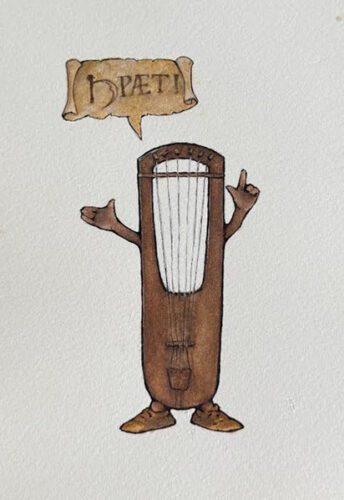
What drew Benjamin Bagby to create his remarkable Beowulf program was a love for language, which, in turn, led him to create music. It’s a fascinating story. “In high school, I bought an anthology of old English texts that included Beowulf. I thought, ‘Wow, this language really suits me.’ I gradually learned about the metrics of the language, and the pronunciation (as much as we can know it). It occurred to me that Beowulf was not literature, it was a performance, an English language text that tells an epic tale.”
Years later, he continues, “I had been in contact with historical harp maker Lynne Lewandowski, who was interested in building an Anglo-Saxon harp. She built the harp, and I started working with it.”
Sequentia was doing a program of early English song, “and I thought, ‘what’s an earlier English song than Beowulf?’ So I workshopped a 10-minute scene from Beowulf into the program. Put a lot of energy into it. The Utrecht festival director, Jan Nuchelmans, heard me perform and said, ‘the festival theme this year is storytelling. Come and do a whole evening of Beowulf.’
“This was in April, the festival was in August. I spent the worst summer of my life trying to put together that one-hour program. It really forced me to get my act together, deciding how to tune this harp. If you’ve got six strings, you won’t be performing a lot of chromatic music. I chose the most common mode of the Middle Ages, D mode, applied that to the instrument, and used it as a point of departure. It gave me what I call a matrix between the metrics of the texts and the tones that the instrument could provide. It gave me a zone where I could function vocally that encompassed one octave and change, which coincided with the highest note of my range and a middling low note, plus a lower register. And I found that in telling the story, a lot of details started to emerge. There were set pieces with a beginning and an end, laments, praise songs, event descriptions, and travel scenes.”
Bagby continues, “There were dialogues and discussions, expostulatory texts, and long genealogical passages. I needed to find a vocal way to do all of them. The instrument guided me through. I basically said, ‘look, I’m going to recite this on one note until I have a reason to change it.’ And the reason was always the text. That was my process. If I was borrowing anything, I was borrowing from the vast, unspoken, common pool of D mode that we’ve all grown up with. There’s nothing fancy about this mode; it’s very direct, and it’s a great vehicle for storytelling.”
TWO
I’ve got a personal stake in this next category. I’m an instrument jock, always have been. But until I was 18, I couldn’t play a thing. A combination of poor vision and processing problems made me a lousy violinist. In college, someone handed me a viol, and we clicked. Take it from me, having the right instrument can make all the difference. My fellow instrument jocks have equally compelling stories.
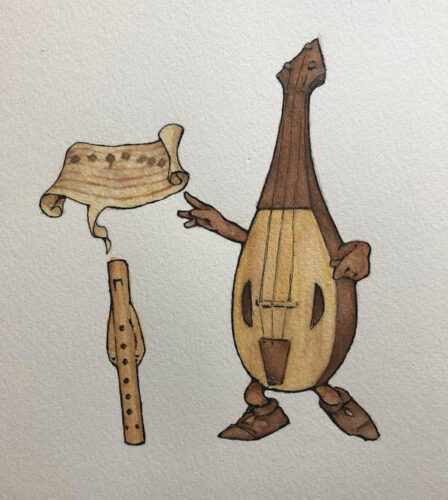
Chris Wilke sees the lute as a living tradition: “Yes, it existed in the past, and there is an incredibly rich artistic heritage. But I’ve never believed that we can’t continue to treat it as a living instrument, because we exist now. We’re the ones playing it. We can pretty much do whatever we want.”
Dan Meyers takes it further: “The attributes of an instrument may incline it towards particular repertoires, but careful attention to those attributes can easily make any instrument a success in a variety of domains. There’s an intricate, functional relationship between the characteristics of an instrument, the music that’s habitually associated with it, and the music its proponents write for it.”
For example, Meyers continues, “a limitation of the recorder is that it has a relatively narrow dynamic range. Its compensating strengths include agility, the possibility of fluid melodic improvisation, and a huge variety of potential articulations with both the tongue and the fingers. When using a recorder, or any instrument in non-native repertoire, it’s best to try to focus on what it does well. It can be a great instrument for bebop, blues. and jazz, as Tali Rubinstein and others have demonstrated. Its limited keywork makes microtonal repertoire both enjoyable and accessible.”
But let’s take this discussion in another direction. There’s more to consider when writing or arranging for a particular instrument than range, acoustics, and function. Some instruments were treated differently by composers and players because of the instrument’s social position. The five-string pardessus de viole, for example, was invented in the early 18th century for aristocratic women amateurs who wanted to play virtuosic sonatas by Corelli and Leclair but were prohibited by custom from playing the violin. Held on the lap, resonant and powerful due to its construction and tuning, the pardessus de viole had a short but intense life span of about a half-century. Invented to be a borrower, its name was added as an alternate instrument to the title page of dozens of Baroque solos and small ensemble pieces. Was this a courtesy or a ploy to sell more copies? Hard to know. Among the few works written for 5-string pardessus are the six virtuosic duo suites by Barthélemy de Caix. (They were the subject of my dissertation; 30 years later, the only complete recording is still the one Cathy Meints and I made for Dorian Recordings.)
THREE
Another instrument whose social position affected the way it was treated by composers and arrangers was the violoncello, and Paolo Pandolfo took that into account when he arranged the six J.S. Bach cello suites for viol and recorded them in 2017. His process is emblematic of an affinity group that loves to put instrument and music in balance.
Pandolfo’s preface for his transcription spotlights the familial relationship between viol and cello. Although they have a close connection, these Bach suites (probably written around 1720) are the only Baroque collection of unaccompanied suites for cello, as opposed to dozens for viol. This means that Bach “made a clear, brilliant, stylistic ‘transfer operation’ from the ‘ancient’ viol to the ‘new’ cello.”
“In the next decade,” Pandolfo explains, “the viol’s popularity began to wane in Italy, England, even in France, though not in Germany. It was clear that it was destined for oblivion everywhere in Europe, being too closely associated with the old order. Had Bach written the suites for viol, they would have been played by a few aristocratic old gentlemen and forgotten. Nevertheless, Bach patterned these cello suites on viol music, using the constantly alternating melodic and chordal writing, continuous dialoguing of different voices, and explicit or hidden polyphony so prevalent in viol suites by De Machy, Ste. Colombe, Marais, and Forqueray.”
‘If I were Marin Marais, how would I play this?’
How did Pandolfo create his viol version? “I allowed most transcription solutions to be suggested by the viol itself, with chords, transpositions, bowings, etc. I was always guided by a primary question: ‘If I were Marin Marais, how would I play this?’ Also, it’s a work constantly in progress. Many details have changed in my hands simply while playing the suites over again, and I consider this a part of the transcription process.”
Pandolfo adds: “Bach gave refined literature to an instrument that came from the streets. If you looked closely at the 18th-century cello, you could see the hole in the neck where the strap passed through to make it a cello da spalla or procession cello. As the century progressed, the low-class cello became middle class, and the suites reflect its change in status.”
FOUR
Group 4 is populated by garage mechanics up to their armpits in music. Jacks of all trades, experienced composers and arrangers, they write music in a variety of styles and genres, add material to existing early music, or adapt music from any genre for early instruments. All perform, many also improvise.
Lutenist Mark Rimple: “I’m pretty task-oriented. Sometimes I borrow the gestural language of a style, the contrapuntal texture of Baroque music, or the linearity of Renaissance music. It could be a particular schema or shape in a style that I then warp. Sometimes I’ll steal a tune, taking found objects and making them new on their own. I find something that I want to gloss, to turn into my own thing from something preexistent. Sometimes it’s as abstract as ‘I want to write something contrapuntal using my own harmonic language’ or ‘I want to write an intabulation in the medieval style.’ It’s very practical.”
Robert DeBree also does what’s needed. He writes music for children, arranges early flute music for viols, repurposes Beethoven for early instruments. “Yes, that spectrum. I have written some contemporary pieces that combine early and modern ideas. I wrote a fantasia on a chorale tune fleshed out with multiphonics. People ask, ‘Oh, who wrote that?’ That’s always a good sign when it’s not, ‘Oh, did you just write some random stuff?’”
Richard Stone recently arranged the Bach organ trio sonatas for his group, Tempesta di Mare, and reconstructed the orchestral parts for a Weiss concerto and wrote a second lute part for a book of Weiss lute duets. “One of the reviews said that some of the pieces are almost unrecognizable. That’s fine. You see how you and the piece interact and what comes from it. I’ll transpose a part, write an inner voice, and I can hear it in my head.”
Agueda Macias says it all starts with her viola da gamba. “Before practicing, I improvise and make good sounds. Composing and arranging comes from finding different things to do with my instrument.”
Adam Gilbert sometimes composes music in historic styles for Piffaro and other early-music groups. “That line between arranging something — like taking a 15th-century ground bass and making variations over it — and composing something entirely new became rather nebulous, transparent.” He’s coined the expression, “songs that know each other.” He explains that “it’s a term for borrowing without talking about people’s intent. I deal with songs that are borrowed from other songs, making allusions to each other, or that share a lot of material affinity, but also have an affinity for each other.”
He loves arranging for viol or, as he calls it, ‘a fun box that makes really cool sounds.’
Brady Lanier, who made a transcendent viol consort version of the Beatles’ “Blackbird,” has been composing music since before he knew what a score was. A child prodigy, he did it all by ear, composed pieces for orchestra, strings, winds, then learned theory in college. He loves arranging for viol, or as he calls it, “a fun box that makes really cool sounds.”
Emily O’Brien muses on the democratic nature of consort music: “I think homogenous recorder and viol ensembles fit into our modern musical lives in a very specific way. In consort music, all the parts are satisfying and none of them are boring. Nobody has a viola part. And so, in that sense, Renaissance consort music is perfect recreational music for both amateurs and professionals. So, we’re taking the musical conventions from one time and applying them to pieces written in a different time because it fulfills the expectations of our modern society, where we want a more democratic approach to the equality of musical lines. It’s democracy at work. This is what early instruments have to offer that playing in a modern string quartet doesn’t.”
FIVE
Here’s some advice for would-be arrangers.
Heather Spence: “If you’re starting with something that’s designed for a different time, place, or instrument, think about what you liked before, and what will make it more exciting now. Otherwise, what’s the point? A good arrangement brings out some new quality in the original thing.”
Ellis Montes: “To play traditional music, form relationships with the communities that you want to engage with. Get to know Andean musicians and listen to their music, collaborate with dancers. A lot of traditional music can’t be divorced from its function — it might be part of a religious ritual or a ceremony.”
Bill McJohn: “In Medieval music, you’ve got a lot of decisions to make to get from the beginning to the end of a piece. Take this scrap of music inherited from the past and decide scoring, tempo, road map, character! Daunting. But playing Bach requires all those decisions, just later in the process. Know that that scrap of music alone won’t get you to a performance, and those who think so end up with very thin performances.”
Ben Bagby: ‘Don’t get into something because somebody might like it. You do it because you have to.‘
Two final thoughts. We talk a lot about borrowing. Larry Rosenwald thinks even the most extreme musical appropriation can work, but you need to own it. T.S. Elliot agrees: “good writers borrow, great writers steal.” Jean Cocteau has a corollary: An original artist can’t help but be original therefore he need only copy. Counter-intuitive, eh? But when you steal, you’re saying, “This is mine.” When you borrow, you’re saying, “This is only temporary, I’ll give it back,” without the commitment.
And as Barbara Thornton once said in a masterclass, to an insecure soprano who was obviously not at home in Medieval chant, “Is this your music? If it’s not your music, why are you singing it?”
Tina Chancey is director of HESPERUS and a member of Trio Sefardi, Trio Pardessus, and Passio. She plays early bowed strings, teaches, writes, and produces recordings, and will continue to do so until her fingers fall off and she can neither see nor hear.