by Parker Ramsay and Arnie Tanimoto
Published January 4, 2026
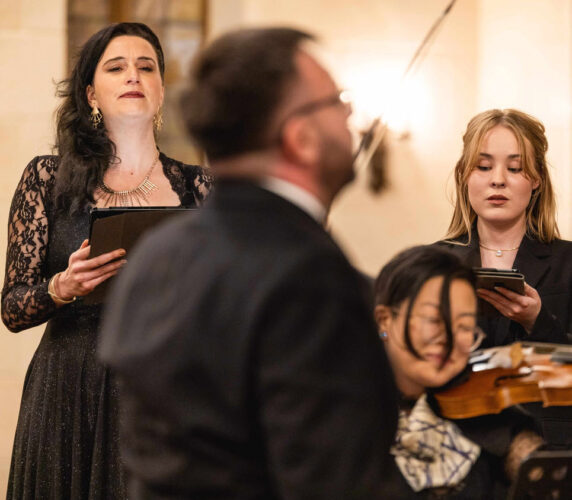
A Golden Wire is joined by soprano Karin Weston for See Those Sweet Eyes, an evening of Elizabethan music and verse. Moving from Twelfth Night to Candlemas, they will celebrate the quiet wonder of the Feast of the Epiphany in Tudor England with consorts and lute songs. The concert is Jan. 16 at the Church of Saint Luke in the Fields in New York’s West Village.
EMA asked the directors of A Golden Wire to write about this intriguing program, the culmination of the Holiday Season.
Christmas is past, as is New Year’s. Many of us are winding down vacations to head back to work. In Tudor England, celebrations would have continued. The Feast of the Epiphany on January 6 commemorates the arrival of the Magi to the manger, giving a few extra days of revelry. And in 16th-century England, another major feast would arrive on February 2: Candlemas, traditionally 40 days after the birth of Christ and the final celebration of the Christmas cycle.
This wasn’t an ordinary holiday or a simple service at church, but a celebration that would involve the whole community. Parishioners gather, each bearing a candle and a penny, evoking the image of a light arriving in the world — a light so intense that a blind man named Simeon could even bear witness to it.
Students of English history will note, however, that over the course of 16th century, public celebrations of this kind became more infrequent, if not outright forbidden: ashes were often absent from Ash Wednesday; palm branches on Palm Sunday were dispensed with; and the symbolic candles for Candlemas were never lit, all in the name of expunging society of superstition. The repression of the hallmarks of Catholic pageantry was but the tip of the spear in the internal battles of religion, forcing some English composers like John Bull, Peter Phillips, and John Dowland to flee, and others, such as William Byrd, to compose music in secret, or perhaps more cunningly, in code.
Indeed, the mere possession of certain works of music could merit arrest and imprisonment. In 1594, Penelope Devereux (sister of the famed Robert, Earl of Essex) interceded on behalf of John Bolt, a musician who faced torture for carrying a book with a musical setting of an elegy for Jesuit martyr Edmund Campion. Bolt confessed “that certeine leaves conteyninge lines and many verses beginninge Why do I use my paper inke and penne etc … is all of his owne hand wrytinge.” The verses in question are those of Henry Walpole, who was present at Campion’s execution in 1581, which begins:
Why do I vse my paper, inke, and penne?
And call my wits to counsel what to say?
such memories were made for mortall men;
I speak of Saints whose names can not decay:
an Angel’s trumpe were fitter for to sound
their glorious death, if such in earth wer found.
Byrd would go on to set Walpole’s complete poem to music, but omitted more pointed verses when publishing in his Psalms, Sonnets and Songs 1588.
England looke up, thy soyle is stained with blood,
thou hast made martirs many of thine owne,
if thou hast grace their deaths will do thee good,
the seede wil take which in such blood is sowne,
and Campions lerning fertile so before,
thus watered too, must nedes of force be more.
Such omissions were careful decisions on Byrd’s part, using the portions of the poem as a shibboleth for illustrating the plights of Catholics in Elizabethan England without explicitly advocating sedition.
At this time of year, Byrd’s settings of poems such as “Out of the Orient Crystal Skies” and “Sweet was the Song the Virgin Sung” depict scenes from the crèche. Songs for Candlemas seem to be lacking in his publications, unless one remembers that his music might have double meanings. In another lullaby, “My Little Sweet Darling,” Mary’s son is said to have “beauty surpassing the Princes of Troy.” This is perhaps a reference to Ganymede, the most handsome of all mortals, who, for his golden locks and pulchritude, was abducted by Zeus. A direct comparison between Oedipus’ abandonment by his father is seen in “From Citheron, the Warlike Boy is Fled,” and Mary takes the place of his adoptive mother Queen Merope, who in taking the child on her lap, has “thralls are scorched to the heart.”
In Byrd’s “When First by Force,” we hear of Dido’s woes in seeing the departure of Aeneas (“The Troian Knight”) after which “with sword ful sharp, she pearst her tender hart.” Such evokes the prophecy of old Simeon in the Gospel of Luke, who, after declaring that a child was the Messiah, tells Mary that his son will ultimately die and that “a sword shall pass through thine own soul, that the thoughts be showed of many hearts.”
Byrd was not just a Catholic, but also a humanist, using the cloaks of Classicism to express the emotional weight of the Candlemas story, in a mother being told that her son was to be killed. The imagery of the stoic but protective mother mirrors the quiet conflict of conscience faced by Elizabethan Catholics, who wished to protect the soul and fate of their own country. The dual lives of Recusants seems apparent in an upbeat setting such as “My Mind to me a Kingdom Is,” where a lilting melodies and counterpoint betray a darker poem:
My wealth is health and perfect ease,
My conscience clear my chief defense;
I neither seek by bribes to please
Nor by deceit to breed offense.
Thus do I live, thus will I die.
Would all did so as well as I.
Of the myriad benefits of getting into the weeds with early music is taking the time to explore what the music meant for the composers and their own audiences in times of yore, rather than just using beautiful music as props for our own holiday festivities. In our upcoming program with guest soprano Karin Weston, we here at A Golden Wire thought it might be interesting to dispense with the customary seasonal levity to shed light on a time when the images of the manger, the mother and child, and the tale of Simeon in the Temple had a more complex meaning.
Parker Ramsay is a harpist and keyboardist based in New York, where he is pursuing a doctorate at Columbia University. He specializes in early and contemporary repertoires. For EMA, most recently, he wrote about the peculiar programming of early music.
Arnie Tanimoto is a gambist based in New York, where he serves on faculty at the Juilliard School and Princeton University. He has performed and recorded in venues across North America and Europe with the likes of Barthold Kuijken, the Boston Early Music Festival Ensemble, and the Smithsonian Consort of Viols. He is a founding member of the Academy of Sacred Drama.