by Anne E. Johnson
Published January 31, 2026
As an educator, Rasháwn King uses ‘music as a unifier within the community.’
‘We had college students, professional musicians, vocalists, and we had period instruments. Just seeing all of that together creates a buy-in.’
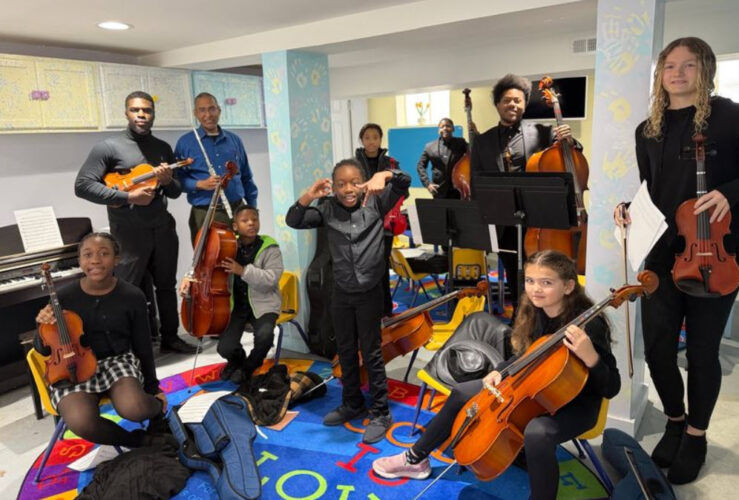
On December 9, 2025, the Yudah School of Music crowed on its Instagram:
Last night we broke barriers and made history by joining with Lincoln University and William C. Lewis Dual Language School to perform excerpts from Handel’s “Messiah”!
That performance represented quite an accomplishment. The non-profit Yudah School has only been around for about a year, with free tuition for all its students, mostly Black and Latino elementary- and middle-schoolers from underserved Delaware communities. Yudah’s founder, Rasháwn King, who is 25, pronounces the name “Judah.” It refers to the familial line of King David, ancestor of Jesus, renowned musician, and a person of color himself.
A Delaware native, King has family roots in Wilmington and Dover, the two regions where Yudah focuses its work. His background is his constant motivation. “My family was so poor, we couldn’t afford anything,” he says. “But my 8th-grade music teacher noticed that I had a love for piano. She said, ‘We’re going to teach you piano for free.’ It changed my life forever.”
He intended to study music education at Delaware State University. When COVID turned all teaching remote, he switched his major to piano. While in college he got married and started a family, and later sent his son to the William C. Lewis Dual Language School. When the school’s music teacher left, King was offered the job.
He was also involved at the non-profit Music School of Delaware, where a distressing incident served as the catalyst for Yudah’s formation. He describes their students and staff as “more elitist, and they’re mostly white, which I didn’t think was an issue.”
He was wrong. No one complained when he used MSD rooms to teach free lessons to underprivileged kids. But then “I invited my godfather [Delaware State professor Lloyd Mallory, a conductor and multi-instrumentalist] to come and play in the orchestra. The MSD administrators made it known two people of color was too much. I was frustrated about it.” When he expressed this frustration, they revoked his ability to use rooms for free lessons.
“I was so enraged by that, I said I’m going create my own organization. Anyone can come and feel welcome.” Word of his free lessons spread quickly among his Lewis Dual Language School students, and Yudah School of Music was born.
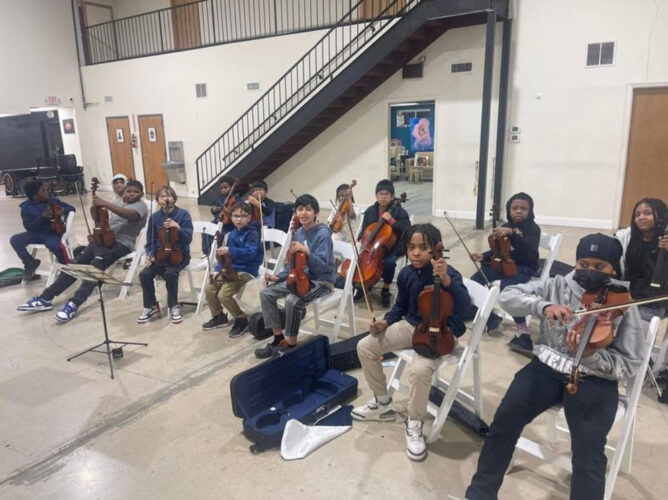
One early recipient of King’s free teaching was the nine-year-old son of Frankie Bonilla, a professor of music education at Delaware State. His son goes to Lewis, where during music class King noticed that the boy had perfect pitch. “Our son is on the spectrum,” says Bonilla. “In the first few years of school he had to wear headphones. But then it turned into such a gift: Now he can play anything that he hears,” on any instrument he tries.
When the Lewis school board wouldn’t allow the talented boy to join band because of his age, King simply started a pre-band after-school class. Meanwhile, Bonilla’s son had begun studying violin at the Music School of Delaware. When King was blocked from giving free lessons there, Bonilla was amazed that his response was to create his own school.
Dover-based music educator and soprano Jazmin Salaberrios met King while helping out at concerts led by Mallory, her former teacher. “I was trying to create a community choir,” she recalls, “and he said, ‘Well, I want to start a community orchestra for the kids.’ I was like, ‘Yeah, but I don’t want anybody to have to pay.’ And he said, ‘I know, me neither!’ It just kept rolling from there.”
First, they stockpiled free and cheap instruments. He found two spaces for teaching, serving two needful areas: Solid Rock Baptist Church in Dover, where King is pianist and music director, and Wilmington’s Union American Methodist Episcopal. Yudah mainly teaches strings and piano — currently about 50 students — although other instruments are available. Recruiting the next generation has mostly been through word of mouth.
Besides classical music, Yudah’s curriculum includes Hispanic genres such as salsa and cumbia. Bonilla believes that’s significant: “Rasháwn talks about the African connection and cultural component that goes into the Latino population, using music as a unifier within the community. I don’t think he fully understands how many barriers and stereotypes he’s breaking.”
Free Tuition, Free Concerts
In 2025, Yudah held its first summer camp, for about 30 youngsters. It culminated with a concert in the historic Murphy School in Dover, a group home for foster children. Says Salaberrios, “Some of those students participate in the orchestra. It was really lovely to see the kids grow so much in just a week.”
Most of the instruction is done by King himself, as Yudah has no budget for teaching salaries. Yet a few prominent Black musicians have offered master classes or workshops, such as Baroque cellist Wade Davis, violinist Lionel Thomas, and violist Arin Wilson. “I’ve never had a teacher say, ‘If you don’t compensate me, I won’t teach,’” says King, who usually pays them a little out of his own pocket.
Not surprisingly, Yudah’s five-member board often discusses fundraising. “We applied for some grants for Messiah,” says King. “They were a small fraction of the total cost, but it still was a huge help.” The summer camp was partially sponsored by a local restaurant. The school also fundraises through Facebook and GoFundMe.
Salaberrios, a board member, estimates the first year’s expenses as $30 to $40 thousand. That was before they started presenting concerts with contracted musicians. “This past season, one of our concerts was easily $20,000 in itself.” She figures the 2025-26 budget at over $60,000.
Besides lack of income, King acknowledges another downside to free lessons: “People don’t always value things as much as they would if they’d paid for it.” Still, he stands firm because of his own experience. “I just can’t find it in my heart to charge.” Tickets are also free for Yudah’s concerts. “We want to make sure that families can also come free of charge, without any barriers,” Salaberrios explains.
Yudah undertook Messiah despite its financial stricture. The idea came from Mallory, who conducted the performance. King was determined to “do Messiah in its original glory, with a predominantly Black and Hispanic orchestra.” He saw it as a challenge to fundamental assumptions about classical music, “what it’s supposed to be, who’s supposed to play it.”
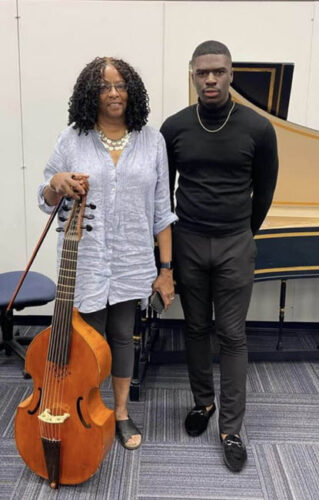
Yudah students participated in the choir along with singers from Lincoln University. The orchestra was mainly professional players, with soprano Courtney Williams, mezzo-soprano Courtney Porter, tenor Bruce Bean, and bass Jim Williams as soloists. The early-music players in the orchestra included a few students and faculty from Juilliard’s Historical Performance Program, among other institutions. Another HP specialist was viola da gamba player Patricia Ann Neely, who has known King since he attended Amherst Early Music Workshop in 2022, playing harpsichord. “Everyone loved him,” recalls Neely. “Within that week he learned to read figured bass and was able to improvise around it, so he was a great continuo player.”
Neely thinks this undertaking was important for the Black community in particular: “Messiah is the one piece that joins so many different types of people together. I grew up listening to my godmother singing this in her church in Harlem.” In her view, King has “resurrected something that has been going on in history.”
Bonilla was impressed by the quality of musicians King convinced, not only to participate, but to attend Messiah, “people who are really high at what they do in their profession, and a lot of Black and brown people.”
King thought it best to make a few cuts to the oratorio. However, he was determined to honor elements of Baroque performance practice. “I went and bought some snakewood Baroque violin bows,” he says. “I didn’t want anybody to have any reason why they couldn’t.” The choir rehearsed and performed at A=415. “These are 4th and 5th graders. They were amazing. I taught them Baroque embellishments. Like when we do a trill, we’re going to start from the top and go down.”
Neely remembers one teen cellist. “I thought, he’s really lucky that, at that age, he’s gotten this opportunity. He will own that the next time as a professional when he walks in and tells everyone, ‘Oh yes, I played this at 415 pitch and with a Baroque bow.’”
There has been growing acknowledgment over the past few years that teaching early music to youth provides important benefits. Seattle Historical Arts for Kids (SHAK), Lute4Kids in Upstate New York, and Pedro Funes-Whittington’s Viols of Deer Park are a few examples of such programs. As Funes-Whittington explains about his viol students at a junior high in Texas, playing complex early music “ensures everyone has an equal voice. Our ensemble allows each player to contribute.” (A recent EMAg article explored the scarcity of early-music youth education programs in the U.S.)
Yet there is sometimes resistance to that repertoire in communities of color. Gambist Neely found this while teaching at Harlem School of the Arts. “I couldn’t get people to be interested in early music. They weren’t even interested in classical music.” Referring to King, she says, “I don’t know what he said or how he presented it,” but, somehow, he was able to “make them receptive and not fear the unknown.”
“Rasháwn is always so enthusiastic when he speaks to people,” agrees Salaberrios. She believes the Messiah performance was especially enticing: “It’s such a spectacle. We had college students, professional musicians, vocalists, and we had period instruments. Just seeing all of that together creates a buy-in. You think, what is this fantastic thing that’s happening, and what are the ingredients?”
Growing Young Brains
Yudah also provides an alternative to violence and gangs, or even boredom, says Salaberrios. “Kids can instead come over to the Yudah School of Music for free and engage in playing music. They will be subconsciously growing their brains without even trying.”
Salaberrios continues, “I hope to see us grow financially so that we can reach more students and we can employ people,” who believes the school can become “the primary source of strings programming for the state of Delaware. And we’re moving over to chorus as well.”
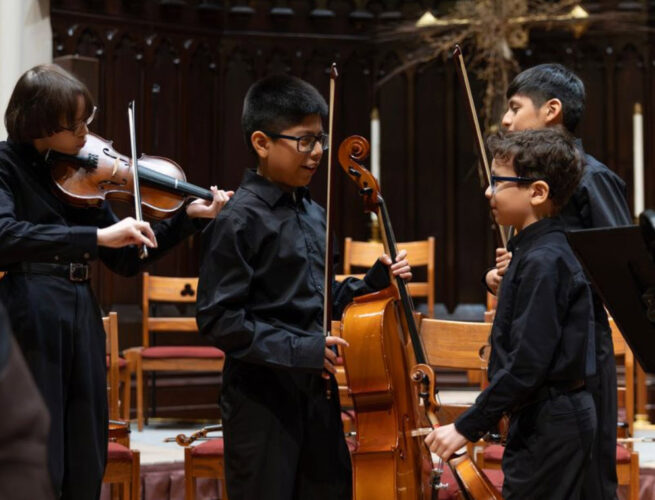
Bonilla wants Yudah to grow into “an after-school program that’s connected to a school district or some kind of academic institution.” He envisions a connection with a summer reading program he runs in Wilmington. “There’s no way a kid that can read music should be struggling with regular reading. I would love to see Rasháwn do some research work based on that.”
King intends to mount more large-scale performances, calling that Messiah project “probably the hardest thing I have ever done, but it was so worth it.” He plans on Vivaldi’s Gloria in the spring.
Yudah’s watchword is “equity, which is the idea that anyone can love music,” he explains. He was both pleased and saddened that his BIPOC Messiah was unprecedented. “Why isn’t this something that’s happening more often?” The continued existence of racism seems to baffle him. “It’s hard to understand that we still see the world that way. How about we just all get in the same room and play the music that we all love? When we do that, we forget what color we are.
“If you give someone a chance in music, no matter where they come from, no matter who they are, you may be surprised at the impact that that person could have on the world.”
Anne E. Johnson is EMA Books Editor and frequent contributor to Classical Voice North America. She teaches music theory, ear training, and composition geared toward Irish trad musicians at the Irish Arts Center in New York and on her website, IrishMusicTeacher.com. For EMA, she recently reviewed the latest album by New York’s Ensemble Galilei, where trad and early music meet.