by Agathe Créac’h
Published March 2, 2026
REMA – European Early Music Network publishes an annual survey of its members to assess the wider European early-music scene.
In 2025, the numbers ‘seemed terrifying.’
The 2025 edition of an annual survey by REMA – European Early Music Network aimed to assess the impact of budget cuts on our members’ activities.
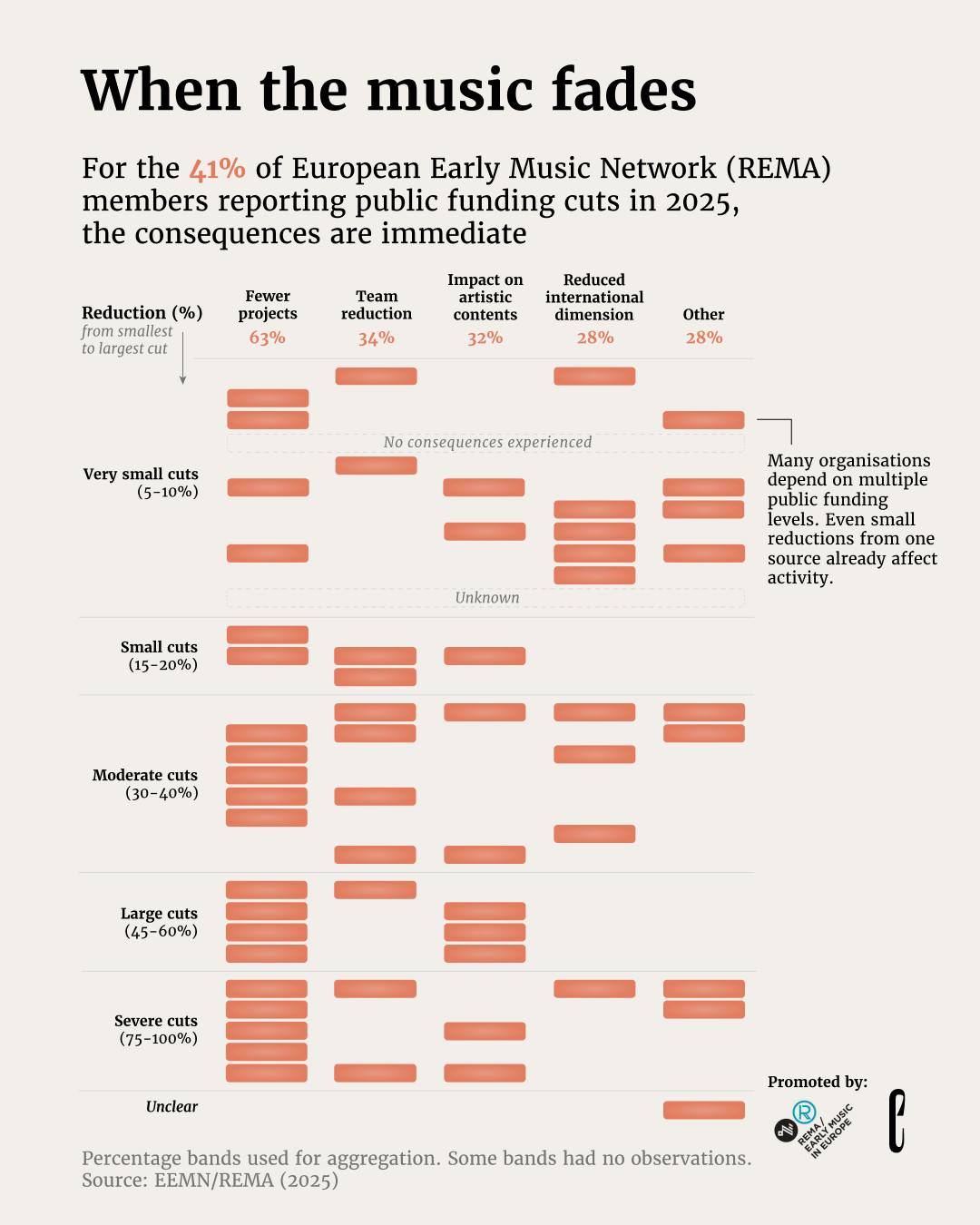
We assume that the 41 percent of our members (80 respondents, festivals, ensembles, research institutes, conservatories, labels, etc. in 29 countries) who reported experiencing funding reductions are a representative sample of REMA’s membership. If the data is consistent with our own membership, it is only relevant to the European early-music scene; further surveys would be useful to expand it to other areas.
When we first received the figures from our 2025 study, they seemed terrifying. Just a few months later, we already know that what’s happening in the field goes far beyond — especially for festivals and independent ensembles.
When a region, a city, or the state cuts funding by just 5 percent, it already means fewer concerts for audiences, safer, less diverse programming options, less work for independent musicians, and more pressure on organizations that were already trying to hang on.
Now imagine the cocktail effect when several funding streams are reduced or disappear altogether.
A Snapshot of Funding Culture
As each country has its own practices when it comes to funding culture, it is difficult to assess the severity of the situation on a country-by-country basis. In France, where structural funding has traditionally been a cornerstone of support for independent ensembles and festivals, 57 percent of respondents reported cuts. In Italy, where public funding exists but is less systematic, the figure was 28 percent. Asking the question in 2025, without considering an organization’s resources over a longer period of time, inevitably produces only a “snapshot” at a specific moment, which should be put in perspective by a 2026 update.
But our goal here is not to highlight the weaknesses of the European model, which relies on public subsidies. But whether cultural funding originates from public or private sources, the consequences of a decrease are the same. And this is where members’ responses become alarming. These 41 percent of respondents reported a decrease in at least one source of funding, although organizations generally rely on multiple levels of support that is structural or project-based. (Those sources may be municipal, national or, in some cases, international).
But put into perspective, a single 5 percent decrease already has consequences: a concert cancelled, a reduced artistic team. At 10 percent: fewer outreach activities or the end of free concerts.

Beyond that, a cut may bring reduced administrative staff, and the worrying response, “fewer concerts, more organizing work.” In a sector already under strain, how long can teams continue to serve as an adjustment variable?
And what happens when there are multiple 5 percent cuts? Or 10 percent, even 30 percent? What if project funding is withdrawn entirely from a policy program?
The real consequences of these cuts emerge clearly from the responses: at the early-music sector level, they translate into salary reductions, job losses, fewer work opportunities for independent musicians and, ultimately, if the international dimension can no longer be sustained, the decline of a cultural ecosystem built on the circulation of works and artists.
On a broader scale, the public ultimately bears the long-term cost. Respondents report dispensing with artistic directors and acknowledge turning to safer programming choices, scaled-down projects without staging, or simply well-established repertoire. Many are no longer able to offer less-profitable activities focused on cultural outreach, which once connected them to their audiences.
In short, what becomes available to the public is a less diverse, less ambitious, and above all less abundant artistic offering. Ultimately, one question remains: are funders reducing their support in full awareness of the consequences, or is the impact on cultural access a collateral damage of their reduced means? That, however, is a separate debate.
Agathe Créac’h is Co-General Delegate of REMA-European Early Music Network