
by Cecilia Duarte
Published March 6, 2026
‘I started wondering why we don’t put any effort into being better human beings’
This CANTO column was first published in the January 2026 issue of EMAg, the Magazine of Early Music America
Many years ago, when I went to my very first yoga studio, I had a conversation with an instructor who asked what I did for a living. I responded that I’m a singer.
She immediately asked, “And why do you sing?” I replied, “Well, because it is who I am, and when I sing, I have no fear.” After a pause, she told me something that stayed with me ever since: “When you learn to be happy without singing, you’re going to sing better than ever.”
Jump ahead to 2020. When the pandemic hit, most performers were left with no work, no music to play, and feeling completely isolated from one another. I saw how many of us were invaded by a deep state of depression and anxiety — quite understandable because “uncertainty” was the scariest word out there, one that we had to live with every day, not knowing how we were going to pay our bills or what would come next.
Thinking about my first yoga teacher, I started asking my own questions: Who are we outside of what we do? Are we still valuable people if we don’t make music? Do we feel we have anything to offer beyond beautiful performances?
An instrumentalist who’s very close to me had put all his value in his musician identity, believing he had nothing to offer as a human being. During the pandemic, he sank into depression, feeling worthless. His sad words made me really consider my own emotional state and who I was when I wasn’t singing. As professionals, we put a lot of effort into perfecting our technique. We study increasingly challenging repertoire, and strive to work with more prestigious ensembles and better music organizations, all in the name of advancing our career.
I started wondering why we don’t put any effort into being better human beings.
Something else that I have found is that one of the biggest ailments we suffer in our industry is lack of connection. We have become so focused on being excellent at what we do that we often forget we are working with human beings and so we keep our fears and feelings to ourselves without realizing that mostly everybody is facing a different type of challenge related to the profession.
A fellow vocalist mentioned to me that whenever she was onstage, she would hear the voices of every person that had ever criticized her. Another fine musician and colleague, plagued by a combination of nerves and low self-esteem, admitted that while onstage she always looked for the nearest exit, in case she suddenly needed to leave mid-performance.
It is only when we dare to be vulnerable and open ourselves to each other that we can realize that we are not alone and that it is very important to work as a community that can support each other. A much bigger question might be, do we feel safe enough to open up and be vulnerable with each other?
The answer might be one more reason why mental health is so important in our industry.
So when COVID happened, I had already been wondering about all of these things. I’d already been struck by seeing so many of my colleagues suffering from complex, if very common, emotional and self-esteem problems, all because they were not performing and making music. It became crystal clear to me that our artistic community had a huge need. And I felt a call to tend to it.
So in 2021 I started a second master’s degree, this time on clinical mental health counseling from Northwestern University. My main intention was to create spaces for mental health in the arts. I wasn’t really sure what this idea in my head was going to look like, but I realized that this concept meant creating something that hadn’t existed before, and that it would involve going beyond the traditional talk-therapy sessions. It would involve creating programs and systems that could be used for arts organizations to provide resources to the artists that work for them — a coaching plan for professional artists to tackle issues such as performance anxiety, perfectionism, imposter syndrome, and identity in general.
As a recent graduate, I go back and forth between the therapy sessions. I do on-site work in Houston, where I live, and provide coaching for various performing artists — not to mention attending to my own singing career, family life, and motherhood!
This is so important to the field. As a performer, I am able to offer validation and understanding because I have experienced many of the ailments I have seen in my dear colleagues. And my biggest reward is the confirmation that mental health in the arts is not only much needed, but also effective for those who want to understand more about their experiences on stage — with the goal of singing better than ever.
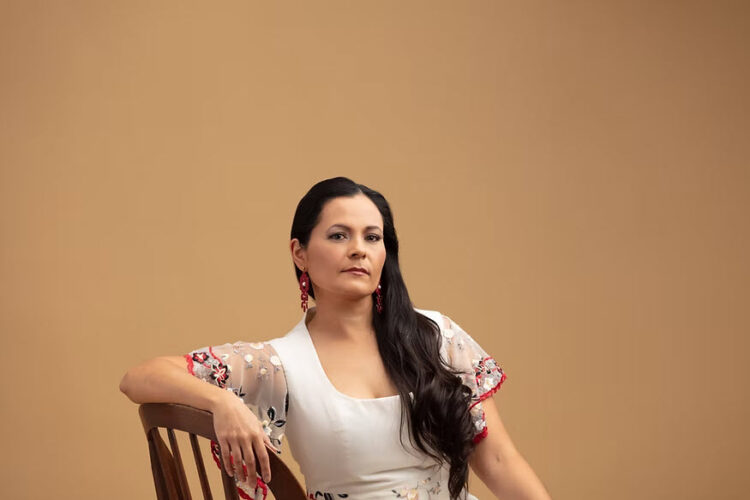
Cecilia Duarte has performed widely in early and contemporary music, and is an active promoter of Spanish-language repertoire. A versatile vocalist, she released her first solo album, a compilation of Latin American songs (on Reference Recordings Reencuentros). www.ceciliaduartemezzosoprano.com