by Vivian Teresa Tompkins
Published March 22, 2026
The Purcell Compendium by Peter Holman and Bryan White. Boydell & Brewer Press, 2025. 270 pages.
‘As I read The Purcell Compendium, I found myself wishing that it had been available to me as an undergraduate student with a burgeoning interest in early modern English music’
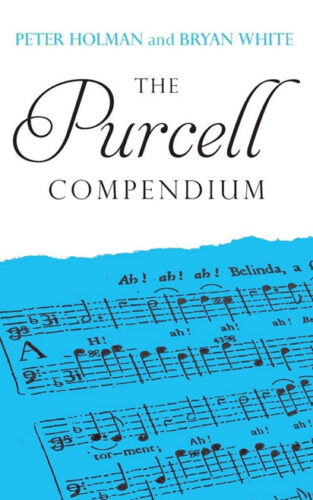
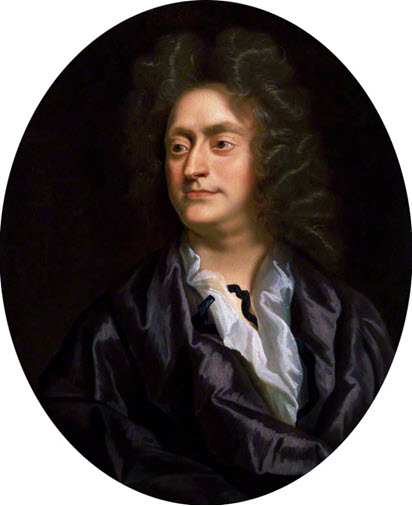
In the introduction to their engaging new book, Peter Holman and Bryan White write that a “compendium or encyclopedia devoted to a single composer is the ultimate accolade from the scholarly community.” The Purcell Compendium fits this description, presenting a detailed guide to Henry Purcell’s life, works, and legacy. Yet the book is far from a simplistic encomium to an isolated musical genius. Instead, through the lens of Purcell’s life, the authors illuminate the array of musical, political, and religious networks in which he existed and provide both a practical reference source on Purcell and Restoration England as well as an insightful study of composers, performers, patrons, and repertoires that have received less attention.
Like other entries in The Boydell & Brewer Press’ Composer Compendium series, The Purcell Compendium includes four main sections: Biography, Dictionary, Works, and Bibliography. Holman and White, who both teach at Leeds University in the U.K., note that their biography is “intended only as a stopgap,” and they emphasize the need for a more in-depth and up-to-date biographical study of Purcell. Nevertheless, their short biography is thorough, lucid, and moving. Bereavement was constant in Purcell’s life: For instance, he and his wife Frances lost four children in infancy between 1681 and 1688. The authors weave these and other losses into a meticulous account of Purcell’s activities as a working musician in settings as varied as court, churches, theaters, homes, and concert rooms. The biography concludes with an image of Purcell’s last will and testament bearing his shaky signature. This image is the first of 15 illustrations, which allow readers to visually connect with key people, places, and works of the era.
The heart of the Compendium is an easy-to-navigate dictionary. When a definition contains a term that has an entry of its own, the first appearance of that term is marked with an asterisk. Most entries conclude with lists of related terms and bibliographic references. The various examples of Purcell’s music mentioned in the dictionary are also found in the Works list, which features introductory notes, a list of abbreviations, and logical genre divisions with clear section labels. In addition to listing essential characteristics of each work in Purcell’s oeuvre (such as title, key, scoring, and dates of composition or performance), the Works section also incorporates numbers from Franklin B. Zimmerman’s catalog of Purcell’s music, as well as references to the revised second edition of the Purcell Society’s Works of Henry Purcell.
The comprehensive dictionary remains accessible to non-specialists. Especially valuable are the entries for lesser-known composers, performers, and other musicians with whom Purcell worked. Thus we read about not only his more famous teachers and collaborators such as John Blow, but also individuals such as Rhoda Cavendish, one of Purcell’s students and the dedicatee of the posthumous Ten Sonatas in Four Parts (1697). Women musicians of the era are well represented in this volume, particularly through the entries on theater singers such as Charlotte Butler and Letitia Cross.
In addition to Purcell’s contemporaries, the dictionary draws attention to later individuals who shaped his reception, including Samuel Wesley, George Bernard Shaw, and Benjamin Britten, among others. Purcell’s reception is also the focus of entries such as “Editions from 1695” and “Performance history from 1695,” and his continuing influence becomes clear in discussions of contemporary works like Errollyn Wallen’s 2021 opera Dido’s Ghost.
Holman and White’s descriptions of primary sources and performance practices address the needs of scholars and performers alike. The authors highlight major manuscript sources such as the Gresham autograph and the Purcell-Draghi Manuscript, laying out their contents and explaining the circumstances of their creation. Overviews of topics such as “Tempo” and “Temperament” provide crucial context for the interpretation of Purcell’s music with reference to the composer’s relevant thoughts. There are also entries on the locations in which Purcell’s works were first performed, allowing readers to vividly imagine the spectacular music-making at events such as James II’s coronation.
In the dictionary, as in any reference source with limited space, some topics of interest are omitted. The authors’ rationale for what to include is largely clear and consistent. However, there are some topics that warrant separate entries, yet only appear in connection to related terms. One example is Frances Purcell, who is mentioned in discussions of her family’s Catholic background and in relation to the memorial publications that she issued for her husband; she does not have her own entry.
There are also some minor aspects of the Compendium’s scholarly apparatus which limit accessibility. The digital version of the book would benefit from hyperlinks connecting related entries, in addition to the asterisk system. In the bibliography, the authors use the @ symbol to identify sources which are currently available for free online; however, greater access could be enabled with DOI (Digital Object Identifier) links or permalinks, where available, as these persistent identifiers provide a stable web address in an abbreviated format. Notwithstanding these small issues, the Compendium is generally accessible thanks to its moderate size, efficient organization, and engaging tone.
As I read The Purcell Compendium, I found myself wishing that it had been available to me as an undergraduate student with a burgeoning interest in early modern English music. The authors have created a concise guide to a set of terms that can otherwise be overwhelming. Students, performers, and other readers now have easier access to this historical period and its repertoire through Holman and White’s work. This volume is a much-needed guide not only for Purcell scholars and enthusiasts, but also for any readers interested in musical life during the Restoration and late Stuart eras.
Vivian Teresa Tompkins is a PhD Candidate at Northwestern University and a 2025-2026 research fellow at Northwestern’s Buffett Institute for Global Affairs. Her dissertation explores women’s devotional music-making in late 17th- and early 18th-century England, focusing on how women used printed devotional songbooks to both enact and challenge ideals of female piety.