by Andrew J. Sammut
Published April 24, 2026
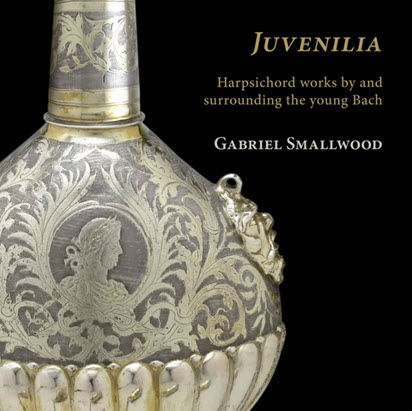
Juvenilia: Harpsichord works by and surrounding the young Bach. Gabriel Smallwood, harpsichord. Ramée RAM2409
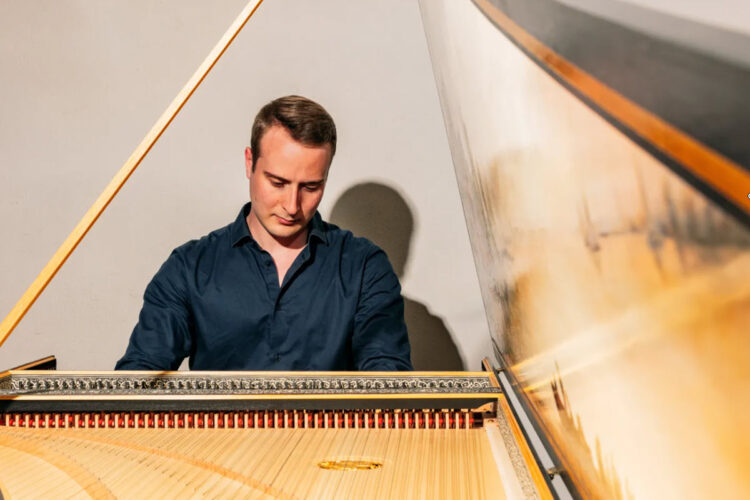
What made Johann Sebastian Bach (1685–1750) the Bach, the one most of us need neither a first name nor any dates to identify? That question will keep scholars across multiple disciplines busy for centuries. On Juvenilia, Gabriel Smallwood sheds some light on who made him that Bach. The South Carolina-born harpsichordist began on piano at age three, and by his early teens, was already playing harpsichord and researching early music, which led to studies abroad followed by a busy performance schedule and awards at several competitions across Europe. For this, his debut album, Smallwood plays solo harpsichord works by teenage Johann Sebastian as well as by composers who had a significant impact on the budding composer.
The music on this album is drawn mostly from the Möller Manuscript and the Andreas Bach Buch, notebooks assembled by Johann Christoph, the eldest brother and guardian of young J.S. It offers a peek into what the adolescent composer-keyboardist was soaking up at home and during his travels. The disc also examines works from his now lesser-known contemporaries. Most of these pieces are in the North German style with its free, episodic forms; dense counterpoint; and long, improvisatory flourishes. There are also some unique influences and compositions, such as the anonymously composed Courante in B flat and Bach’s Galant-style Sonata in D (BWV 963).
That may sound like a geographically or stylistically compact space, but Smallwood’s imaginative, technically assured playing reveals more. His knack for pacing and clarity and sense of space amidst all the cascades and clusters of notes keep things interesting and varied. Rapid-fire close imitations, for example, those at the outset of Buxtehude’s Prelude in G minor (BuxWV 163), enjoy clean voice differentiation. There’s a distinct sound of “choirs” in dialogue (rather than a single voice talking to itself in different registers). The Courante, with its lilting ornaments and crisp melodic line, falls gracefully at the same time its contrapuntal textures feel thick.
Smallwood also shows off an organic, compelling sense of rhythm throughout Juvenilia. His touch and interpretation ensure tempos that might otherwise veer into extremes always have something meaningful to say. The second section of the Toccata in F-sharp minor (BWV 910), for example, even at a gradual pace, feels introspective (rather than gloomy) due to Smallwood’s strong attacks and smooth transitions. In its faster first section, bass pedals and changes in the melodic rhythm acquire a subtle weight from his touch and sense of time; they make narrative as well as structural sense.
The opening Allemande of Christian Ritter’s Suite in F-sharp minor feels especially melancholic given Smallwood’s almost glacial tempi, which could easily fall apart but maintain narrative interest and rhythmic cohesion. Smallwood noted having to use special tuning for this piece (and BWV 910) to make this “spicy” key “digestible.” He accomplishes far more: there’s a naturalness and warmth here that makes the Allemande feel like a recitative. The concluding Gigue already has plenty of momentum. Smallwood adds his own air of tension and release, his phrases cresting and then tumbling with a slight push into the next line.
The Capriccio in B-flat major, BWV 992, Sopra la lontananza del fratello dilettissimo (“Upon the departure of the beloved brother”) is one of Bach’s best-known early works. It depicts sad goodbyes as a brother leaves home (with different accounts as to the historical accuracy of whether this was Bach’s brother and where he was headed). In the first movement, Smallwood choreographs a slow, almost suspended narrative that stays taut through his clear attack and sensitive phrasing. It adds up to an especially plaintive reading. The descending bass line, under a melodic line voiced in thirds, hits with heartbreaking immediacy. The second movement warns the departing brother of the potential dangers he may encounter. Smallwood adds a convincing hesitancy to the pulse alongside the crushes of dissonance in Bach’s lines. The third movement “lament of the friends” has a suspended feel, almost falling apart, but Smallwood reveals the contrapuntal textures gradually for an unnerving air beyond lament into inconsolability.
Smallwood plays Milan-based Andrea Restelli’s double-manual copy of a single-manual harpsichord made by Christian Vater of Hannover in 1738. Smallwood has commented that the instrument resembles what Bach would have likely used. Its rich, resonant tone, especially the clear treble and firm (but never boomy) bass notes, might be the best argument. Especially at slower tempos, it helps him to literally sustain interest and “sing” (not “ting”). The sound on this disc is also clear, capturing the acoustic inside the Evangelische Kirche St. Leodegar in Grenzach-Wyhlen, Germany, with enough ambience without overpowering my speakers or headphones. This is exemplary treatment for any composer: the ones we know by just their last name or the ones we only know through association.
Andrew J. Sammut covers music for Early Music America, the Syncopated Times, Vintage Jazz Mart, and his blog, the Pop of Yestercentury. He has also written for All About Jazz, Boston Classical Review, and Boston Musical Intelligencer. For EMA, he recently reviewed Amanda Forsythe and the Boston Early Music Festival’s Grammy-winning album of Telemann’s Ino and arias for soprano.