
From the Executive Director: If we want to keep historical performance alive at the collegiate level, we will have to think bigger than just protecting individual programs.
This column was first published in the May 2026 issue of EMAg, the Magazine of Early Music America
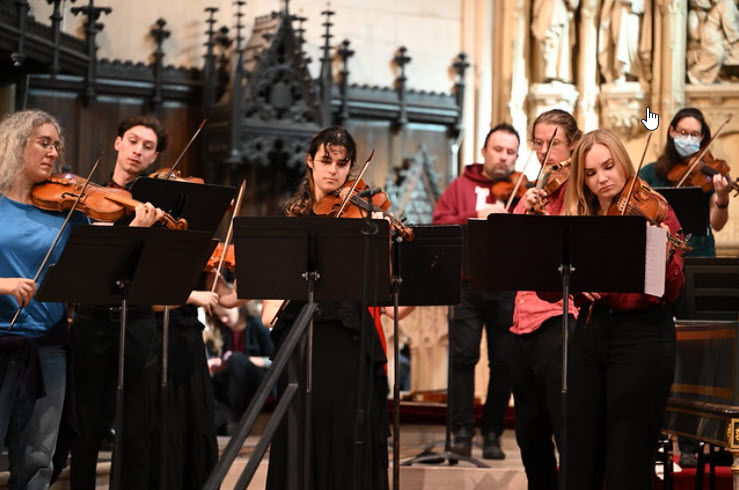
This spring, collegiate early music suffered another painful blow with the announcement that Harvard Baroque Chamber Orchestra lost institutional funding and will become a student-led extra-curricular ensemble. (Current co-directors Phoebe Carrai and Sarah Darling have also announced a new community-based ensemble seeking nonprofit status that will carry on some of the work Harvard Baroque did gathering students and other performers from across Boston, so glimmers of hope remain!) My first instinct upon reading this news was to warm up my pen and write to Harvard in support of the orchestra. But it took only a few moments to realize it was not only too late, but that the shutting down of the orchestra was actually just one piece of a much bigger problem.
Across North America, we are seeing a trend of universities shrinking their offerings, with arts and humanities taking a real beating. Part of this is, of course, funding cuts at the national and state levels, but there’s also a troubling trend of university administrators running their institutions like a business, cutting anything that loses money. This short-sighted approach might serve as an effective temporary Band-Aid for current financial woes, but it’s going to create some serious problems in the decades to come. With A.I. now churning out summaries of existing scholarship, will we get stuck in a knowledge loop if specialists don’t have institutes of higher learning where they can add to what we already know?
If we want to keep historical performance alive at the collegiate level, we will have to think bigger than just protecting individual programs. We need to be activists and advocates for the full range of arts and humanities programs that are under attack. Warm up that pen, folks!
It’s the same with early-music nonprofit ensembles and organizations. We can’t just fight for our own little piece of the pie. We should be hyping each other up to funders and potential audience members. While you’re at it, keep the whole arts ecosystem thriving by supporting new music, the local ballet company, and even that funky art gallery downtown.
In a recent social media post, Liza Malamut of the Newberry Consort encouraged us all to “please stop writing, or saying, that our early-music ensembles ‘fill a gap’ in a particular region or city.” This could be seen as a controversial statement, as we’re all trying to convince funders and audiences that we provide something unique, but she wisely points out that “while every once in a while this may be true, it is actually often not the case, and making such a claim diminishes the truly great work that many resident ensembles have been doing for years.” She suggests we instead focus on what we add to our local scene — how we enrich what already exists, even if it’s not substantially different from other local groups.
Indeed, how we talk about what we do is important in this fight. We can easily come off as a bunch of “cultural elites” sticking together to protect our precious intellectual pursuits. But our niche work has the power to resonate with all kinds of folks, and we need to be talking about it!
In North Carolina, I recently played a program of Bach and spirituals with countertenor Patrick Dailey for 7th Street Concerts in Charlotte. Artistic Director Kristin Olson arranged for us to play at a local men’s shelter the day before our ticketed concert. I’d venture to guess that none of the men there were terribly concerned about the considerable amount of scholarship that went into the program we performed, but when Patrick bellowed “This Little Light of Mine,” time stood still. This rarefied thing we do really is for everyone, and we need to say so — loudly!
David McCormick is executive director of Early Music America