The rise of public concerts was an indicator of social innovations that would come to the fore during the Revolution.
Colonial America produced the musicians and paying audiences needed for public concerts not long after the trend started in Europe. But not everyone on these shores approved.
This article was first published in the January 2026 issue of EMAg, the Magazine of Early Music America
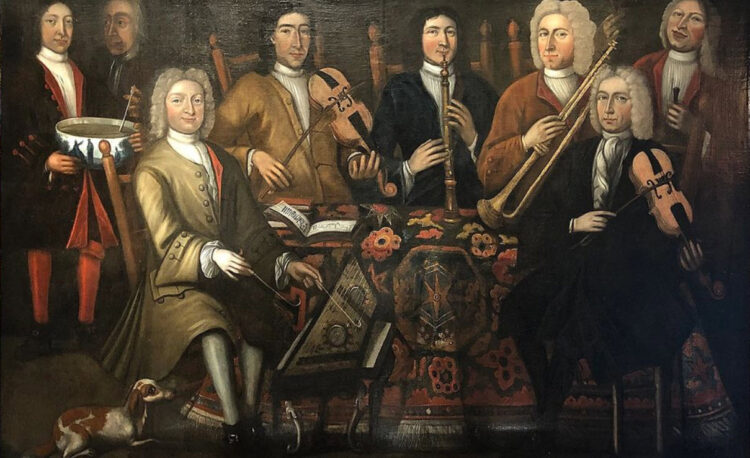
Southern Virginia, 1620. An English ship sailed up the murky waters of the James River. On the deck of the Francis Bonaventure was John Utie, who was to become colonial America’s first documented string player — performing “upon a Violl at sea.” In the midst of the continuous woes that befell Jamestown, in 1625 a certain Willam Tyler accused Utie of stealing the Virginia Company of London’s tobacco and being a “Rogue and Rascall.” Yet Utie was perhaps most offended by being called a derogatory term for a string player, a common “Fidlinage.” By then, Utie was a member of the House of Burgesses, the first democratically elected legislative body in the British American colonies. The slur demanded a formal apology.
Although European music in what would become the United States had a haphazard start — where an insult among prominent citizens was bigger news than the music-making itself — by the 18th century musicians and their performances had made remarkable gains.
As we commemorate America250 in 2026, it’s worth remembering how music played a role in the cultural ideas and civic attitudes of this burgeoning society.
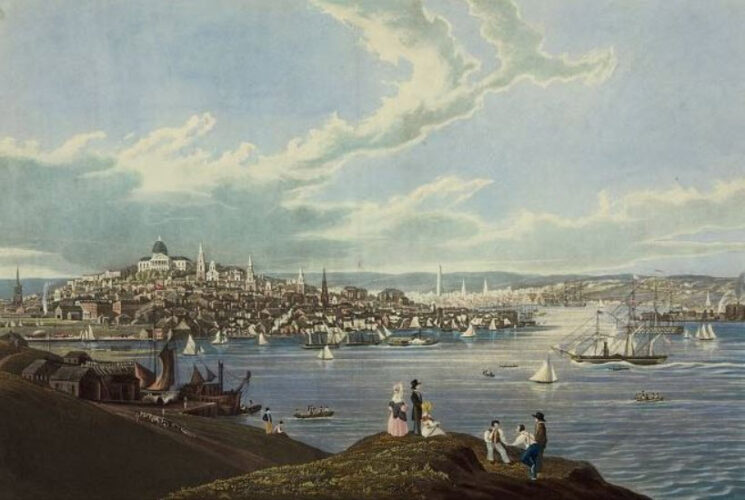
One significant development was the rise of public and ticketed concerts in pre-Revolutionary America. In Europe, where musical performances were often linked to social class, the swift rise of public concerts in the British American colonies was an indicator of the social innovations that would come to fruition during the Revolution. But before we arrived at the musical format we are familiar with today, the colonies first had to produce musicians and an audience willing to pay to hear them.
European secular music was part of colonial America from the beginning. Its purposes ranged from displaying military prowess to providing at-home pleasures and even competitions. Historian Cynthia Adams Hoover has documented many of these developments. Take a key event from March 22, 1621, for example, when Massasoit Sachem of the Wampanoag Confederacy and Governor Willam Bradford of the Plymouth Colony met for a peace treaty. A description recounts how the negotiation started with “our Governour with Drumme and Trumpet after him,” noting that Massasoit was intrigued by the instruments and that “hee marveiled much at our Trumpet, and some of his men would sound it as well as they could.”
A document from 1688 describes hearing music “on board the Duke of Albemarle’s yacht” in Boston Harbor. Another account in 1721 speaks of “…the Wedding of Two Africans, with an unaccustom’d Magnificence…The next Morning a Trumpeter came…and having sounded a considerable Time.”
In October 1737 the Virginia Gazette spoke of an upcoming violin competition in Williamsburg, Virginia:
That a Violin be played for by 20 Fiddlers, and to be given to him that shall be adjudged to play the best: No Person to have the Liberty of playing, unless he brings a Fiddle with him. After the Prize is won, they are all to play together, and each a different Tune; and to be treated by the Company.
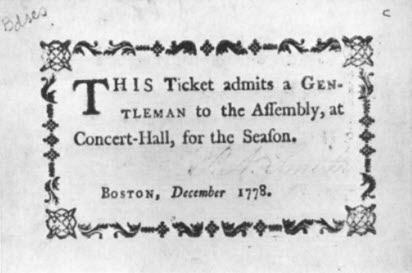
Into the 18th century, as life became somewhat easier for the colonists, music in the pursuit of happiness moved to the fore. Chamber music was thoroughly enjoyed at home, but the gradual shift to performing in the public sphere would become a heated topic. The earliest-known public ticketed concert in colonial America took place in Boston, although the specifics of that milestone are still debated among historians.
Concerts as Circus Acts
In New England, the clergy viewed public concerts as being too secular. This is not surprising, since they were often held in taverns, marketplaces, or theaters. Musicians performed alongside (or doubled as) magicians, balance artists, and actors. One account describes an event where a performer played “the first and second trumpet and a pair of annexed kettle drums with the feet, all at once.” Many musicians also worked in spoken theater, which was often seen as morally compromised. Performances, meant to be as entertaining as possible, were closer to circus acts or street-corner busking than what we would describe as a music-for-its-own-sake concert.
As life became somewhat easier for the colonists, music in the pursuit of happiness moved to the fore.
The Puritans acknowledged dancing as a way to learn deportment and manners yet also believed it could lead to the “profane and promiscuous.” A Puritan tract from 1684 was titled “The Design of Dancing is only to teach Children good Behaviour and decent Carriage.”
As music historians Percy Scholes and Henry Wilder Foote demonstrated in their extensive research, contrary to long-held academic assumptions, Puritans and other New Englanders held a variety of views on instrumental music. As influential Boston Puritan John Cotton (1585-1652) wrote, “Nor Doe we forbid the private use of an Instrument of Musick.” On the other hand, English Puritan Owen Feltham (1602-1668) wrote, “It is a kind of disparagement, to bee a cunning Fiddler. It argues his neglect of a better imployment, and that hee hath spent much time upon a thing unecessaire.” Interestingly, Feltham was worried about men neglecting the duty of taking care of their family by excessive practicing and argued that the violin “is fitter for Women than Men.”
‘It is a kind of disparagement, to bee a cunning Fiddler.’
Inventories following a death give us a glimpse of how widespread instrumental music was in New England. The estate of Governor Willam Burnett in 1729 listed “a large bass violine, two trible violins, clepsicord, large violin or tenor violin, two brass trumpets.” A humble minister from Ipswich named Nathaniell Rogers had a “treble viol.” Another minister, Edmund Browne from Sudbury, left a “base voyall, with all my musicall bookes & instrument.” Tavern keeper William Bryant’s belongings included “a violin with case.”
‘A great Variety of the best Musick’
It was long believed that the first public ticketed concert in the colonies was held in 1731. An announcement that year, in the Boston Weekly News Letter, read:
On Thursday the 30th of this instant December, there will be performed a Concert of Musick on Sundry Instruments at Mr. Pelham’s great Room, being the House of the late Doctor Noyes near the Sun Tavern. Tickets to be delivered at the place of performance at Five shillings each the concert is to begin at exactly Six o’clock, and no Tickets will be delivered after Five the day of performance. N.B. There will be no admittance after Six.
The advertisement does not suggest anything extraordinary was taking place. Pelham’s precise instructions about ticketing is an argument that past events had taught them how to put on a successful concert and get paid for it.
And indeed an earlier, strikingly similar event predates Pelham’s ticketed concert by two years and ten months, in February 1729, identified by historian Henry Woodward:
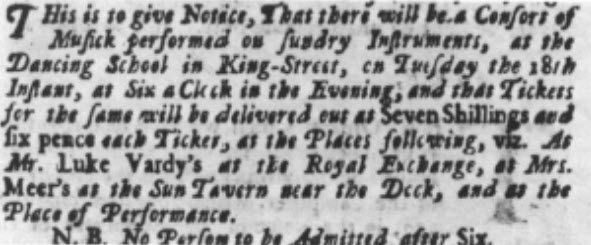
This is to give Notice, That there will be a Consort of Musick performed on Sundry Instruments, at the Dancing School in King-Street, on Tuesday the 18th Instant, at Six a Clock in the Evening, and that Tickets for the same will be delivered out at Seven Shillings and six pence each Ticket, at the Places following, viz. At Mr. Luke Vardy’s at the Royal Exchange, at Mrs. Meer’s at the Sun Tavern near the dock, and at the Place of Performance. N.B. No Person to be Admitted after Six.
There is evidence that Peter Pelham took part in this earlier concert — and perhaps others before 1729 — with several other men who might include the influential Stephen Deblois (whose family would open a “Concert Hall” in 1754 in Boston), Edward Enstone (organist and dancing master), and William Price (essential in establishing organ music in Boston Anglican churches).
Lamentably, like many aspects of colonial music history, much has been lost or destroyed. Musicologist O.G. Sonneck first argued in his 1907 book Early Concert Life in America that there is a chance that public concerts had already been advertised in the earliest publication of the Boston Weekly, as early as 1704. Even over a hundred years ago historians were certain that many “firsts” were yet to be discovered. However, to date, we can confidently say that public concerts were occurring in colonial America by 1729 at the latest.
Once the model was established, public concerts spread rapidly up and down British colonial America. The South Carolina Gazette in April 1732 advertised “a Consort of Musick at the Council Chamber, for the benefit of Mr. Salter,” and that same year an announcement mentioned a “Consort of Vocal and Instrumental Music. Tickets to be had at Mrs. Cook’s and Mrs. Saureau’s House at 40 s. Each.”
The Messiah Premiere
Although concerts were on the rise, it did not signify that they were accepted in all corners. An exceptionally long letter to the Boston Gazette in 1732 aired the grievances of one particular citizen:
I hope not too late to prevent the Growth of an Evil too dangerous to be overlookt by any Person who has either a Value for Religion, or Love for his Country…a Piece of Paper was slipt into my Hand, giving notice of an Entertainment of Musick and Dancing…to be held at Mr. Pelham’s Dancing School on the Thursday following….I could not read the Advertisement without being startled and concern’d at the Birth of so formidable a Monster in this part of the World.
Yet amid some outrage, the curtain of the public concerts in colonial America had opened, and nothing could pull it shut again. After 1731, notices of public concerts in newspapers started to occur frequently. These notices of public concerts followed the language and pattern of London concert advertisements. On November 23 and December 28, 1732, an advertisement was placed in Boston about “Consorts of Musick perform’d of sundry Instruments.” One piece of information is particularly thrilling: Performances were held “at the Concert Room in Wing’s Lane near the Town Dock.” In whatever capacity, a dedicated concert space in colonial America in 1732 is an extraordinary detail.
Music and Dancing: ‘the Growth of an Evil too dangerous to be overlookt’
To put colonial America’s concert progress into a historical context, the earliest-known public instrumental concert in England not related to theater was organized by violinist John Banister in 1672 in Whitefriars. The first building built specifically for music is thought to be the Holywell Music Room in Oxford in 1748, which notably was used by both Handel and Haydn. In France, the first public concert was put on in 1725 by Anne Danican Philador, the start of a series named “Concert Spirituel” in Paris held when the Académie Royal de Musique’s opera was closed for religious holidays. It is striking that colonial America was able to produce musicians, concerts open to the public, and a paying audience not long after its European counterparts.
The earliest-known public concert in New York was launched in 1736 with a performance by Charles Theodore Pachelbel (son of the famous Johann). It was advertised as “A Consort of Musick, Vocal and Instrumental, for the benefit of Mr. Pachelbel, the Harpsichord Part performed by himself. The songs, Violins and German Flutes by private hands.”
Indeed, Pachelbel’s immigration from Europe and his engagement with public concerts helped set a precedent for other highly trained musicians to make a livelihood in America. By the 1740s, public interest had increased enough that newspapers began to cover not only concert announcements, but more details about the concerts themselves: what was performed, the number of performers, and even the abilities of the musicians. One publication wrote, “The Stabat from the music of the celebrated Jacchiny will be sung in Latin by three or four voices.” Another newspaper noted that the vocal part was sung by “a gentleman, who does it merely to oblige on this occasion.”
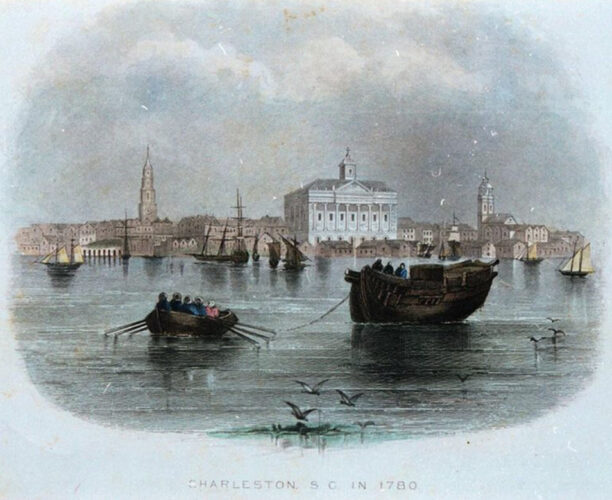
By 1760, New York had established the city’s first series of subscription concerts. Two years later, colonial America’s first musical society, the St. Cecilia Society, was established in Charleston, the coastal Carolina port made rich by the slave trade. A foreign officer wrote of the concerts that “Handel and even Corelli are still loved there.” The society was active until 1912.
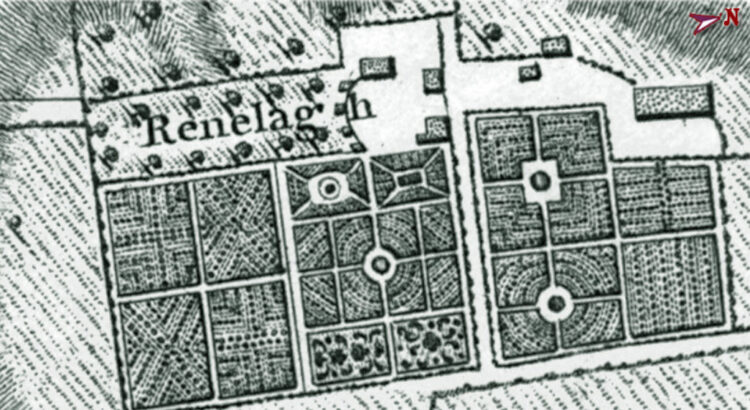
In 1765, the earliest-known summer open-air concerts were launched at Ranelagh Gardens in Manhattan. Concerts also spread from coastal big cities to smaller or more rural locations. The Virginia Gazette advertised a 1766 concert to be held in Fredericksburg by some of the “best Hands in Virginia.” The ensemble consisted of “3 Violins, 1 Tenor, 1 Bss, 2 Fluuits, 1 Hautyboy, 1 Horn,1 Harpsichord.”
In 1769, Peter Pelham (son of the first Peter Pelham in Boston) began a subscription series at Bruton Parish in Williamsburg, Virginia which attracted the patronage of a young Thomas Jefferson.
Then as now, few musicians or producers could live solely on individual ticket sales. Even Peter Pelham, Jr., who had the backing of the Virginian Anglican Church and local government, needed subscription concerts to bolster his income and support his family. His main job was as superintendent at the Public Gaol.
Income, as much as art, was the impetus for another celebrated event in Colonial America. On January 16, 1770, parts of Handel’s Messiah were produced by William Tuckey at the Burns Coffee House in New York:
A Sacred Oratorio, on the Prophecies concerning Christ, and his Coming; being an Extract from the late Mr. Handel’s Grand Oratorio, called the Messiah, consisting of the Overture, and sixteen other Pieces, viz. Air, Recitatives, and Choruses. Never performed in America.
The evidence suggests it was never Tuckey’s great conviction to perform Messiah for the public. Rather, he had been fired from Trinity Church in New York City and was bankrupt.
Whatever the initial motivation for public concerts, by 1786 they had exploded into astronomical productions. In Philadelphia, Andrew Adagate founded “The Institution for the Encouragement of Church Music” and held a festival in the German Reformed Church. The public festival had a staggering 280 performers and sold over 1,000 tickets. The programming included music by American composer William Billings and ended with Handel’s “Hallelujah” Chorus. The Pennsylvania Packet described the event:
At 11 o’clock the doors were shut, and after a dead silence of about 5 minutes, this feast of harmony began with Martini’s famous overture, which was performed with such a prosperity of expression that could the author himself have been present, he would not have thought his composition disgraced, or, the ideas he intended to convey, misunderstood.
From the arrival of European-style instruments in colonial America in the 17th century to the birth of secular, public, for-profit concerts in the 18th century, the musical landscape grew at a dizzying pace. It’s incredible that less than a century separates John Utie and his fiddle arriving in Jamestown to the first ticketed concert in Boston. This cultural shift in colonial America — becoming more democratic, more accessible — at the same time as the colonists were moving toward revolution and democracy is an intriguing parallel. Although once labeled a “monster in this part of the world,” public concerts soon became permanently embedded into the framework of American society.
Sophie Genevieve Lowe is a Baroque violinist based in Virginia where she lives with her husband, Baroque cellist Ryan Lowe. She is the artistic director of Williamsburg Baroque and in the pianoforte trio Assai Ad Libitum. For EMA, she’s written about the 21 Reasons HIP Kids of Colombia Flock to Medellín.