Seattle Historical Arts for Kids offers a holistic approach to youth education, with each artistic form complementing and nourishing the others
There is arguably no other program that can match SHAK’s customized, cross-genre approach
This article was first published in the September 2026 issue of EMAg, the Magazine of Early Music America
Most early-music artists start on modern instruments and only learn about historical performance practice much later, often when they are university undergrads. In the U.S. especially, you hear about teachers who worry that “side ventures” at a young age into a specialized world, such as early music, could divert students from a central focus on technique. It could thwart their career prospects toward, for example, winning a symphony orchestra audition.
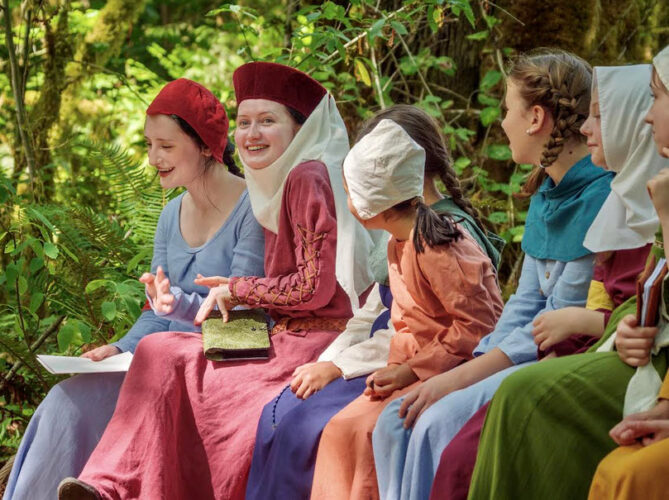
But from its origins in 2005, Seattle Historical Arts for Kids — everyone simply calls it SHAK — has set that idea on its ear. SHAK’s students, many of whom also study modern instruments, are plunged into Medieval, Renaissance, and Baroque music, with the belief that the expressive freedom of those centuries-old realms helps them perform music of any era better. Not to mention that historical performance offers its own innate joys.
“I’ve always thought that SHAK is one of the great unsung treasures of early music in America,” says Robert Mealy, director of the historical performance program at New York’s Juilliard School. “It’s a place of play and creativity that is incredibly valuable.”
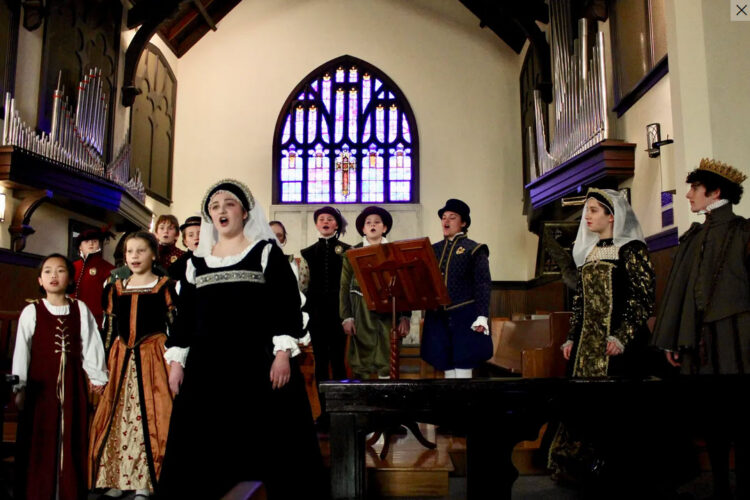
As the “arts” in its name suggests, SHAK is not just about music, although music undergirds everything it does, giving participants the chance to also learn about historical theater, dance, crafts, poetry, and even fencing as part of a holistic artistic approach. By design, each art form complements and nourishes the others. “It offers the potential of engaging different types of people who have different interests,” says teaching artist Jacob Breedlove, who helped build programming during SHAK’s early years. “But since there is a little something for everyone, I think there is also the opportunity for a cross-pollination of interests.”
The organization’s leaders emphasize that its participants range in age from six to 18. Many return year after year and, as they grow, the program evolves to meet their changing needs. “It’s hard to describe it all at once, because it really depends on who’s there and what they’re interested in. The program kind of adapts to people’s interests at the moment,” says Tess Roberts, an alum who is currently pursuing a professional career in early music.
Now 24, Roberts started violin lessons when she was six and discovered the viola da gamba during the decade she was involved with SHAK. “Through all the programs I found my niche, which was a cool thing to do at such a young age,” she recalls. She is now finishing a graduate degree at London’s Royal Academy of Music. Overall, several hundred children have taken part in SHAK programs across its 21-year history.
SHAK is “hard to describe all at once, because it really depends on who’s there and what they’re interested in. The program adapts to people’s interests at the moment.”
Founding Director Shulamit Kleinerman makes clear that the emphasis has never been on big numbers but rather on the quality and depth of the experience that each participant receives.
“The sheer breadth of what we do at SHAK has actually worked against us in the perception of the historical-performance community,” Kleinerman believes, “since people may hear about one of our programs and make assumptions about the others — for example, fixating on the little-kid programs and ignoring the high-level work of our teen musicians and teaching artists.” On the flip side, she adds, “they might not grasp how formative those little-kid experiences were for students who grew up to become pro-level instrumentalists.”
While it’s possible to find isolated programs that introduce children to the viola da gamba or teach polyphony, there are arguably none in the U.S. or Europe that can match SHAK’s customized, cross-genre approach or the long-term commitment of its students. “I really think there is not anything quite like it,” says Roberts, reached in London. “There is not another organization that has as many different opportunities across the arts for kids in one place.”
Another alum, Baroque bassoonist Rylie Patching, is studying at the Schola Cantorum Basiliensis in Switzerland. “Before SHAK, I didn’t have a good foundation regarding ensemble work and how to be a continuo instrument,” she told EMA in 2025. In conversation with her classmates in Basel, she recalls that “almost every person has said they wished they had a pre-college program like SHAK when they were young.”
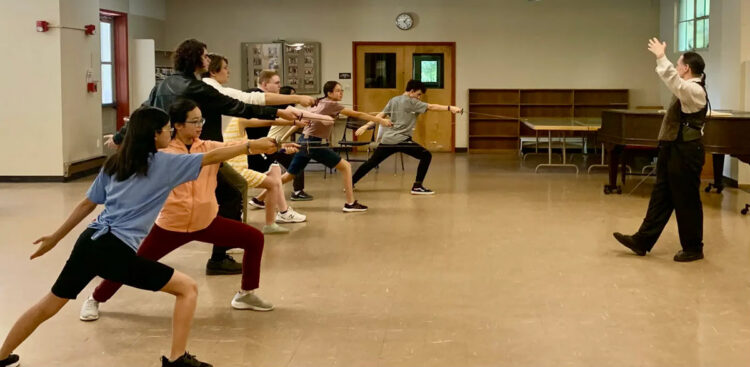
‘Kids are hungry for it’
And yet SHAK remains under-recognized in the larger classical music world — and perhaps even within the narrower confines of early music — although it has received national accolades. Its Early Music Youth Academy, for example, has been invited to perform at prestigious festivals. Kleinerman’s youth-friendly adaptations, tailored to the individual student’s abilities and with a focus on “aliveness” and fun, include two Handel operas: Alcina, which was performed at the Boston Early Music Festival in 2015, and Serse, at the 2018 Berkeley Festival and Exhibition.
Musicians from SHAK have also participated in several of Early Music America’s Young Performers Festivals and took the stage at the October 2026 EMA Summit in Seattle. “It’s important for us to show the field what is possible,” says Kleinerman, who in 2015 won EMA’s Laurette Goldberg Award for educational outreach.
To some observers, SHAK might seem anachronistic and out of step with a society being force-fed a diet of social media and learning through artificial intelligence. But supporters say that’s exactly why the program is so relevant and needed now. Early music provides young people with a sense of groundedness and connectedness in a time of technological upheaval and rampant disconnection.
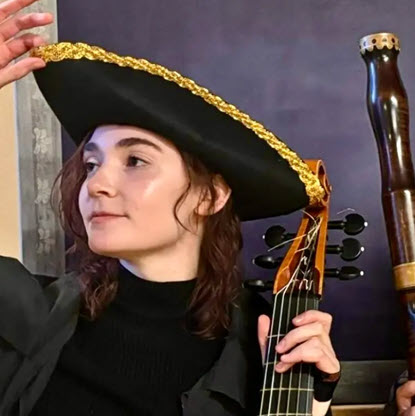
“For me, it’s more of a pace thing,” says gamba player Roberts. “I really enjoy these older art forms because they just let you slow down and do something really carefully with very minimalist means. You don’t need a computer and video every three seconds to be engaged.”
As proof, SHAK’s longest-recurring event is its annual summer Medieval music workshops for children and teens. They learn skits and sing monophonic and polyphonic music. They can learn to play the vielle, recorder, and percussion for staged presentations that include goofy miracle songs from the 13th-century Cantigas de Santa Maria and, most recently, The Partly-True Story of Roland the Farter, about an 11th-century English flatulist. On weekends they don costumes for performances at Camlann Medieval Village, described as a “detailed, non-commercialized, living-history museum setting.”
It all feeds into Kleinerman’s belief that young people need the experience of feeling “embodied,” which they can do through, say, performing Renaissance polyphony and fashioning a musical phrase in collaboration with others. “To really be making something with your hands and body in space and time in connection and community with other people — that is the ‘ground’ of being human, and these days that experience is being taken from kids and adults,” she says. “I think kids are hungry for it and don’t know how to articulate it.”
Early music provides children a grounding and sense of connection in a time of technological upheaval and rampant disconnection
Kleinerman, 49, is a former pre-school teacher and has maintained a Suzuki-inspired modern violin studio in North Seattle with about 20 students. She plays the Medieval vielle and Renaissance and Baroque violins and was a founding member of an Elizabethan quartet called Plaine & Easie, which won Early Music America’s 2009 Unicorn Prize (and also took home the Audience Award). In 1999, as part of her undergraduate studies at UC-Berkeley, she received a fellowship that took her to study Baroque violin in London with Monica Huggett and other luminaries, and she even dipped her toes into historical dance.
“The experience of historical performance is not so much about achieving technical gymnastics but more about finding something interesting within the language of the music,” says Kleinerman. “There is a lot more scope to make individual choices.”
Organic Growth
People inside and outside of SHAK speak with a kind of awe about Kleinerman, praising her uncommon devotion, creativity, and mentorship. “I feel like there is a simplicity and directness about Shula’s approach,” says teaching artist Breedlove, who plays hurdy-gurdy among other early instruments. “She never talks down to students. She is never patronizing. She raises the student up in a way, and she is very good teacher, and she knows how to reach people.”
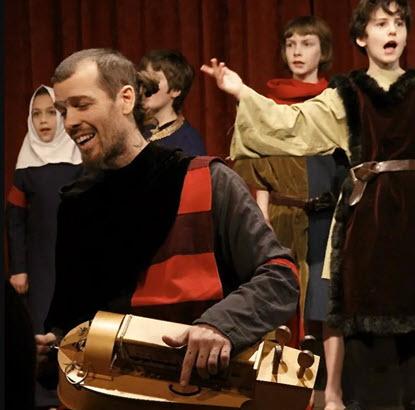
Back in 2005, Kleinerman started with “exploratory camps” around subjects like the arts of the Middle Ages, in which students sang songs and created arts and craft projects. “The material came alive for them, as I knew it would,” she says. The camps were immediately popular, and the kids (and their parents) clamored for more, recalls Breedlove, who started suggesting repertoire and related cultural activities and shared his collection of Medieval instruments.
Kleinerman freely admits she had no grand plan for what SHAK might become. It can be difficult to describe its trajectory because growth has not been linear but organic, often zigging and zagging in response to the interests and talents of the young people involved with an array of camps, workshops, and courses. “I think of SHAK as being co-created with the students in a fairly fundamental way,” Kleinerman offers, “because their responses and desires are what have helped the program and allowed it to grow.”
In 2010, Kleinerman and Breedlove teamed up to record an album of student favorites called Merry It Is!. They were joined in the dance tunes by adult colleagues and a 12-year-old playing vielle and violin. Returning students, ranging in age from eight to 12, sang the songs and set the scene with short spoken readings from historical sources. As a polished calling card, it drew an invitation to perform on Early Music Seattle’s family concert series and ultimately led to SHAK’s musical and theatrical performance programs.
During COVID, Kleinerman shifted the programming to online classes, allowing for new topics and direct-to-video performances, which not only reached new students but turned out to be transformative for the organization. The videos drew donors from outside Seattle. “It was also incredible for me to be able to hire new teachers so easily,” Kleinerman recalls. “It was the first time SHAK classes were happening that I wasn’t personally teaching.”
That’s how Sylvia, the now 14-year-old daughter of celebrated Chicago violinist Rachel Barton Pine, got involved. Pine, who plays both modern and period instruments, had already introduced her daughter to Baroque violin and rebec. SHAK became Sylvia’s creative outlet, with online classes in Medieval composition and calligraphy, Baroque ornamentation and ground-bass practice, and even Shakespeare monologues. Pine describes her daughter’s experience as “really extraordinary.”
As an aspiring concert violinist in her own right, Sylvia has also traveled to Seattle for several in-person offerings, including the Medieval workshop in Camlann village. “I think as a violinist,” says Pine, “knowing where it all came from and being able to understand the full trajectory and history of your instrument gives you a wider perspective. I honestly believe that Sylvia’s Romantic playing is better because she has done so much Baroque playing.”
‘A Pretty Geeky Field’
For more than a decade, SHAK’s instrumental programs have cultivated high-level playing among teens, with eight young-adult alumni so far continuing to perform and study their period instruments, including lute, viola da gamba, bassoon, violin, and cello. Some of them grew up playing Renaissance polyphony for five seasons in Kleinerman’s first Early Music Youth Academy, begun in 2014. The group included five to eight students at a time and spanned the continuing members’ middle- and high-school years.
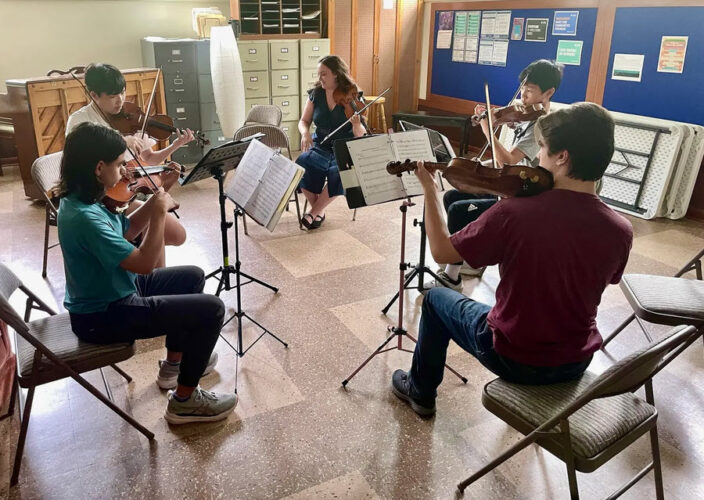
After that cohort graduated during the pandemic, Kleinerman rebuilt the program in 2021 with a Baroque focus in response to student interest. To accommodate students traveling from out of town, the format shifted in summer 2024 to a pair of intensive annual workshops with the inaugural Baroque Strings Festival. Violinist Eleanor Legault and cellist Nick Chrisman came in as faculty and began serving as workshop co-directors with the first New Year’s Baroque workshop a few months later.
Legault is a recent graduate of Juilliard’s historical performance program. Chrisman, now 23, grew up in SHAK, learning English country dances and building model gargoyles starting at age 5. He sang on SHAK’s studio album a few years later, sang Medieval music at Camlann, and acted lead roles in several staged productions. As a cello student, he took up the tenor viol at 11 to play in the Early Music Youth Academy.
For the Baroque Strings Festival, “it’s not like we can plug in the students, plug in the repertoire, and rinse and repeat,” Legault says. There is no fixed template. Instead, each workshop is customized to each set of enrollees in keeping with how the entire organization is run. “It’s exhausting, but it’s part of its success. Each student is taken care of. And it is specific to them. And that’s all Shula. That’s been Shula’s vision.”
Festival students typically start playing on their own modern instruments with Baroque bows provided by SHAK. If they get really interested, some will switch to gut strings or borrow a Baroque instrument from the collection on loan to SHAK. While a few of these players might eventually become professional musicians, that is not the main goal.
Instead, according to Legault, the aim is to “encourage them to be lifelong appreciators of the field which they enjoyed as a young teen.” (She adds that one day they may become supporters and donors as well.) “The end goal of each festival is to have fun, and that is itself an inherently worthwhile pursuit. These students are so eager, and it brings me so much joy to see their unbridled enthusiasm for this pretty geeky field.”
A big question is why more organizations like SHAK don’t exist in the early-music world. There are no easy answers. One obvious reason is that leaders with Kleinerman’s vision and commitment are hard to come by. “I think it takes a huge amount of dedication,” Juilliard’s Mealy says. “Shula has worked immensely hard to make this work over this last 20 to 25 years.” As Kleinerman admits, with a mix of pride and frustration, “I sometimes say I’m our largest donor, based on the high volume of unpaid hours I put in, especially for the first 15 years. It’s been important to me to find excellent collaborators and to gain financial support for their work, so that no one ever again has to work as hard as I did.”
Money, of course, is a challenge for any arts organization, and Kleinerman feels the early-music field could do a much better job of supporting youth education. SHAK’s annual operating budget hovers around $50,000, with tuition covering about half the costs and a third coming from individual donors. The organization typically produces a dozen projects each season, including classes, workshops, and public concerts featuring students, faculty, and alumni. Notably, SHAK’s student fees are on a sliding-scale model, based on the family’s income, although no one is turned away for lack of funds.
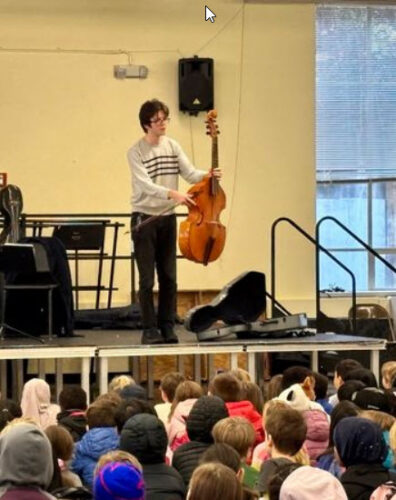
“I think a lot of programs in other cities get started with good intentions and fizzle out,” reflects Kleinerman, “not just from lack of support but because people don’t know what goes into teaching.”
An ethical vision of what the arts could do for kids
For her part, Legault believes there remains a kind of stigma around early music and historical performance. The benefits of this kind of program tend not to be clearly understood in the broader classical field. “There is still a sense, at least for teachers who have conservatory-bound students, that this is some kind of niche specialty that students can pursue,” she said, “but there is no realization that historical performance education is simply musical education. The chamber-music skills, shaping skills, the ownership skills — all are directly transferable and so helpful.”
With that in mind, SHAK published a method book, Recorder from the Ground Up, by Seattle recorder player and teacher Miyo Aoki, the first of its programs made to be exportable. Using this curriculum, SHAK went into Seattle public schools for after-school recorder clubs.
“Looking back, I had no recruitment vision about bringing kids into historical arts,” says Kleinerman. “What I did have was an ethical vision of what these arts could do for kids. I was there to serve kids with this material. It just seemed to bring them alive.
“I think a lot of outreach endeavors come from a motivation that is more about getting new people to serve the field. And I think people don’t want to come in and save our field. They want to do something that is joyful and engaging for them.”
As violinist Pine puts it, “I think the ripples of what Shula has done extend far beyond Seattle at this point, and I couldn’t be more excited and grateful.”
Kyle MacMillan served as the classical music critic for the Denver Post from 2000 through 2011. Now a freelance journalist in Chicago, he’s written for many publications, including Early Music America, the Chicago Sun-Times, the Wall Street Journal, and Chamber Music.