For lifetime achievement in the field of early music in the Americas
This award is named in memory of the renowned and beloved musicologist from the University of Chicago, Howard Mayer Brown.
Brown’s scholarship covered a wide range of subjects. He published on the music of the Renaissance, especially the chanson and instrumental music, and frequently returned to problems in historical performance practice, a subfield in which he was one of the most important commentators.
2026 Recipient: Gwendolyn Toth
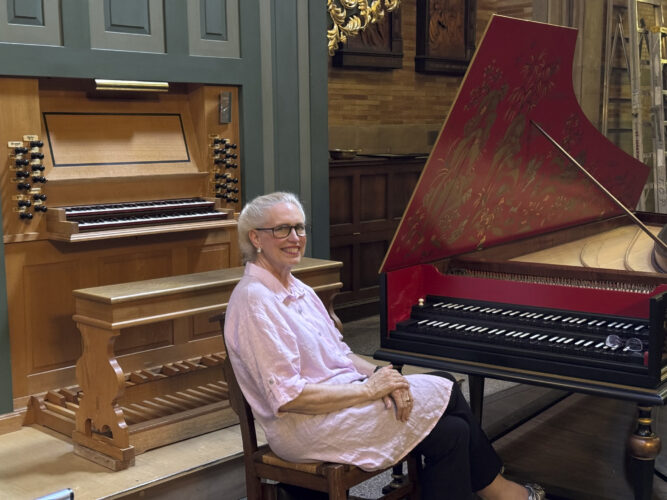
Recognized as one of America’s leading early music performers, Gwendolyn Toth is a conductor and early keyboard artist based in New York City. “Her interpretive skills are sensitive and intelligent, and she clearly has a gift for program conceptualization.” (The New York Times). She has conducted at Sadler’s Wells Theater in London, BAM and Bach Vespers in New York City, Skylight Theater in Milwaukee, Washington Bach Consort in Washington, DC, Astoria Music Festival in Oregon, Carmel Bach Festival in California, and for the German Radio network in Cologne, Germany.
Ms. Toth is the founder and director of New York City’s period instrument ensemble, ARTEK, specializing in music of the early baroque. Under her direction, the ensemble released the first North American recording of Monteverdi’s opera, Orfeo, to outstanding critical acclaim. Other CDs include Love Letters from Italy, I Don’t Want to Love, Monteverdi’s Madrigals Book 5, and Solo Cantatas of Rosenmüller. ARTEK recently released Monteverdi’s complete Madrigals Book 7, another landmark North American recording, in fall 2020. Ms. Toth and ARTEK have appeared at Lincoln Center, the Metropolitan Museum, and major churches in New York City; at the National Gallery of Art in Washington, DC; and at the Regensburg Tage Alte Musik Festival in Germany and the Boston, Berkeley, Bloomington, and Indianapolis early music festivals in America. ARTEK was privileged to tour throughout America, the UK and Europe with the Mark Morris Dance Group in the dance “I Don’t Want to Love” for several years, receiving numerous accolades for their fine performances. ARTEK’s early music theater show, “I’ll Never See the Stars Again” at the Edinburgh Fringe Festival in Edinburgh, UK was lauded as “a stark reminder of just how rich and passionate, as well as achingly sad, Monteverdi’s songs can be.” (The Stage, UK).ARTEK’s latest theatrical venture under her direction is the one-woman show, “Artemisia: Light and Shadow” on the life of female artist Artemisia Gentileschi with music by baroque female composer Barbara Strozzi. Opera News hashonored Ms. Toth as an “Outstanding Young Conductor” and she was the recipient of the “Newell Jenkins Prize” for excellence in early music performance.
As a soloist on historical organs, Ms. Toth has performed on the 1434 organ in Sion, Switzerland; the 1457 organ in Rysum, Germany; the 15th-century organ in Oosthuizen, Netherlands; the 1509 organ in Trevi, Italy; the 1531 organ in Krewerd, Netherlands; the 1649 organ in Zeerijp, Netherlands; the 1655 organ in the Nieuwekerk, Amsterdam, Netherlands; the 1696 Arp Schnitger organ in Noordbroek, Netherlands; and the 1714 organ in St. Michael’s Church, Vienna, among many others. Her numerous CD recordings of Renaissance and baroque music have been recorded on historic Dutch organs in Noordbroek, Zeerijp, Oosthuizen, Eenum, and Krewerd. Ms. Toth’s upcoming CD releases include recordings on the 1434 organ in Ostönnen, Germany and the 1435 organ in Sion Switzerland. Ms. Toth also has a solo recording of J.S. Bach’s Goldberg Variations performed on a lautenwerk, a reconstruction of Bach’s lute-harpsichord, strung in both gut and metal strings.
Ms. Toth’s interests also extend to contemporary music. Ms. Toth has worked and recorded with eminent composer/performers such as John Cage, Rhys Chatham, Petr Kotik, Dave Soldier, Louis Andriessen, and Elliot Sharp at BAM Next Wave Festival, The Kitchen, Bang on a Can Festival, Cage Nachttage in Köln, Germany, and others.
Ms. Toth holds the D.M.A. in organ performance from Yale University and did post-graduate study with Ton Koopman at the Sweelinck Conservatory in Amsterdam, the Netherlands. She is Adjunct Professor of Historical Performance at The Graduate Center, CUNY; and in 2017 she was Music Director of the Virginia Best Adams Master Class at Carmel Bach Festival. She is also currently Music Director at Saint Ignatius of Antioch Episcopal Church in New York City, where she oversees a professional choir that performs Renaissance masses and motets weekly.
I actually started out in contemporary music. But then, I happened to compete as an organist at the Bruges Festival in 1979, and found myself in a brand new exciting world I didn’t recognize: early music. At first I tried to stay in both fields, but by the mid-1980s, I realized that in fact I found early music much more intellectually stimulating, much more creative – “dead” music that felt much more “alive” to me. I’ve been thinking about why this is so of late, because it seems to me that my life’s work has been trying to share with others – audiences, colleagues, students – just what makes early music so alive today.
For me, it’s like reading the greatest mystery novel ever written: how did it actually sound, how did they play it, how did they learn how to play it? And just as I feel like I’m getting closer to solving the whodunit, the plot twists and we’ve found out a new historical fact that changes everything. Early music is simply the greatest mystery ever written, one we will never truly solve.
Some of my earliest idols were people like my teacher Ton Koopman, who was the first to really use early fingering; or Andrew Parrott, with his recording of the 1589 Intermedii that (to put it quaintly) “blew my mind”. (Although part of me still thinks that the vocal purity, superb diction, and expressive clarity of Julie Andrews in my youth may have been the most important influence of all). And I have to mention all of my wonderful ARTEK colleagues the past 40 years who influenced me as well.
Then there have been the historical instruments that have taught me so much: the great organs of the 15th, 16th and 17th centuries that I have been privileged to perform and record on, not to mention the harpsichord collection that my husband Dongsok Shin and I have amassed in these years of playing (only we could have a coffee mug that says “We have TWO lautenwerks – that says it all.”) And the ability in these recent times to explore manuscripts in facsimile online. To walk on the Lüneburg steps that Bach walked on! To read Josquin from an original tablature! To recreate Lully’s orchestra!
All this mystery and history and, yes, excitement is something I’ve tried to share, and if this award means I have managed to succeed in even a very small way, then wow, I call that a life well lived. Thank you for the honor of the 2026 Howard Mayer Brown award. I am truly humbled by this recognition – but I’m not done sharing my passion with the world. The mystery that is early music still fascinates me, and you as well, I hope. – Gwendolyn Toth
Past Recipients
- 2025: Kenneth Slowik
- 2024: Elisabeth Wright
- 2023: Arthur Haas
- 2022: David Douglass & Ellen Hargis
- 2021: Joan Kimball & Robert Wiemken
- 2020: Mark Kroll
- 2019: Lyle Nordstrom
- 2018: Ross Duffin & Beverly Simmons
- 2017: Thomas Forrest Kelly
- 2016: Louise Basbas
- 2015: William Monical
- 2014: Jeanne Lamon
- 2013: James Nicolson
- 2012: José Verstappen
- 2011: Boston Early Music Festival
- 2010: Benjamin Bagby
- 2009: Stanley Ritchie
- 2008: Robert Cole
- 2007: Mary Springfels
- 2006: Alejandro Enrique Planchart
- 2005: Friedrich & Ingeborg von Huene
- 2004: Laurette Goldberg
- 2003: Joel Cohen
- 2002: Philip Brett
- 2001: Timothy McGee
- 2000: Michael & Kay Jaffee
- 1999: George Houle
- 1998: George Hunter