
Anna Mansbridge’s cross-pollination of dance styles — Renaissance, Baroque, contemporary — has informed her work in Seattle for the last 25 years
This story was first published in the May 2026 issue of EMAg, the Magazine of Early Music America
Editor’s Note: At the 2026 EMA Summit in Seattle and virtually, Anna Mansbridge will lead a historical dance workshop. Visit the EMA Summit page for details.
In 1994, with a mischievous mindset and a technique honed for historical dance, Anna Mansbridge choreographed and performed an unconventional solo, “Mock Baroque,” set to “Spring” from Vivaldi’s Four Seasons. “I came on stage in full Baroque regalia, wig, and big costume,” including a full-length dress draped over a hoop, she recalls. “Then two dancers entered and took everything off me — well, almost everything.”
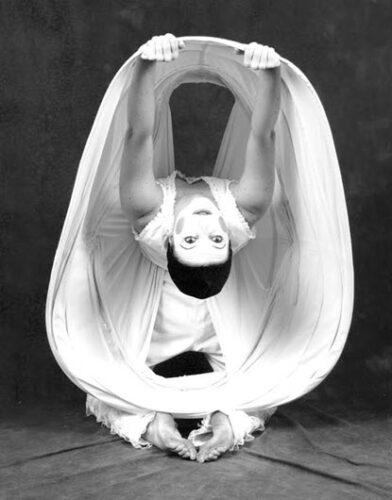
She was left wearing just the hoop, chemise, pantaloons, and a black skull cap that contrasted with her whiteface and rosy cheeks. Her esteemed historical dance teacher, the late Wendy Hilton, would have been horrified.
Mansbridge deconstructed the very fabric of the Baroque style by dancing barefoot, dipping into deep backbends, and manipulating the hoop into different shapes. “The dance felt like going back to the past and being pulled to the future,” she recalls.
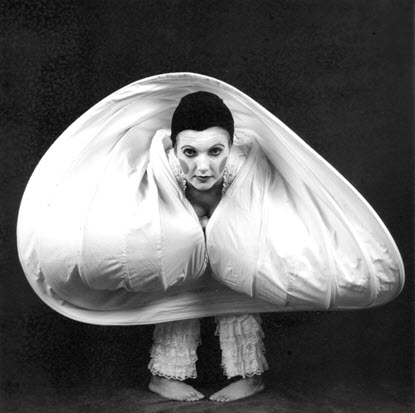
She performed “Mock Baroque” in England and Ireland and, in 2000, as part of a concert series in Seattle’s Chamber Theatre. Now at home in Seattle, her study awash with books and old programs, she has a framed black-and-white photo of herself in that costume. It makes her laugh, she says, “because I have slightly grubby feet.”
Educated in England and the U.S. in the 1980s and ’90s, she had embraced dance as an independent art form, following a post-modern aesthetic where dance had value even when performed without music, in silence or to ambient sound. A decade later, she had become deeply engaged in Baroque dance, where movement and music are inextricably linked. “As I got older,” she says, “I realized I am a traditionalist. I really like music!”
Mansbridge, at 59, has been an integral part of the Seattle early-music scene for at least a quarter-century. With Seattle Early Dance, which she founded in 2000, she has recreated dances from the European Renaissance and Baroque periods and collaborated with musicians across the Pacific Northwest. “All the dance work I have done in the last 20 years has been to live music on period instruments,” she says. “That’s very important to me.”
But, as ever, she is known for tweaking historical choreography and adding her own contemporary flair.
Recently, she has worked with early-music luminaries such as violinist and Seattle Bach Festival founder Tekla Cunningham and Stephen Stubbs’ Pacific MusicWorks. In the summer of 2024, she performed “Dancing with the Sun King” for Cunningham’s Whidbey Island Music Festival.
Mansbridge considers herself a practitioner and a teacher, not an academic, but it’s hard to be a Baroque dancer-choreographer without delving into historical treatises and learning the Beauchamp-Feuillet notation developed in Paris in the late 1600s. She is also interested in Renaissance dance forms created in Italy.
“That’s another rich period, well recorded from 1581 to 1602, because we have the writings of composer and dancing master Fabritio Caroso and dancer-choreographer Cesare Negri,” she says. In her work, Mansbridge refers frequently to Caroso’s 1581 book Il ballarino with its movement descriptions, musical scores, and instructions for social etiquette. Most of the dances Caroso and Negri created were for social events like weddings and balls.
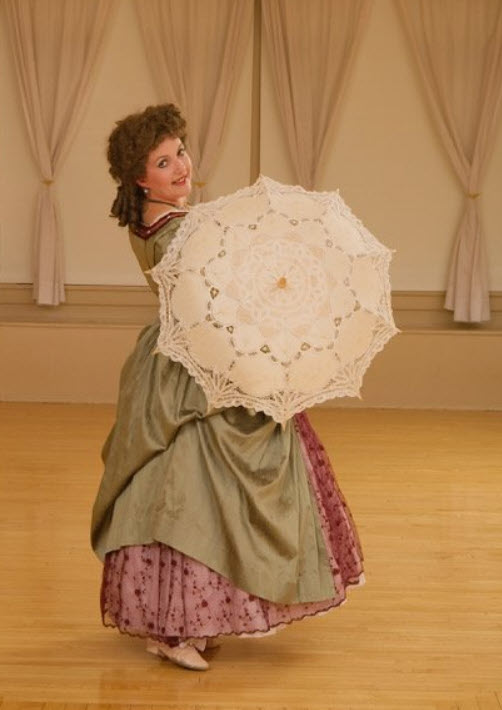
Clothing in that period was highly restrictive, so the dances had to be simplified. But one Italian step from the dance La volta — Mansbridge demonstrates for the camera on our Zoom call — involves the man lifting one of his partner’s legs from just under the knee so her dress billows out like a parachute. That racy move would have created quite a stir, Mansbridge says.
Italian couples generally danced side by side, using a parallel stance, unlike the slightly rotated stance favored later in Paris. She put those insights on stage when she reconstructed a “balleto” for two people from Il ballarino, “in praise of the Most Serene Lady, The Lady Margarita Gonzaga da Este, Duchess of Ferrara,” a great patron of the arts.
‘A Deeply Seattle Thing’
When choreographing the Bach Chaconne for violinist Cunningham, Mansbridge set that magisterial movement on two dancers she has trained since they were children: Tshedzom Tingkhye and Alejandro Frederickson. They were members of a youth dance company, Kaleidoscope, that Mansbridge directed in Seattle from 2014 through 2023.
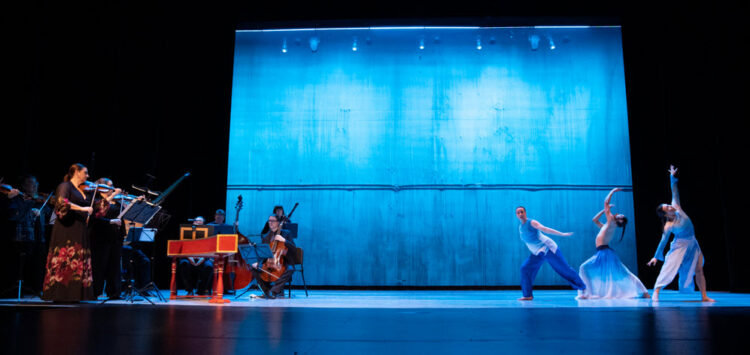
She combined modern dance technique with movement phrases and port de bras (arm movements) drawn from 18th-century notations. The opening gesture of the arms was done in silence followed by a Baroque pas de bourrée vite (a quick four-part movement) and a pas de passacaille (a turning jumping step), interspersed with modern dance phrases.
“What I’m interested in these days,” she says, “is Baroque dance as an abstract form,” shorn of the long, hooped dresses, heeled shoes, and elaborate headdresses. “Taking the movement out of the historical context is fascinating.” She felt the use of modern dance in the Chaconne helped her “do justice to that brilliant score.”
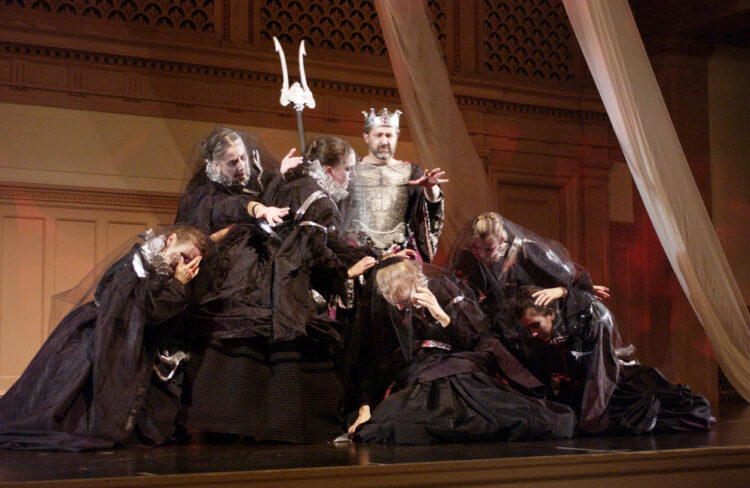
In a 2023 project with Stubbs’ Pacific MusicWorks and bass-baritone Ward, Mansbridge took movement even further away from its 18th-century roots. “A Concert with the Countess: The Baroque Meets Drag” featured Ward in his drag persona The Countess, with mounds of high hair and caked-on makeup. “She is the amalgamation of drag, classical music culture, and Baroque performance practice,” Ward wrote of his alter-ego in the program. He had worked with young dancer Tingkhye at the Boston Early Music Festival and brought her on board. As Stubbs wrote in the program notes, “it seemed the most natural (and deeply Seattle) thing to do to invite Anna to collaborate with all of us and create ‘the show.’”
‘What I’m interested in these days is Baroque dance as an abstract form. Taking the movement out of the historical context is fascinating.’
Mansbridge chose music by André Campra (1660-1744). The original dances set to Campra’s music were choreographed by the French dancing master Louis-Guillaume Pécour (1653-1729). Beauchamp-Feuillet notations of them still exist.
Well versed in that system, Mansbridge selected three of Pécour’s dances, which she contemporized: a Spanish Entrée from Campra’s opera-ballet L’Europe galante; a gigue from the opera Tancrède; and a solo from the opéra-ballet Les Fêtes venitiennes, a particularly complex dance. She and Tingkhye explored gesture and upper body movements, leaping gracefully between the 18th and 21st centuries.
The Countess premiered in 2023 at The Rabbit Box, a theatrical bar in Seattle’s Pike Place Market, and will be revived in June 2026 at the Berkeley Festival and Exhibition. For the upcoming version, Mansbridge will contemporize three solos dances from the Baroque repertoire and stage a few other pieces, including “Hero and Leander” by Nicholas Lanier (1588-1666) to be sung by Ward. (It’s a family moment: Ward is a direct descendent of Lanier.)
Boundaries and Rules
Mansbridge’s life has spanned three continents. Born in Brisbane, Australia, she moved with her mother and sister to England in 1977. Her father, a biochemist, stayed in Australia and later emigrated to the United States.
In England, Mansbridge studied piano, recorder, and oboe. She started ballet lessons but eventually realized she had the wrong body for that art form. She discovered the Baroque when her mother took a Sunday dance class taught by Philippa Waite. It was a pivotal moment in Mansbridge’s artistic life. Waite is now known internationally for her online and in-person retreats, which keep Wendy Hilton’s Baroque techniques alive. (Hilton predated the New York Baroque Dance Company’s Catherine Turocy, and in her day was revered for her work, which included teaching at Juilliard.)
Mansbridge got a scholarship to study with Hilton at her Stanford University summer intensive in 1990. Mansbridge’s father by then was living in Palo Alto. The die was cast. Mansbridge stayed in California and got her MFA in modern dance and choreography at Mills College in Oakland.
She remembers Hilton’s focus on symmetry and strictly correct technique. “One of the things I liked about Baroque initially was the boundaries and the rules,” Mansbridge remembers. According to Baroque style, the port de bras are very restrictive and precise, with the body held erect. Mansbridge might choose to tilt or curve the body instead. “In Baroque dance you bend on the upbeat and rise up on the downbeat. It’s very precise with the music, but I might play with the rhythm in a new way.”
Mansbridge fully emigrated to the U.S. in 1998 with her husband, Mark Cooper, an American composer of contemporary music. She founded her company, Seattle Early Dance, in 2000 and soon got to work. In 2002, she choreographed Monteverdi’s chamber opera Il ballo delle ingrate with the Early Music Guild (now Early Music Seattle).
Those initial years were rich for her as she continued to study, perform, choreograph, reconstruct, and deconstruct Baroque and Renaissance dance forms. Her efforts made an impact on the musicians of the region’s early-music scene. According to Stephen Stubbs, “she connected us to the whole dance world in Seattle, which was a big deal.”
Musicians often tell her how impactful it is to feel the music in their bodies, to literally embody it. She uses music they are likely familiar with. Handel is symmetrical. Lully often is not. “I’ve been teaching a sarabande from Lully. It’s a rondo form, very asymmetrical — ABACCAA. It doesn’t always push the second beat.” That would confuse most dancers to distraction, but Mansbridge enjoys getting inside the music and making new discoveries for herself.
Mansbridge is on stage now less than she used to be. But age is not the issue: “I know a few very accomplished Baroque dancers still performing on a professional level in their early 70s,” she says. “It all depends on how the body adapts to the challenges of sore feet, inflammation and joint pain, and how dancers manage injuries.”
The impetus away from dancing is partly due to her daughter, Isabelle, who is 23 and lives in Ireland. Her husband is retired, and together they plan to travel more. But while Mansbridge may be changing the pace, she’s not giving up on choreographing and directing. There is always more to discover, and Seattle is eager to keep her engaged.
Gillian Anne Renault’s dance writing has been published by numerous outlets including Ballet News, the Los Angeles Daily News, Atlanta Magazine, and ArtsATL.org. She was a recipient of an NEA fellowship to attend American Dance Festival’s Dance Criticism program. She wrote an EMAg cover story (May 2025) on dancer, choreographer, and entrepreneur Julia Bengtsson, recently named co-director of the New York Baroque Dance Company.