
From the Publications Director: Moments of Clarity
This column was first published in the September, 2025 issue of EMAg, the Magazine of Early Music America
Is historical performance practice facing what stock market analysts would call a correction — a downscaling that reflects a more accurate valuation of its current worth — or, instead, are we heading toward what science philosopher Thomas Kuhn would describe as a paradigm shift, where a familiar old model proves to be inadequate and, in a relatively short time, is overturned by a new, workable, and perhaps revolutionary replacement?
You’ve seen the troublesome news, including REMA-European Early Music Network’s 2025 Early Music Survey (“When the Music Fades”); a widely read report from this magazine (“The Ups (and Downs) of Collegiate Early Music”); various online and in-print discussions, much of it from a first-person perspective, such as a Letter to the Editor (“Collegiate Early Music: You Forgot the Students”); and other reports and commentary.

Several pieces in this issue of EMAg (Sept. 2025) consider our situation from different perspectives. To reassign Montaigne for today: There may be no truths, only moments of clarity passing for answers.
So Jacob Jahiel’s essay “Is Historical Performance Still Controversial?” addresses a rags-to-riches tale, starting with what outsiders perceived as quality-control problems and severe interpretations. Our current early-music revival took off in the 1950s and, till just now, hasn’t really slowed down. Performance standards have never been better, a result of more high-level training, more quality ensembles, and more research leading to a fascinating, expanding repertoire. A torrent of beautifully produced recordings and years of exciting concerts have developed savvy audiences — they can hear the differences. Media attention and enthusiastic critics gave the movement a rosy glow, if with a dark lining.
Back in 2011, speaking from its high perch, the New York Times took notice of Juilliard’s successful historical performance program. Yet the headline — “Early Music and Period Instruments are Having a Moment” — suggested more of a fad than a permanent artistic realignment. But just a year later, another Times feature began, “The early-music culture skirmish is long over. Proponents of historically informed performances have won.”
It was an absurd oversimplification, of course, likely to provoke backlash. But, hey, this was heady stuff for what started as a DIY artistic movement outside the big-budget classical mainstream. Many in our field took for granted the “correctness” and the aesthetic pleasures intrinsic to the HP approach. Altogether, these factors built our collective confidence. Still, artists, ensembles, and academia would always chart their own path forward while the field as a whole, perhaps, lost sight of longer-term goals.
Anne E. Johnson’s “Pied Piper of the Southeast” stands out for different reasons. A profile of Atlanta-based recorder player, educator, and early-music activist Jody Miller, the article mentions a panel discussion from the 2023 EMA Summit in Boston. The topic was community involvement. “What I found,” Miller recalls, “was so much despair over getting people involved.”
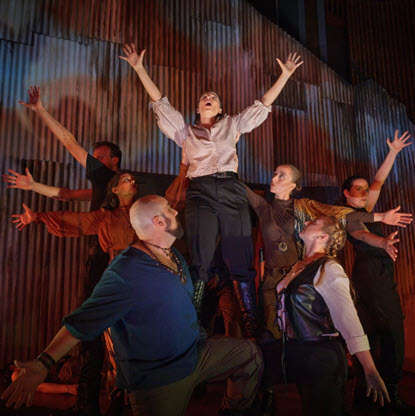
Miller is on to something important. He urges his colleagues to think outside the box that we’ve created. What we call early music, Miller says, was once “part of worship and part of entertainment and basically what we would call ‘Muzak.’ But [today] we expect that concertizing is the way we’re going to reach everybody. I would encourage us all to explore solutions that work for the type of music that we’re dealing with.”
We are in the arts, not the profit-oriented stock market (although there are similarities) nor the experimentation-creativity hard sciences (although there are many similarities). But still, has our field maxed out on the current model? Here’s a moment of clarity: Given the undeniable power of our music, the field’s prestige, and our collective resources, we have not attracted enough new folks into the fold. We’ve been content with our slender niche. We are just now receiving a wake-up call that we need to think about how to sustain it.
Pierre Ruhe is publications director of Early Music America