In the 1970s, early music enjoyed a strong following but historical dance needed help catching up. The New York Baroque Dance Co. was seminal in jump-starting research, performance styles, and popularity.
This article was first published in the January 2026 issue of EMAg, the Magazine of Early Music America
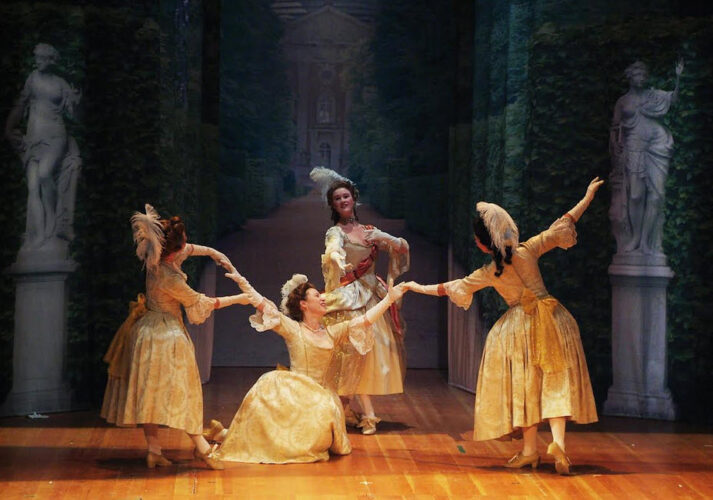
It’s a dedication of a temple for Erato, muse of Lyric Poetry. Apollo wonders why the muse of Dance is not there:
But where is the nimble Terpsichore?
Why does she not come
To measure with her elegant steps
Your lively notes?
At last the dazzling Terpsichore appears, fashionably late. She and her three followers launch into a spirited chaconne. The swift choreography is tricky: One measure of music can have as many as three shifts of weight, with buoyant leaps, intricate footwork, and split-second turns, demanding a keen spatial awareness. These challenges are heightened by the dancers’ costumes, of high white wigs, heavy brocade dresses, tight corsets, expansive hip-baskets, and heeled shoes.
The muse of Dance then performs solo, conveying a spectrum of emotions in a stately sarabande, a frolicking gigue, and a speedy passepied — all accompanied by the intertwining arias of Apollo and Erato. It’s quite a party.
Terpsicore is the prologue of Handel’s ravishingly beautiful Il pastor fido, from a version created for the London stage with the role of Terpsichore created for French superstar ballerina Marie Sallé, who had impressed both Handel and Rameau and was celebrated on both sides of the English Channel. A few centuries later, in 1983, the opera was presented by the New York Baroque Dance Company with its artistic director, Catherine Turocy, dancing the prologue’s title role.
While early music enjoyed a strong following in the 1970s, historical dance needed help catching up — and the New York Baroque Dance Co., founded in 1976 by Turocy and Ann Jacoby, was seminal in jump-starting research, performance styles, and popularity. Across the decades, the company seemed to move from strength to strength.
Among other crowning achievements, Turocy, as choreographer and stage director, with Nicholas McGegan conducting the Philharmonia Baroque Orchestra and Chorus, presented a modern premiere in 2017 at UC Berkeley: Le Temple de la Gloire, a 1745 opera with music by Rameau and words by Voltaire. (The opera disappeared from view in part because Voltaire’s Enlightenment-era libretto, rather than flatter Louis XV, seemed to challenge him to become a better king.)
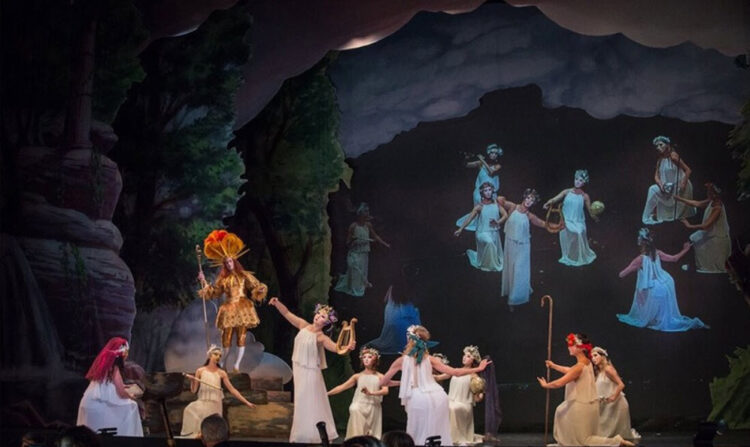
This year, the New York Baroque Dance Co. reaches an impressive half-century milestone, and its admirers are many. Turocy’s “productions are, for me, the most successful recreations of Baroque opera, be they works by Handel or Rameau,” says McGegan. “What I love most about Catherine’s choreography is how wonderfully she uses gesture. This combined with the Baroque gestures of the singers makes for the creation of an integrated style that I find magical. As a conductor, I find that matching her gestures with those of the music is so exciting.”
‘Nobody knew how to do this’
As undergrads, Turocy and Jacoby met in 1971 at Ohio State University, where Shirley Wynne was their professor of dance history. Wynne had studied Baroque dance in London with grande-dames Belinda Quirey and Wendy Hilton. In the early ’70s, Wynne was contacted by Alan Curtis, a soon-to-be-famous harpsichordist interested in historical dance and eager to perform a Jean-Philippe Rameau opéra-ballet.Trouble was, as Jacoby recalls, “nobody knew how to do this. Shirley began to reconstruct Baroque dances and established the Baroque Dance Ensemble at OSU in 1971. Catherine and I became members. That’s how Shirley began to think of Baroque ballet as a viable dance medium.”
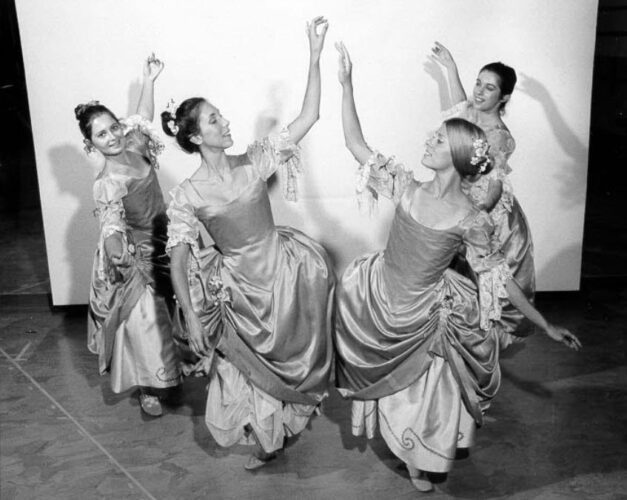
In 1974, Wynne’s Baroque Dance Ensemble was invited to the Aston Magna Music Festival, in western Massachusetts, led by harpsichordist Albert Fuller. The dancers were to perform and teach Baroque dances to the musicians; several, including harpsichordist James Richman, were Fuller’s Juilliard students. “La Cupis starts out with a dancer entering the stage in silence. The start cue for the harpsichord is when she stops, and closes her fan,” explains Turocy. “It was often an awkward thing for the player to get right, but Jim did. And the way he played, it was an incredible connection between dance and music — our breath was one. That had never happened to me before.”
But not long after, work dried up for Wynne’s company. Jacoby returned to her native New York City. Turocy soon followed and reunited with Richman, who was working with Concert Royal, a period-instrument ensemble. Richman’s musical knowledge and innovative programming supplied them with artistic support. Their first major performance was at Lincoln Center’s Alice Tully Hall and featured La Danse, an act from Rameau’s opera Les Fêtes d’Hébé (1739). “Having live music by Concert Royal gave us such an advantage,” Jacoby recalls.
Energized, Turocy and Jacoby created the New York Baroque Dance Company in 1976 and incorporated as a non-profit. Turocy explains, “We wanted to have a secure structure in paying dancers, and to have disability insurance in case of injury. We bought Dance Theater Workshop’s workbooks on how to start and keep a company going.” Newlyweds Turocy and Richman moved to an apartment on the Upper West Side for $400 per month. “We had a large living room where we could rehearse,” remembers Turocy. After rehearsals, Jacoby would head downtown and wade through the Bohemian throng to get to her apartment above Max’s Kansas City, the famous club frequented by the likes of Andy Warhol and the Velvet Underground. From Minimalist artists and composers on the Upper West Side to punk bands in decrepit Chelsea and Greenwich Village neighborhoods, New York City in the 1970s was dangerous and creative, an edgy space where “everything seemed possible,” as Jacoby puts it.
Turocy and Jacoby formulated their aesthetic philosophy and artistic trajectory for NYBDC, espousing the scholar-performer mode. They explored the intricacies of Baroque dance by reading period treatises by the likes of Claude-François Ménestrier and Charles Pauli. The company founders were fluent in reading dance steps recorded in the Feuillet-Beauchamps notation system, published in 1700. Commissioned by Louis XIV, these notations enabled dancers throughout Europe to learn the newest choreographies of the day. Jacoby and Turocy committed to learning how to decode Baroque notation. “I was connected to reading music,” Jacoby says. “For me it’s the same physical relationship between time and the printed notation.” Turocy adds, “We felt reading notation gave you a clearer picture. Our philosophy was this: be as true as possible to the sources, read as much as you can about the style, and figure out how can you add all that into a reconstruction, be it fencing, commedia dell’arte, dance theory, or acting treatises.”
‘Be as true as possible to the sources, read as much as you can about the style, and figure out how can you add all that into a reconstruction’
Criticisms from dance scholars were rife early on. Wynne’s dramatic take on Baroque dance had been influential. Yet when Turocy performed a masked theatrical solo, Pécour’s Passacaille d’Armide (1686), at a conference, one dance expert told her it was “wrong” to mix pantomime and dance. “I was criticized for using port de bras (carriage of the arms) that was not in Pierre Rameau’s book, but that’s a social dance treatise,” recalls Turocy. “I had to defend myself again and again.”
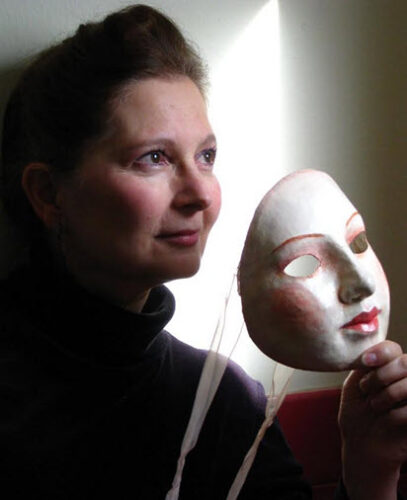
Turocy also took umbrage at claims that ballet’s origins stemmed solely from Louis XIV’s court; she credited the Jesuits, whose teaching included the rules of the art of dancing. “The development of ballet included intellectual discussion to find answers about beauty and perfection,” says Turocy, “which were reflections of God’s work. If your art reflected the geometrical shapes and the movements present in the universe, you were having a direct connection with God.”
In New York in 1980, NYBDC and Concert Royal collaborated on two opéras-ballets. Turocy choreographed Rameau’s Pygmalion (1748), based on Ovid’s sculptor who falls in love with his beautiful statue. André Campra’s Les Fêtes vénitiennes (1710), a frothy entertainment set in Venice, was choreographed by Jacoby, despite her protesting that “I am not a choreographer. I used notation and would cut and paste and fiddle around with making it fit the music.” Turocy and Jacoby worked with stage director John Haber, and several dancers in Pygmalion were masked, which was also a new challenge.
In 1980, Turocy received a research fellowship in London, where she met experts in Baroque performance, including Dean Barnett, a scholar of 17th-century historical gesture; the aforementioned Quirey; Roland Jullien and Philippe Lénaël of Théâtre du Nombre d’or in Nantes, France; and, of particular note, John Eliot Gardiner, the pioneering conductor of the Monteverdi Choir and English Baroque Soloists. After Gardiner saw members of NYBDC performing in London, he invited Turocy to choreograph Rameau’s final opera, Les Boréades, at the 1982 Aix-en-Provence Festival and at the Opéra de Lyon. Politically subversive with Enlightenment attitudes, Les Boréades is a five-act tragédie-lyrique, a love story where the gods of the title — the harsh North Winds — are the villains. “That was the biggest thing we had ever done,” recounts Jacoby, “and it was certainly prestigious. It was incredibly hard work.” The production, directed by acclaimed writer and Opéra de Paris administrator Jean-Louis Martinoty, would be the opera’s first-ever staged performances.
Les Boréades was a career-making event for Turocy and cemented the reputation of the six-year-old company. After its resounding success, Gardiner invited Turocy and Co. to perform in other productions in Aix and Lyon, including Rameau’s Hippolyte et Aricie in 1983 (directed by Pierre Luigi Pizzi), and Jean-Marie Leclair’s Scylla et Glaucus in 1986. One headline compared Turocy to the greatest dancer of mid-1700s Paris: “Une Camargo de l’Ohio ressuscite Rameau” (A Camargo from Ohio brings Rameau to life). For Rameau’s birthday celebration, in 1983, Turocy choreographed Pygmalion for the Théâtre du Nombre d’or, which was later performed at Versailles for French President Mitterrand.
Performing French Baroque dance in France was thrilling for Turocy and Jacoby but, despite their success, work in Europe soon came to a halt. Rameau productions in France were scarce — other than the Gardiner and NYBDC productions. “The French press lauded these and talked about sending French culture all over the world,” says Richman. “But the French government’s standpoint was that it was an English orchestra, an English conductor, English singers, American dancers, and an American choreographer…and done in France. French artists stepped in, and it was massive step backwards for us.” At about the same time, it took William Christie, a Buffalo-born harpsichordist and conductor, to spearhead a lasting revival of the French Baroque. In 1979, in Paris, he launched his era-defining ensemble Les Arts Florissants. An early triumph was Les Arts Flo’s production of Lully’s Atys in 1987 with Baroque choreography by Francine Lancelot — something of a cornerstone event in today’s early-music revival. In a major setback for historical dance’s visibility, however, Christie later came to favor contemporary-dance choreographers.
As a result of these events, Turocy, Jacoby, and Co. turned their eyes toward performance opportunities at home.
In 1984, NYBDC and Concert Royal presented Gluck’s Orfeo ed Euridice in New York City. In addition to the choreography, Turocy made her debut as stage director. Working with Haber, Martinoty, and Pizzi had given her a close view into attitudes and methods. Martinoty had advised, “If you are the choreographer, imagine you are the stage director. Think about the scene, and fit your choreography into that scene.” Pizzi taught her to consider the stage setting as a painting, and therefore a backdrop for her choreography. From Haber, she carried his poignant reminder that there is always someone in the audience for whom this will be their first performance — as well as someone for whom it will be their last.
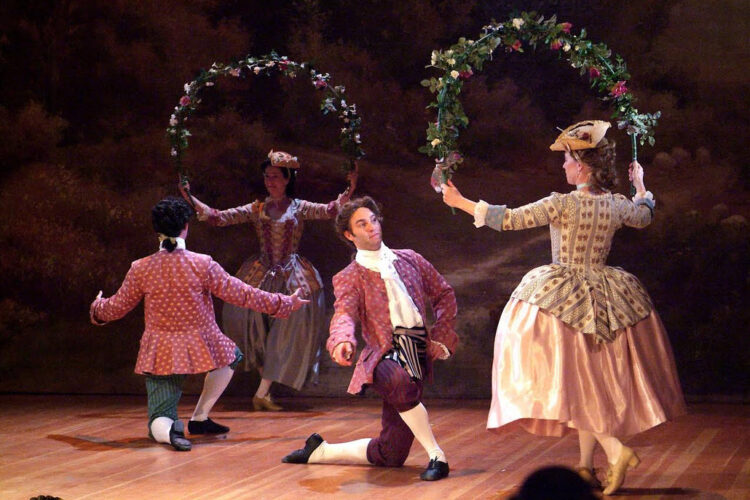
Soon they found several large-scale opportunities in the U.S. In 1985, they presented Handel’s dance-infused opera from 1735, Ariodante, at the Spoleto Festival USA in Charleston, S.C. In 1986, they performed Rameau’s Les Fêtes d’Hébé at the Nakamichi Festival at UCLA, which featured over 13 dancers and acclaimed singers such as Ann Monoyios and Howard Crook.
There is always someone in the audience for whom this will be their first performance — as well as someone for whom it will be their last.
Les Fêtes d’Hébé was a fortuitous engagement. Time magazine published a glowing review: “It is a scene from Watteau or Boucher come to delicate, lilting life,” wrote critic Michael Walsh. Christopher Hogwood, conductor of Britain’s Academy of Ancient Music, attended the California production. Turocy approached Hogwood and introduced herself. “Some choreographers are reluctant to go up to a conductor and ask about working together,” Turocy says. “If he says no, you are in the same place you were. If he says yes, you move forward.” Her moxie paid off. Hogwood commissioned more than ten ballets from NYBDC, which toured Japan and London. The company performed with the conductor at several of his other gigs, such as Boston’s Handel and Haydn Society and the Kennedy Center’s summertime Mozart Festival.
1986 was personally eventful for Jacoby. During Les Boréades a few years earlier, Jacoby had met a French dramaturge named Michel Beretti. The two conducted a long-distance relationship between Brooklyn and Paris. When Beretti took a position with the Paris Opéra that year, Jacoby moved to France. “I am very good as a second in command,” Jacoby confides. “I am an interpreter, and a good director, but not a creator. Catherine is wonderful for all of that. She and Jim were the ones behind all the grants, all the logistical stuff — they had great ambition.”
NYBDC and Concert Royal continued to tour widely with three dance programs: Harlequin, Gods, and Dancers — a chamber-dance program; Mozart’s Les petits riens, which debuted at Lincoln Center’s Mostly Mozart Festival; and a double-bill of Pygmalion and Terpsicore, which had more than a hundred performances, including at Sanssouci, Frederick the Great’s palace, where the legendary Marie Sallé herself had danced. The company performed often with McGegan’s Philharmonia Baroque on tour at the Göttingen International Handel Festival in Germany. In 1995, Richman became artistic director of the Dallas Bach Society, where they introduced their Baroque productions to aficionados in Texas.
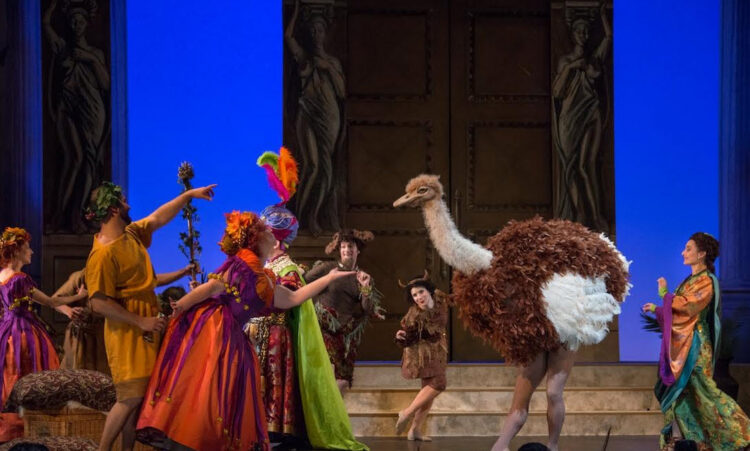
When former Concert Royal concertmaster Ryan Brown moved to Washington D.C. and founded Opera Lafayette in 1995, NYBDC began what evolved into a 30-year collaboration. “Working with Catherine and the NYBDC and Jim in Concert Royal was formative for me,” Brown wrote in an email about his apprentice years. “I still vividly remember Jim playing harpsichord on one side of tenor Howard Crook with me playing violin on the other through the passionate ‘Fatal Amour’ from Pygmalion. Inspired to lead the work myself with the ensemble, which was to become Opera Lafayette, I asked Catherine to dance La Statue animée, a role she had choreographed. The delicacy and magic she brought was typical of her work, and yet extraordinary.”
A Deeper Understanding
The mission of NYBDC has always been to offer theatrically robust research-based performances. If early music and historical dance are two sides of a coin, early music has the stronger position: fundamental scholarship has been done, the music notation exists, and so much is now known about performing on period instruments. Baroque dance, however, is still catching up. Although period dance notations exist, these exquisite steps remain largely unseen compared to the tangible legacies of French court painters, architects, sculptors, poets, and playwrights. Therefore, passing on accrued knowledge about how to bring them to life is crucial.
Yet for all its acclaim and cultural importance, few universities dedicate courses to historical dance itself. Dance publications might cover everything from pink-leotard youth education and Swan Lake to Balanchine, tap, jazz, and TV dance competitions — but makes no space for the enriching world of the Baroque, and few universities dedicate courses to historical dance itself. “I find that students often don’t have an understanding of the history that has brought us to the present time,” says Rachel List, Director of Hofstra University’s Dance Program. “If they were able to study historical dance, it would make their own performance much richer.” Choreographer Benjamin Millepied took private lessons with Turocy, and said in a 2022 Le Monde interview, “I am ashamed that I never learned Baroque dance before. It should be obligatory in all dance schools.”
‘I am ashamed that I never learned Baroque dance before. It should be obligatory in all dance schools.’
NYBDC member Caroline Copeland, to whom Turocy taught her signature role in Terpsicore, and had a starring role in that Berkeley Le Temple de la Gloire, was first exposed to historical dance at Goucher College, and further inspired by a NYBDC workshop. In an email, Copeland wrote: “It was here that my arts education expanded to include lessons in the history and practice of music, acting, fencing, mask work, and dance notation, something that a normal undergraduate dance degree could not cover. This workshop set up a model and expectation; a life in early ballet required continuing research and education to deepen one’s understanding of the art.”
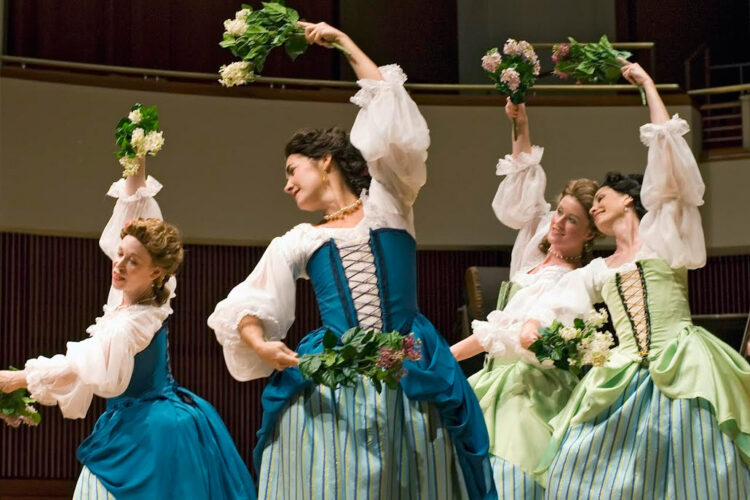
As a two-decade member of NYBCD myself, beginning in the 1980s, I reveled in the necessity of acting while dancing. I delighted in inhabiting characters so unlike my own, including a number of aloof Goddesses, a mischievous Cupid, a vengeful Fury, a three-legged male commedia character, and an oversexed coquette. Consequently, my own neo-baroque productions are significantly character-driven and influenced by 18th-century sensibilities.
Turocy’s prolific 50-year career has garnered honors. In 1995, Turocy and Richman were each awarded the prestigious title of Chevalier in the French Order of Arts and Letters for their research and realization of French historical productions, and she received a Sustained Choreographic Achievement BESSIE award in 2000. And there’s more to come, including Turocy’s staging of Monteverdi’s L’Orfeo with Ars Lyrica Houston in 2026. As the dance company’s half-century mark approaches, Turocy is exploring the idea of a shared leadership with a co-director. [Update: In April, 2026, Julia Bengtsson was named NYBDC’s co-director.]
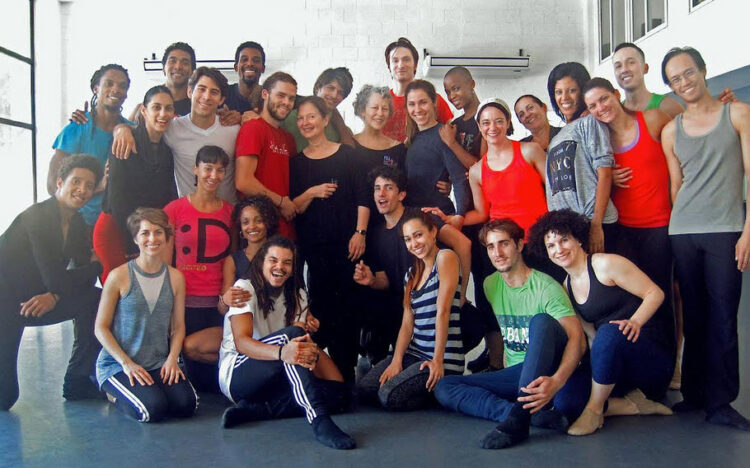
Mentoring the next generation is key. “If one is building a historical dance community, one must cultivate the people who will continue the work,” Turocy stresses “NYBDC has many resources — trained dancers, repertoire, costuming, and dances that are easily teachable at colleges. I will continue on as one of the stage directors and choreographers and will spend time on new projects. I have a great love of the work, and love for the dancers. I want them all to move forward.”
Patricia Leigh Beaman is University Professor of Dance at Wesleyan University. As a longtime member of the New York Baroque Dance Company, she toured widely, performing in numerous operas-ballets and with numerous early-music ensembles. She has also performed, choreographed, and taught contemporary dance in the U.S. and Europe. She is the author of World Dance Cultures: From Ritual to Spectacle.