
From the Publications Director: ‘A.I.’s skill in gathering and summarizing information opens boundless possibilities. But writing and the interpretation of facts is an art all its own, not to be casually handed over to a bot.’
A version of this column was first published in the September 2026 issue of EMAg, The Magazine of Early Music America
The mood among old-school writers and editors is increasingly pessimistic. Last month, David A. Bell, a Princeton historian of the French Revolution, wrote a smart essay on artificial intelligence titled “The Future of Plagiarism.” The definition of “authorship,” he notes, has always been slippery, going back to the Middle Ages.
Even a modern notion of authorship, he continues, has “itself has been anything but a straightforward concept,” adding that writers “often depended on hidden collaborators: editors, research assistants, servants, spouses, ghost writers, and many others. We don’t have to dive into poststructuralist debates over authorship and language to ask if ‘authors’ actually ‘write’ the works attributed to them.”
But with today’s technology, as Bell’s essay summarizes, “when machines can draft competent prose, summarize scholarship, rewrite paragraphs, and imitate styles in seconds, the central ethical question will no longer be whether particular sentences have been copied. It will be whether a piece of writing embodies original thought. That is a much harder standard to define — and one that universities, publishers, and scholars have only begun to confront.”
Bell then admits that after he wrote his essay he asked ChatGPT to craft a few summary sentences, the ones I’ve just quoted. The point is taken: A human can pass off A.I.-generated content as their own, but editors trying to police the uses (and misuses) of this devouring technology might be overlooking the salient elements of what it means to create original content.
For early music, one essential and often thrilling aspect of historical performance practice is that much of what we do is rediscovery — rediscovering and reviving lost or distant music and cultural practices and interpreting them anew, for today. On the research side, A.I.’s skill in gathering and summarizing information — a powerful tool to augment human expertise — opens boundless possibilities. (Last year, we published an account of a musician’s frustration and success with ChatGPT helping decipher 17th-century handwriting.)
But the interpretation of facts is an art all its own, not to be casually handed over to a bot.
And it’s crazy to have to say this, but here we are: Writing is hard, and it’s as much an art as playing the viola da gamba or the crumhorn or singing Bach. If you value any of these you ought to value the others.
We are of course deeply troubled by A.I.’s penchant to spout misleading information or hallucinations. By its environmental damage. By the fact that A.I. systems are instruments to serve rapacious corporations (and may attempt to terminate humanity). And, not least, by the inevitable homogeneity and “blandification” in writing styles and voice that comes from large language models.
As Bell’s A.I. prompt summarized, the technology has profound problems that the intellectual world has yet to confront, although some have started. The peer-reviewed Journal of Singing created a detailed A.I. policy and boiled it down to an easy-to-understand chart:
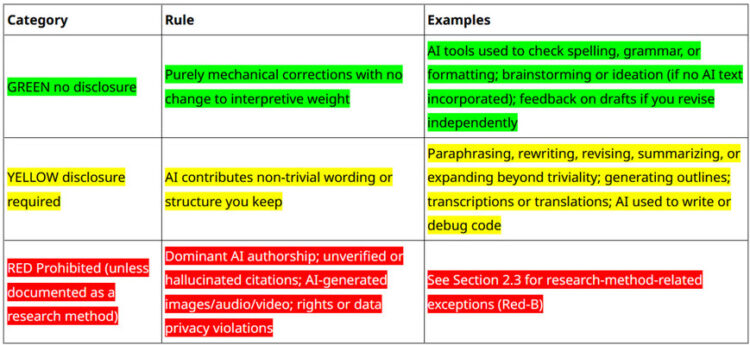
All this is to suggest that EMA should savor human-directed research and writing for just a little longer. Partly inspired by the Journal of Singing policy, and aware that A.I.-created content may soon be impossible to detect, EMA drafted a policy that puts our in-print EMAg and online E-Notes contributors and editors on notice:
The author acknowledges that they submitted original work and that EMA has permission to use images the author supplied for this article. Contributors may use Artificial Intelligence (A.I.) as an initial research or organizational tool, like any other resource. All A.I.-generated information must be verified by the contributor before submission to EMA. Contributors are not allowed to submit any A.I.-written texts, which may be considered ghostwriting or plagiarism, or A.I.-generated (or enhanced) images. In all cases, transparency in the use of A.I. is required by the contributor.
A.I. is a burgeoning cultural force and a moving target. Is our full-disclosure policy useful? All-but-irrelevant? Let us know your thoughts: editor@earlymusicamerica.org.
Pierre Ruhe is publications director of Early Music America