
New England Conservatory’s Pratt Early Music Program aims to teach historical performance practice to ‘modern’ instrumentalists and to populate symphony orchestras going forward
Collegiate early-music education is facing budget cuts across the country. NEC’s Pratt Program shows a way forward — with dedicated funding.
This article was first published in the September 2026 issue of EMAg, the Magazine of Early Music America
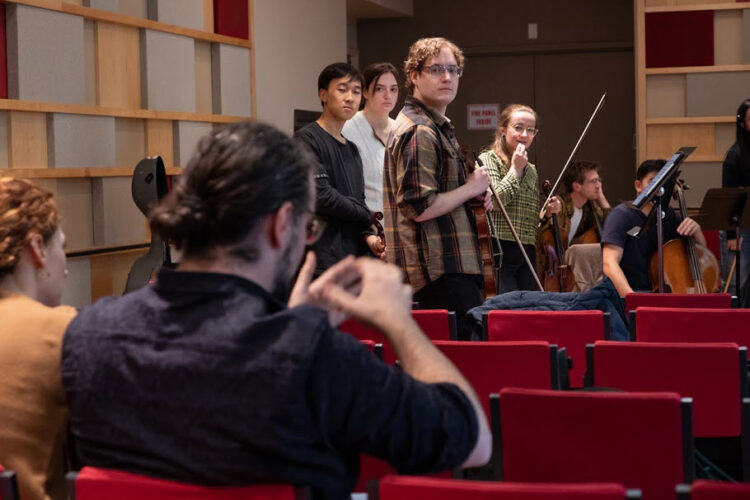
I had been teaching at New England Conservatory (NEC) for about eight years when, in 2022, I was asked to oversee a new historical performance initiative. Harold I. Pratt, a life trustee, has championed early music at the Conservatory, reflecting a passion that began in high school. The Harold I. and Frances G. Pratt Early Music Residency, which is now called the Pratt Early Music Program, is the result of that commitment.
My initial responsibilities included adding to NEC’s period-instrument collection and identifying distinguished scholars and performers who could lead our students in early-music projects. Compiling a list was not difficult. But it occurred to me that prior to working with a Jordi Savall or a Rachel Podger, our students should understand the foundation of a shared language, and that foundation had to be built in studio lessons. Young musicians attend NEC to study with renowned chamber and orchestral musicians, opera singers, and concert pianists who largely represent the “modern” tradition. NEC had long supported early music in some direct and peripheral ways but, by the time I studied here in the early 2000s, it was primarily in the form of classroom exposure to historically informed performance.
So in 2023 we assembled a group of established early-music players to serve as the Pratt Program faculty and surveyed the student body to gauge interest in what would be a small number of tuition- and credit-free early-music lessons. Seventy students requested lessons.
At the outset, interested students studied and performed early-ensemble repertoire on an elective basis. Since then, NEC’s orchestra department has incorporated early-music ensemble experiences into students’ orchestral performance requirements. I, or a guest, leads these projects. Additionally, a group of students — led by violinist Tara Hagle and cellist Lily Stern, who were undergraduates at the time — formed the NEC Early Music Collective, a period instrument ensemble that receives a budget from NEC. This student-led group will perform professionally in the winter of 2026-27.
Far from eschewing the use of steel strings, or 88 keys and three pedals, the Pratt Program seeks to augment students’ core studies and meet them where they are. These are talented young musicians who grew up with recordings of early-music superstars. They are finding that their modern studio teachers support their interest in early music, and the Pratt faculty are there to help them explore that approach.
This aligns with NEC’s goal of developing the “compleat musician” (to borrow a term from Gunther Schuller, the late former NEC president). To that end, NEC extends an education in early music to students in the Conservatory’s Expanded Education Program through the Preparatory School (NEC Prep), whose early-music department is co-chaired by Aldo Abreu and Renée Hemsing.
Hemsing introduced her students not only to Renaissance and Baroque dance music but also to dance itself. String and wind players as young as six, coached by Baroque dance expert Ken Pierce, recently danced a pavane while accompanying themselves with music by Gervaise.
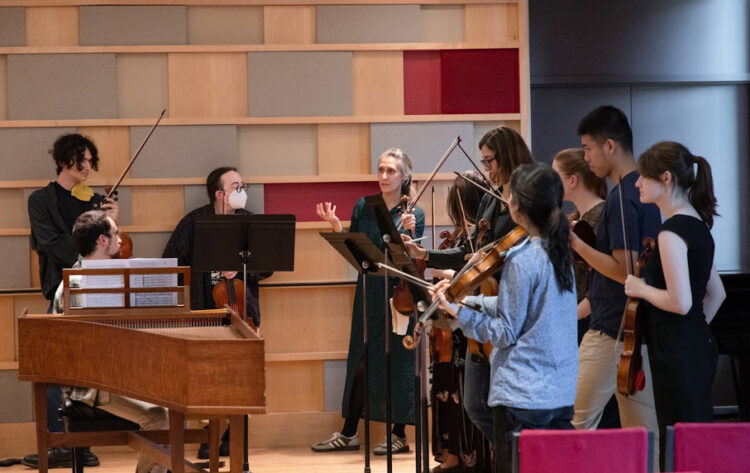
In the 2026-27 school year, NEC will begin offering a Concentration in Early Music. In addition to officially codifying and awarding credit for students’ early-music coursework, lessons, and participation in ensembles, this concentration will create pathways for pedagogical synergy between NEC and its Preparatory School. College students will have the opportunity to broaden their understanding of historically informed performance by serving as teaching artists and mentoring their younger counterparts in NEC Prep.
The benefits of early-music study within the framework of intensive modern schooling are evident. Faculty and students alike have attributed dramatic improvements in their playing, on both modern and period instruments, to exposure to early-music principles.
“I credit early music with opening up my overall musicality and revealing my ability to create art from my playing — something I used to struggle with,” student bassist Alyssa Burkhalter told me in an email interview. “I’m thrilled by how exploring this music perpetually shapes me into a more well-rounded, multifaceted, modern bassist.” Burkhalter recently transcribed Marais’s Les Voix Humaines for her instrument.
The benefits of early-music study within the framework of intensive modern schooling are evident. Faculty and students alike have attributed dramatic improvements in their playing on both modern and period instruments.
Faculty Baroque bassist Heather Miller Lardin explains that she and Burkhalter “explored the piece on her modern instrument using viola da gamba techniques along with 18th century notational convention and gesture. This afforded her an interpretive vocabulary that many of her peers simply don’t have. Alyssa was able to build an expressive and multidimensional interpretation that worked on her bass and that she enjoyed performing.”
Student violinist Mara Zaner, also in an email, told me that “Studying historically informed practice has allowed me to deeply examine the physicality and expression in my approach to modern and period playing. The Baroque violin pushes me to explore how I think of the sound I produce by giving me the chance to experiment with an entirely new sound world. I sense my musicianship growing through a new sense of curiosity and creativity in my modern playing. It expands my love for music and my relationship with the violin.”
Increasingly, symphony orchestras at every level are inviting early-music specialists to direct performances of Messiah and the St. Matthew Passion, as well as symphonies by Haydn and Beethoven among other 18th-century works. Meanwhile, esteemed “modern” conductors are invited to lead early-music ensembles. The maestros often return to their home orchestras requesting approaches they found appealing in the early-music groups.
I believe this represents the natural evolution of the early-music movement. Certainly, if one extols the power and beauty of the approach, how can one deprive others of its lessons? If you haven’t heard HP-inspired recordings by Claudio Abbado and Orchestra Mozart or Simon Rattle and the Bavarian Radio Orchestra, I highly recommend them as examples of what can happen when symphonic players on modern instruments embrace early-music ideals.
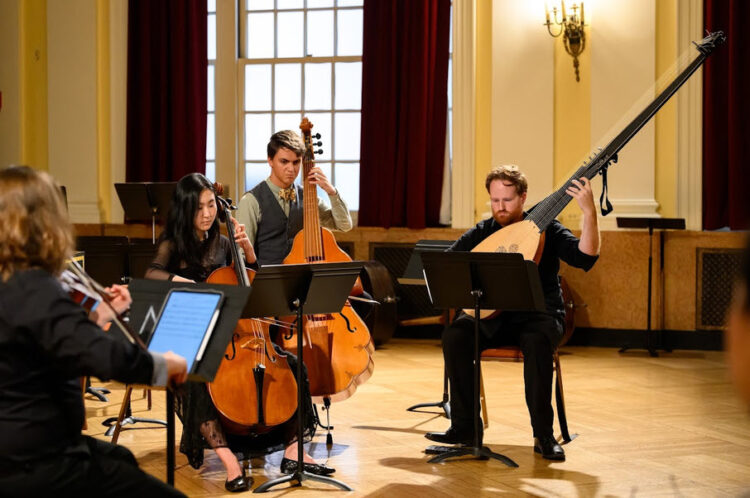
The Pratt Early Music Program works to populate symphony orchestras with players who can integrate shapely bass lines, harmonically responsive playing, inequality of emphasis, and rhetorical articulation into an otherwise “modern” approach. As Lardin put it: “Bassists who spend real time focused on Baroque performance practice tend to come away with a more secure understanding of how to anchor an ensemble harmonically and rhythmically that carries into much later repertoire. It’s a priceless advantage.”
‘I believe this represents the natural evolution of the early-music movement’
My colleagues and I work hard to provide that advantage. Most of our students won’t be stepping away from their Steinways or Böhm flutes. But when they play an unmeasured prelude or an orchestral solo in a Haydn symphony, their listeners will hear something they might otherwise never experience. Some of our students will specialize in period instrument performance. Our graduates have gone on to Juilliard 415 and to schools in Europe to do so. Others are entering the workforce equipped with gut strings and fewer keys. Some are competing across the globe on modern instruments and bringing Baroque bows and ornaments to their first-round performances of Bach, right before they play their Kaija Saariaho.
When Hemsing asked one particularly gifted violinist, “Are you concerned about distracting a modern jury with an early-music approach?” the violinist answered, “I’m not worried. I love playing in competitions because it’s an opportunity to play music that I love the way I love it, and this is how I play Bach.”
The jury may be out, but if we do our job well, when they come back, they’ll have to come around to this kind of “compleat musician.”
Guy Fishman is artistic director of L’Armonia Boston and principal cellist of the Handel and Haydn Society. He is on the faculty of New England Conservatory of Music, where he directs the Early Music Institute in the summer and administers the Pratt Early Music Program, in addition to teaching Baroque cello and chamber music.