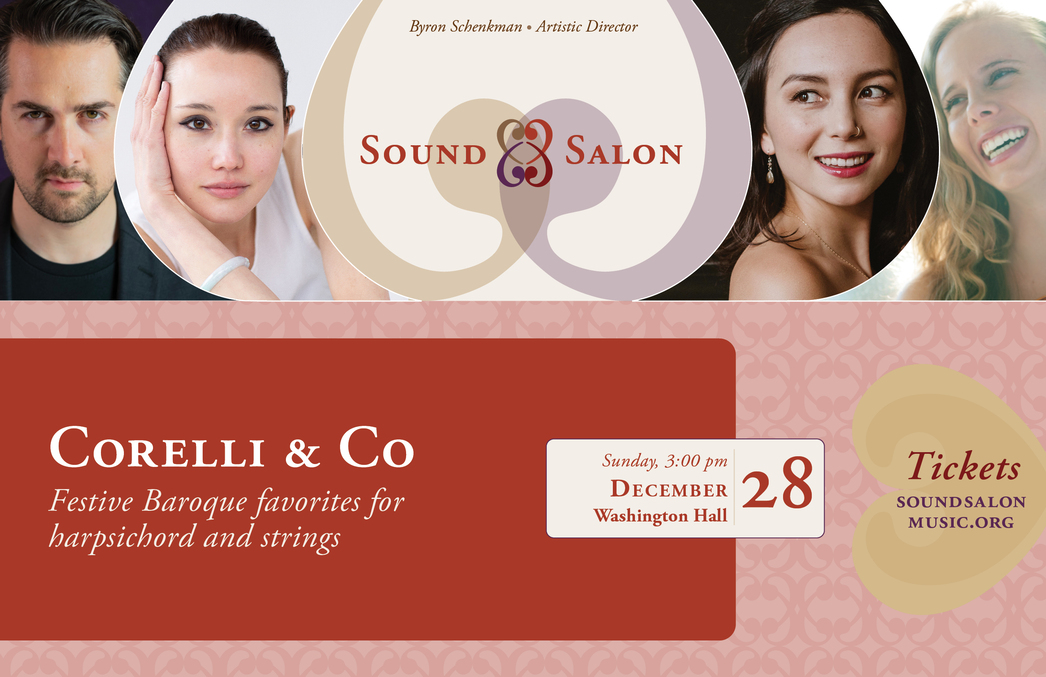
An ensemble of violins, cello, theorbo, and harpsichord presents some of our favorite music of the High Baroque, including works by Arcangelo Corelli and composers he inspired: Antonio Caldara, George Frideric Handel, and Antonio Vivaldi. These baroque works are juxtaposed with two Japanese folk songs arranged for the ensemble by violinist Anna Okada.
Notes on the Program by Byron Schenkman
Arcangelo Corelli was probably the most influential composer of the Baroque Era, the period of European music history which includes the 17th and early 18th centuries. His music was widely reprinted, edited, arranged, and imitated for almost a hundred years after his death. Antonio Caldara, George Frideric Handel, and Antonio Vivaldi are just three of the many composers who modeled works after those of Corelli. And Corelli’s music formed the basis for what would become known as common practice harmony, the structure of most “Western” (typically white) music to this day.
Two thirds of Corelli’s published work consists of trio sonatas, sonatas for two violins and continuo, sometimes with an independent part for the cello. (Continuo is the standard Baroque accompaniment, realized by any combination of bass and chordal instruments, such as the cello, theorbo, and harpsichord which we are using in this concert.) By the time Corelli published his trio sonatas there were many examples dating back to the early 17th century. Isabella Leonarda’s are some of the best from the generation immediately before Corelli.
As a counterpart to the European music on our program we are including two Japanese folk songs in new arrangements for Baroque instruments. “Sakura Sakura” (Cherry blossoms, Cherry blossoms) may have started out as a purely instrumental melody celebrating spring. It has since become a popular song representing Japan in international settings. “Hana” is one of the most popular songs by Kina Shoukichi, an Okinawan folk-rock musician and peace activist whose slogan has been “Lay down your weapons; take up musical instruments.”