
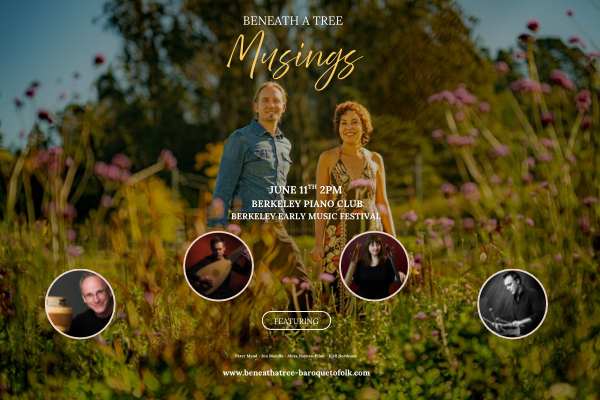
Musings — In Concert
Musings is a collection of reimagined works inspired by fragments of history, beloved texts, folk
traditions, and the unending curiosity that fuels artistic creation. Each track begins with a muse—
some ancient, some modern, some personal—and grows into something newly shaped through
improvisation, composition, and collaboration. The album invites listeners into a world where
baroque meets folk, classical meets contemporary, and memory becomes the spark for musical
invention.
Gail Hernández Rosa – violin, viola, vocals
Daniel Turkos – contrabass, octave mandolin, guitar, vocals
Peter Maund – percussion
Alexa Haynes-Pilon – cello, bassoon
Kjell Nordeson – Vibraphone
Mission Statement
Beneath A Tree (BAT) believes baroque music is not a relic—it is a living language, capable of crossing cultures, generations, and traditions. Founded in 2017 by violinist Gail Hernández Rosa and double bassist Daniel Turkos, this California-based ensemble bridges historical performance with folk, global, and contemporary traditions in bold, genre-defying programs. In concert halls, schools, and community spaces, we invite audiences into a dynamic relationship with early music—transforming how it is experienced, shared, and understood through immersive performances and community collaborations that make it relevant, inclusive, and alive. We are rooted in the past while fearlessly open to the future, building a more expansive musical landscape for audiences everywhere.
Beneath A Tree is a fiscally-sponsored affiliate of InterMusic SF, a not-for-profit organization dedicated to small-ensemble music in the San Francisco Bay Area.
#weplaywithguts
———-
BIO
Beneath A Tree (BAT) is a multi-genre ensemble led by violinist Gail Hernández Rosa and bassist Daniel Turkos that explores the deep and often overlooked relationships between baroque music and global folk traditions. Founded in 2017 in Philadelphia and shaped through performances in both urban and rural communities—from concert halls to pubs in Chester County—BAT emerged from a shared curiosity: how do composed and traditional musical languages intersect, and how do these connections continue to resonate today?
Rooted in historical performance practice, BAT approaches music as a living continuum rather than a fixed canon. Our work examines the kinship between baroque repertoire and vernacular traditions such as Celtic, bluegrass, and other global folk idioms. These genres, often separated by institutional boundaries, share common ground in their reliance on improvisation, ornamentation, storytelling, and communal exchange. By bringing them into dialogue, we aim to dissolve artificial divisions and illuminate their shared origins.
Our creative process is collaborative, intuitive, and research-driven. It begins with careful study of historical sources alongside deep listening to folk traditions, followed by experimentation through improvisation and arrangement. We perform on period instruments as well as folk instruments—including violin, contrabass, octave mandolin, and voice—allowing us to move fluidly between stylistic worlds. Each project evolves organically, shaped by the musicians involved and the cultural contexts we engage. Rather than presenting a static interpretation, we treat each performance as an opportunity to rediscover and reinterpret the music in real time.
The artistic voice of BAT is deeply informed by the distinct yet complementary paths of its founders. Gail Hernández Rosa, born and raised in Puerto Rico, grew up in a culture where music is an integral part of daily life. Her early immersion in both vocal and instrumental traditions, combined with her father’s influence as a classical baritone, led her to pursue a career in violin performance at the highest level. Her specialization in historical performance—cemented through advanced study at the Royal Academy of Music in London—has taken her across Europe and the United States, performing with ensembles such as the Gabrieli Consort & Players, Florilegium, Scottish Chamber Orchestra, Philharmonia Baroque, and American Bach. Her cultural experiences, including her Puerto Rican heritage, Scottish connections, and Galician roots, have profoundly shaped her artistic perspective, fostering a deep affinity for the interplay between baroque and folk traditions.
Daniel Turkos brings an equally expansive and multifaceted musical background. A freelance bassist, educator, and arts administrator based in Sonoma County, Dan’s work spans orchestral, chamber, jazz, bluegrass, and theatrical settings. He has performed with ensembles including American Bach, Handel & Haydn Society, Tempesta di Mare, Opera Philadelphia, and the Chamber Orchestra of Philadelphia, among many others. His commitment to music as a vehicle for social impact is reflected in his extensive work in education and community engagement, including leadership roles with The Primavera Fund and Play On, Philly!, as well as his involvement in culturally driven initiatives such as the Prometheus Chamber Orchestra. His experience across genres informs BAT’s grounded, exploratory approach, bridging rigorous historical practice with the spontaneity of vernacular music-making.
Together, Gail and Dan form the core of an ensemble that is both deeply personal and inherently collaborative. Their partnership, which began in 2012 in an unlikely setting—a dilapidated gothic revival cathedral in North Philadelphia—has grown into a shared artistic vision rooted in authenticity, curiosity, and resilience. Beneath A Tree reflects not only their musical convergence but also their belief in lifelong artistic evolution. As performers, educators, and community members, their work is continuous and ever-changing, shaped by both individual journeys and collective experiences.
Since relocating to Northern California in 2018, BAT has entered a significant period of artistic growth, expanding its presence through performances, recordings, and interdisciplinary collaborations. The ensemble has appeared at venues and festivals including the American Bach Soloists Festival, San Francisco Early Music Society, Chamber Music Society of San Francisco, California Jazz Conservatory, and the Green Music Center, among others. BAT has also maintained a strong commitment to alternative and community-based spaces, performing in wellness centers, schools, farms, breweries, and private homes—contexts that foster intimacy, accessibility, and direct audience connection.
BAT’s recordings reflect its evolving artistic identity. The ensemble’s 2022 release, My Cup of Tea, recorded at St. Stephen’s Episcopal Church in collaboration with lutenist Paul Holmes Morton, captures an early stage of this cross-genre exploration. In 2025, BAT recorded its latest project, Musings, at Skywalker Sound with twice Grammy-nominated producer Geoffrey Silver, marking a significant step in refining and expanding its sonic vision. The anticipated release in April 2026 represents not only a culmination of years of artistic inquiry but also a forward-looking statement of the ensemble’s direction.
Central to BAT’s mission is a commitment to community engagement and education. Both Gail and Dan are dedicated educators, bringing their expertise into academic institutions, youth programs, and public workshops. Their work with organizations such as Sonoma State University, local school districts, and outreach initiatives reflects a belief in music as a tool for empowerment, connection, and lifelong learning. BAT’s performances often extend beyond the concert stage, incorporating elements of storytelling, dialogue, and participatory experience that invite audiences into the creative process.
The ensemble’s influences are as diverse as its repertoire. From baroque composers such as Telemann, Vivaldi, and Bach to traditional fiddle music, bluegrass practices, and global folk traditions, BAT draws from a wide spectrum of musical languages. These influences are not presented as contrasts but as interconnected threads within a larger cultural tapestry. By highlighting these relationships, BAT seeks to reframe early music not as a distant or specialized field, but as a vibrant, relevant, and accessible art form.
Recognition of BAT’s work includes features in Early Music America’s Emerging Artist Showcase, the Boston Early Music Fringe Festival, and various media appearances, as well as multiple nominations for the San Francisco Classical Voice Audience Choice Awards, including Best Early Music Ensemble and Best Chamber Ensemble. These acknowledgments reflect both the ensemble’s artistic excellence and its growing impact within and beyond the early music community.
At its core, Beneath A Tree is guided by a simple yet profound belief: that music is a living, evolving practice rooted in human connection. By bridging genres, histories, and communities, we aim to create work that is both deeply informed and widely resonant—music that invites curiosity, fosters dialogue, and reflects the shared humanity at the heart of all artistic expression.
————-
Program Notes
Beneath A Tree — Baroque to Folk
Composers: Gail Hernández Rosa (b. 1980) & Daniel Turkos (b. 1984)
Reimagined
Muse: Bach Minuets & Gigue, from Cello Suite No. 1, BWV 1007 & a seed planted by a dear
friend
Composers: Gail Hernández Rosa & Daniel Turkos
A highly respected colleague and lifelong Bach interpreter once shared their belief that “Bach
never wrote melodies—only harmony.” This single statement became the seed for Reimagined.
What happens when Bach’s solo lines—played here on octave mandolin—are treated purely as
harmonic material? What emerges when a new violin melody is composed atop Bach’s implied
bass and inner voices?
The result is a dialogue across centuries: Bach’s harmonic genius transformed into a foundation
for new musical storytelling.
Uncle John’s Band
Muse: Robert Hunter’s lyrics, Emily Dickinson’s poetry, and the original Grateful Dead acoustic
recording
Composer: Daniel Turkos
Emily Dickinson’s poem #478 asks us to consider time, love, and the fragility of life:
“I had no time to Hate—
Because the Grave would hinder Me…”
Robert Hunter expresses a similar sentiment in his own way:
Ain’t no time to hate, barely time to wait…Perhaps Dickinson’s meditation was Hunter’s unwitting muse. Both poets center the urgency of
living fully—and lovingly—while we can.
Turkos’s reharmonization frames these lyrics with the contemplative “tick-tock” of the octave
mandolin, inviting listeners to reflect on their own passing moments. As the opening track on the
Grateful Dead’s Workingman’s Dead (1970), Uncle John’s Band was Turkos’s entry point into
the world of acoustic folk music. Here, it becomes a bridge between past and present, poetry and
song.
O, Were I on Parnassus Hill
Muse: Robbie Burns’s poem & Hernández Rosa’s years in Scotland
Composers: Gail Hernández Rosa & Daniel Turkos
In this setting, the poetry of Robbie Burns takes center stage. The sparse opening melody evokes
the distant Corsincon hillside, while pizzicato strings echo the trickle of the River Nith. Burns
gazes upon the Scottish landscape and remembers his wife dancing on the hill—a moment of
aching beauty.
The music mirrors this memory: beginning with minimalist text painting before blossoming into
lush, springlike harmonies.
Wondrous Machine
Muse: Henry Purcell’s “Wondrous Machine” & Artificial Intelligence
Composer: Daniel Turkos
Purcell’s celebrated ode to the organ becomes a lens through which to explore our modern
fascination—and unease—with artificial intelligence.
Turkos reimagines Purcell’s contrapuntal oboe lines on synthesizers, grounds them with baroque
bassoon ostinatos, and propels them forward with electro-pop rhythms. The fusion of 17th-
century craftsmanship and 21st-century technology asks: What does it mean to be a “wondrous
machine” today?
The result is a vibrant reframing of Purcell that invites new listeners to discover baroque music.
GreensleevesMuse: English folk tradition & time spent with loved ones
Composer: Daniel Turkos
A melody known for centuries becomes a reflection on past joy, present gratitude, and the hope
of future togetherness. The violin’s playful variations dance through a large-scale baroque
hemiola, suggesting two overlapping time signatures.
The familiar tune becomes something fresh—nostalgic yet forward-looking.
Organ Preludes — BWV 624, 637, 721, 639
Muse: J.S. Bach & ECM Euro-Jazz
Arranger: Kjell Nordeson
In this unconventional trio of baroque viola, baroque double bass, and vibraphone, Bach’s dense
organ textures gain new transparency. Each movement begins with a free improvisation,
allowing the ensemble to explore the timbral colors of a rarely heard combination.
The result is meditative, spacious, and unmistakably contemporary—yet rooted in Bach’s
harmonic language.
Suite de Bailes Barrocos
Muse: Latin American heritage & the dance suites of the French baroque
Composer: Daniel Turkos
Drawing on melodies preserved in manuscripts from México, California, and Argentina, this six-
movement suite celebrates the convergence of European forms and Indigenous traditions across
the Americas.
Many of these melodies—documented in the José María García and Santiago de Murcia
manuscripts—were danced on the 1775 expeditions between México and Alta California.
Turkos’s settings honor these cultural crossings, weaving them into a vibrant new suite.
Closing Reflection
Musings challenges the conventional sound world of historical performance. It invites listeners to
experience the baroque from fresh perspectives—blended with folk traditions, contemporary
composition, and electronic textures. From Purcell refracted through AI, to Bach reimagined asharmonic landscape, to dances born of cross-cultural exchange, the album expands what
historical performance can be while honoring its roots.
Above all, Musings invites curiosity: a chance to listen, reflect, and rediscover.