by Kyle MacMillan
Published February 13, 2026
A South Carolina music museum was transformed by the gift of Marlowe Sigal’s important collection of keyboard and wind instruments
A new exhibition, American Voices: Lost and Found, opens March 28
Nearly all the major public musical-instrument collections used to be clustered along the East Coast in places like the Museum of Fine Arts in Boston, the Metropolitan Museum of Art in New York City, and the Library of Congress in Washington, D.C.
In recent decades, single-focus institutions began to expand to other parts of the country: the National Music Museum in Vermilion, S.D., opened in 1973, and the Musical Instrument Museum in Phoenix in 2010. This geographical diversity most recently got a big boost with the establishment of the eight-year-old Sigal Music Museum in Greenville, S.C., the first important institution devoted to historical music instruments in the Deep South.
“We are it,” said Tom Strange, the Sigal’s artistic director and curator. “That’s part of the whole rationale to do it. We didn’t have anything like that in the South. You could talk about wanting to be in Charlotte or Atlanta, but I had plenty of financial support in Greenville and we’re big enough at this point that we can easily support a museum like this.”
After opening on a modest scale as the Carolina Music Museum, the institution was transformed in 2019 when it acquired the internationally known Marlowe Sigal collection, which included more than 80 high-quality keyboard and 500 woodwind instruments.
“Transformative is almost an understatement,” said Darcy Kuronen, who served as curator of musical instruments at the Museum of Fine Arts, Boston from 1986 through 2020, and is now a member of the Sigal’s advisory board.
The Carolina Music Museum was renamed the Sigal (rhymes with “wiggle”) Music Museum in honor of the late collector, with help from his family’s additional seven-figure cash donation to pay for transporting the collection from Massachusetts to South Carolina and, not least, to provide for the collection’s on-going care.
The Sigal gift spurred other collectors to make significant donations to the museum, including the 19th- and 20th-century collection of flutes from western Carolina collector Eldred Spell, and a group of 36 historical clarinets from Sidney Forrest of the Maryland-D.C. area. The museum’s current featured exhibit, A Favorable Wind, highlights woodwind instruments from the collection and is on display through March 20.
Starting March 28, the museum presents American Voices: Lost and Found, gathering keyboard instruments that help “tell the story of music-making in the young United States,” exploring who owned them, how they arrived here, and “what they reveal about the culture of the time.”
The Sigal also hosts lectures and a concert series, several shows a month in a variety of genres, often performed on instruments from the collection and recorded for YouTube. Coming up Feb 22: Alex Davis, founder of Tempest Instruments, will speak on his efforts to preserve the sounds and “voices” of historically significant instruments through digital recreations. On Feb. 26, Patricia García Gil, artist-in-residence at Cornell University’s Center for Historical Keyboards, will sit down at the Sigal’s prized fortepianos for a recital.
According to curator Strange, the museum has amassed more than 2,000 instruments spanning some 450 years including more than 200 harpsichords and early pianos — arguably its strongest area of emphasis along with woodwinds.
The museum is “absolutely one of the major music-instrument museums in the country,” said John Koster, who served as curator of keyboard instruments at the National Music Museum in 1991-2015 and is also a member of Sigal’s advisory board.
Highlights of the Sigal Museum collection include:
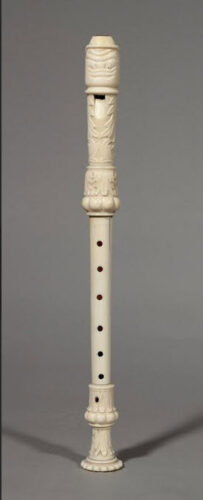
- Soprano recorder, ivory, attributed to Johann Benedict Gahn, Nuremberg, c. 1710. Gahn apprenticed in ivory turning and began producing recorders and oboes as early as 1698. According to a museum listing, he is best known for extravagant ivory recorders like this one, adorned with meticulous carvings of a mask and acanthus leaves.
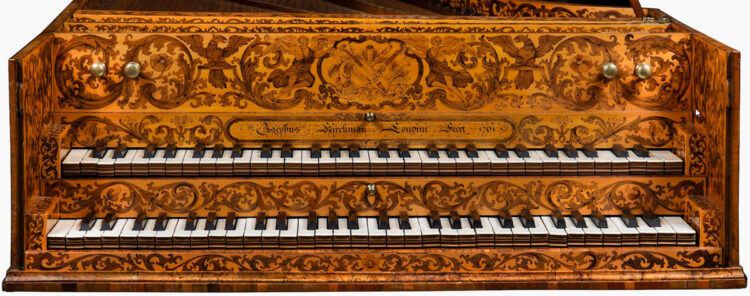
- Double-manual harpsichord, Jacob Kirkman, London, 1761, wedding gift of George III to Charlotte of Mecklenburg. As a child on tour, Mozart performed on it for the royal family. Kirkman was one of the two leading harpsichord makers in England in the latter half of the 18th century.Marlowe Sigal purchased this beautiful instrument, with its intricate decorative marquetry and royal pedigree, in 1987.
- Grand piano, John Berent, Philadelphia, 1775. In an in-depth paper published by the American Musical Instrument Society, Strange and a co-author offered proof that this is the first grand piano crafted and sold in what would soon become the United States. The instrument was donated in 2021 by Nicholas Giordano, professor of physics at Auburn University and author of the book, Physics of the Piano.
- Square piano, John Joseph Merlin, London, 1783. First a clockmaker and later an inventor of intriguing instruments, Merlin created innovative designs, such as one that combined a fortepiano with a harpsichord. In 1783, he opened Merlin’s Mechanical Museum on London’s Hanover Square. Koster called him a “mechanical genius” and cited this instrument as one of the highlights of Marlowe Sigal’s “great collection.”
- Piano, Johann Stein, Augsburg, Germany, 1784. Stein, who contributed some important innovations to the development of the piano, was friends with Mozart. Strange told me how the composer wrote admiringly of this keyboard maker in an oft-quoted letter to his father: “There aren’t that many working Steins left in the world and this is a really fine example.”
- 11-key alto saxophone, Adolphe Sax et Cie., Paris, ca. 1860. Adolphe Sax, a Belgian musician whose innovations include a redesign of the bass clarinet that is still in use, invented the saxophone in the early 1840s and patented it in 1846. The Sigal Museum has a complete set of original Sax instruments from Marlowe Sigal, including the sopranino, soprano, tenor, baritone, and bass saxophones.
Strange envisioned what is now the Sigal Museum in part as a repository for his own noted collection of some 50 early keyboard instruments, a pursuit that sprang from his interest in historical engineering.
A South Dakota native, Strange is a material scientist and inventor who holds more than 60 patents. He moved to Greenville in 1996 to take advantage of its skilled work force and start a company that would capitalize on technology he developed to shrink implantable medical devices like pacemakers and defibrillators.
‘Jumped on a plane, bought it with cash’
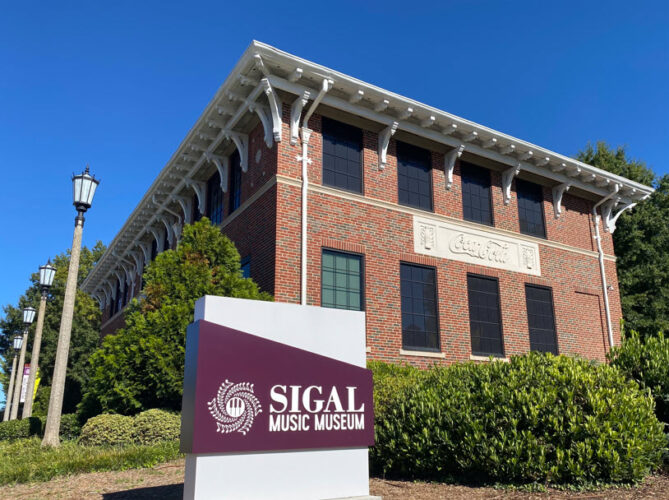
The museum, which has a six-member staff and an annual budget of about $600,000, is housed in a 1930 building that was once part of a regional Coca-Cola bottling plant. The most prominent feature of the rectangular brick building is its ornate cornice with its carefully spaced, curved supports. The two-story structure, which is owned by Greenville County, was renovated in 2004 by Bob Jones University for an off-campus museum and gallery. That facility remained in operation for about 10 years.
Once the space became vacant, Strange and the museum’s two co-founders, Steve Bichel and Beth Marr Lee, presented their vision to the county board. The local government agreed to lease the building for $1 a year, as long it remains open and continues to engage the public with its exhibitions and programs.
About 5,000 of the building’s 8,000 square feet is devoted to exhibitions. The museum must display its grand pianos on the first floor because they are too large to fit into the old building’s elevator.
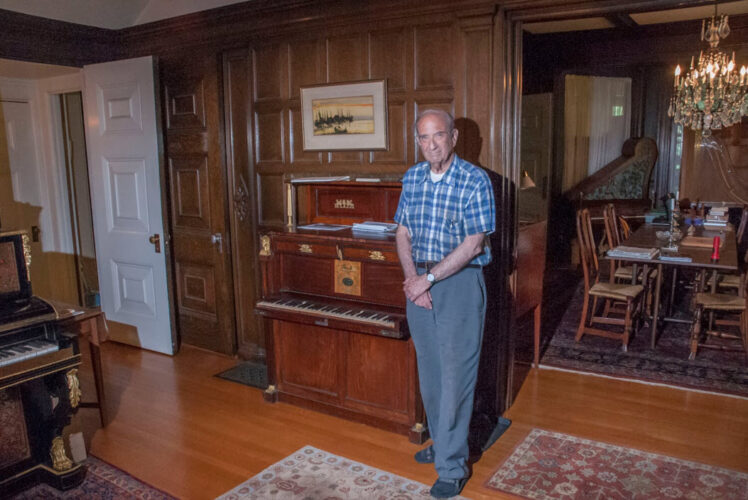
Marlowe Sigal, who owned a Boston company that provided chemicals for specialized photo processes, got interested in musical instruments after reconstructing a reed organ as a teenager and began collecting them in the 1970s. The Newton, Mass., collector bought instruments at auctions in North America, Europe, and on-line. He was quick to seize any opportunity to expand his holdings. Darcy Kuronen, from the Sigal advisory board, knew Marlowe Sigal well. He recalls once getting a tip about an early American bassoon that was for sale in Los Angeles — only to learn that Sigal had already jumped on a plane and bought it with cash.
When Sigal died in May 2018, his family began looking for a museum that might take his collection as a whole — a commitment that most institutions were not willing to make. But the then-Carolina Music Museum, still in its fledgling stage, was in a position to accept the entire holding. “It was extremely fortunate for us that it became available when it did.” Strange said.
An agreement was reached in 2019, and, in the fall of that year, 13 trucks transported Sigal’s collection to Greenville over 13 weeks, with keyboard expert Koster helping to oversee the process.
The next steps for the museum, Strange said, are the development of a study and engagement center, which would be essentially a storage area that will allow researchers and students access to the parts of the collection not on view.
Strange is actively seeking a site for such facility, researching public-private partnerships and raising the necessary funds “It’s too early to say just at the moment,” he said, “but I’m on the cusp of what I think would a very good solution to this. So, stand by for news.”
Kyle MacMillan served as the classical music critic for the Denver Post from 2000 through 2011. Now a freelance journalist in Chicago, he’s written for many publications, including the Chicago Sun-Times, the Wall Street Journal, and Chamber Music. For EMA, he recently reported on Bach in the City, Chicago’s newest period-instrument ensemble.