by Clare Stevens
Published February 22, 2026
Beyond Borders, the theme of the English festival’s 50th anniversary, is a celebration of how far early music has traveled
‘We have aimed to make important scholarship come to life through vibrant and sometimes bewildering performances’
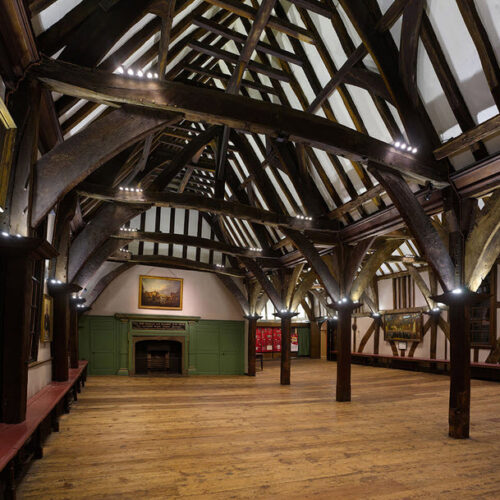
You can hear John Dowland’s “Lacrimae” and some of his more joyful dances from the Rose Consort of Viols, performed in the undercroft of the medieval Merchant Adventurers Hall. York’s businessmen have been meeting here for more than six centuries.
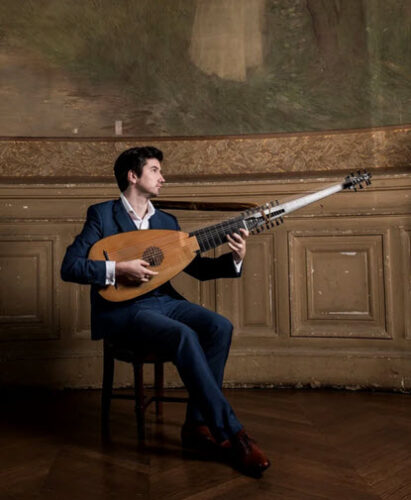
Dowland died in 1626, and on this 400th anniversary you can celebrate Dowland Day and explore his life and music in Bedern Hall, the refectory of York Minster’s College of the Vicars Choral used from the 1390s until the middle of the 17th century. Star lutenist Thomas Dunford’s program includes “Flow my teares” and the melancholy self-portrait, “Semper Dowland semper dolens.”
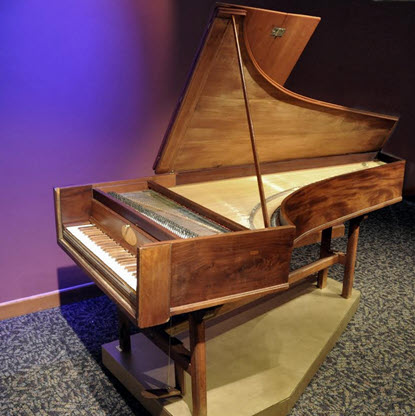
You can marvel at one of the most exceptional collections of medieval stained glass in England as you listen to Stephen Devine playing clavichord music by Krebs, Beethoven, and the Bach family in All Saints Church. You can hear music for solo voices, strings, and harpsichord in the stunning acoustic of the Minster’s Chapter House, and in the great cathedral itself The Sixteen will sing music from the Spanish Renaissance. Or contrast the soundworld of early 17th-century Venice with the architecture of a late 20th-century university campus as you listen to I Fagiolini and the English Cornett & Sackbutt Ensemble in Monteverdi’s Vespers of 1610 in the Sir Jack Lyons Concert Hall.
All these experiences and much more will be on offer in York, England, July 3-11 at the 50th anniversary York Early Music Festival (YEMF).
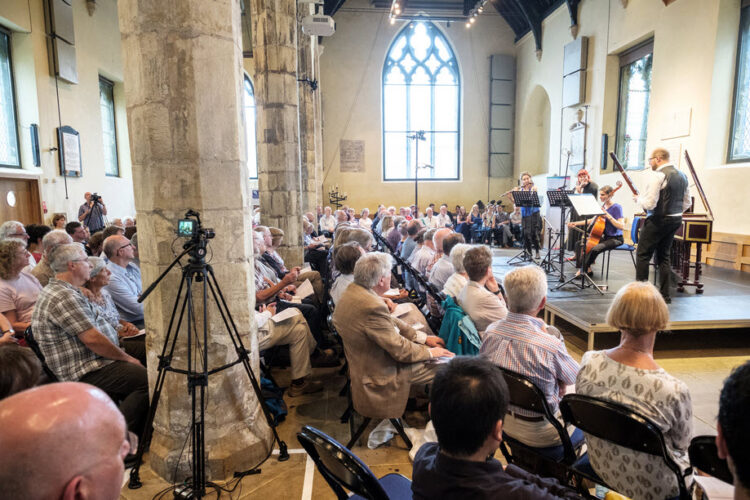
Beyond Borders is the theme of this year’s festival, interpreted very liberally to celebrate how far early music has traveled.
I was intrigued to learn from Delma Tomlin, director of the National Centre for Early Music (NCEM) which runs the festival, that it has similar roots to the Huddersfield Contemporary Music Festival, based on the other side of the Pennine hills. Both festivals were founded on new academic campuses in the 1970s, driven by the enthusiasm of performers, scholars, and audiences for two very different but often complementary strands of music. Each seems to lend itself to discovery and exploration. (Richard Phillips, who died last month, at 85, is credited as founder of both festivals: York in 1977 and Huddersfield in 1978.)
“Our 1977 event contained all the seeds that have grown and flourished,” says viol player John Bryan, emeritus professor at the University of Huddersfield, and today one of the early-music festival’s artistic advisers.
“Then as now, the aim was to shine a light on music that was still being discovered in libraries and archives, alongside what we now tend to call ‘historically informed’ performances of familiar pieces by better known composers,” he adds. “Throughout our 50 years we have aimed to make important scholarship come to life through vibrant and sometimes bewildering performances.”
An Ancient Church Remade
The history of the festival is closely entwined with the recent history of medieval St. Margaret’s Church, Walmgate, one of five redundant churches that were taken over by the York Civic Trust with a view to putting them to appropriate uses. They were lent on 99-year leases, at peppercorn rents and with minimal repairing obligations; one became an archaeological resource center, another a meeting place for older citizens. At the time, St. Margaret’s was a properties storehouse for York Theatre Royal. The Civic Trust offered it to the York Early Music Foundation, which had been formed in 1994 to provide support, greater financial certainty, and continuity for the festival by promoting additional events year-round and developing a strong educational program. But instead of a straightforward refurbishment, St. Margaret’s became a complex development project. (The remarkable details of how an ancient church in a narrow medieval street was turned into a national resource center can be found on the NCEM website.)
In April 2000, the National Centre for Early Music was formally opened with a weekend of concerts and educational workshops. Since then, St. Margaret’s has proved to be a welcoming space for study and performance. It is the primary social and administrative hub of the festival, and this year will host a wide variety of talks and performances. They include Haydn in the Cracks, a presentation by instrumental ensemble Anacronía of repertoire by composers such as Haydn, C.P.E. Bach, and the Spanish composer Juan Oliver Astorga that would have been heard in the 18th-century salon concerts of London’s Bach-Abel Society. The Music Party is a selection of instrumental and vocal music by Handel, Arne, Sammartini, and the Scottish cellist and composer James Oswald — a program inspired by Philippe Mercier’s 1733 painting of Frederick, Prince of Wales playing chamber music with his two sisters, and performed by the University of York Baroque Ensemble with Ensemble Hesperi.
Not least, there’s the 2026 York Early Music International Young Artists Competition. Prizes include a professional CD recording contract (from Linn Records) and opportunities to work with the NCEM and BBC Radio 3.
St. Margaret’s also hosts a showcase performance by Minster Minstrels, NCEM’s ensemble for school-aged musicians. Their program of dances and concerti grossi by Holborne, Handel, Telemann, and Vivaldi will explore the changing relationship between soloist and ensemble. Younger children are catered to with Mini Magic Flute, an introduction to Mozart’s opera aimed at 4- to 7-year-olds and presented by Opera North.
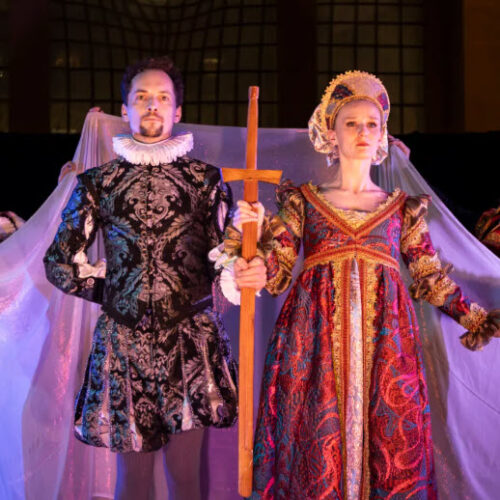
Music spills out onto the city’s streets and open spaces, too, with events such as The Great Noyze, when wind and percussion players from across Europe will gather under the auspices of the International Guild of Town Pipers. There will also be the York Mystery Plays, biblical stories from Creation to the Last Judgement, presented by York Festival Trust on wagons at “stations” around the city, just as they were in medieval times.
Other highlights include the Belgian collective B’Rock Orchestra and Vocal Consort’s Da Pacem, a presentation of sacred music by Heinrich Schütz and his contemporaries that was composed around the Thirty Years War, which decimated Central Europe between 1618 and 1648 — songs of lament and jubilation, and songs that describe everyday life in the midst of horrific battle and senseless pillage. With the festival theme of Beyond Borders in mind, the performance then zooms out using electronic soundtracks and field recordings to look at how environments regenerate after periods of brutal human conflict — how does nature restore or reinvent itself?
High Standards, Open Minds
Delma Tomlin has run the niche early-music festival since 1985, having arrived in York three years earlier to work on the city council’s much larger, multi-disciplinary arts festival. What appealed to her at the time, and still does, she says, is the enthusiasm that audiences have for early music — their interest in the research and their eagerness to get involved themselves, to have a go at playing or singing unfamiliar repertoire. She recalls with affection the early days of YEMF when performers like Anthony Rooley and Emma Kirkby had opened up this new world to people and the boundaries between amateurs and professionals were very fluid.
“It was all very joyous, and we do aim to maintain that feeling with our encouragement of young artists,” she says. “Professionalism of the administration and facilities has been a major change over the 50 years. People now expect to be able to get a cup of coffee or a drink, to have modern, clean lavatories, to be able to access the venue easily even if they have mobility issues — that’s all part and part of the experience now, in a way that it didn’t need to be when we were all full of the joy and excitement of discovering early music for the first time.”
Asked how the artistic program and perceptions of early music have changed across her tenure, Tomlin cites improved performance standards as the main difference: “These days everyone can really play.” But attitudes have also changed, with audiences becoming more open-minded. “Thirty years ago, if we put a ‘modern’ piece into a festival concert people would have been outraged, but now the NCEM runs a Composers’ Award. We regularly put new music into our programs but, of course, it’s by people who are used to writing for Renaissance instruments and understand them and can produce glorious results. So, in a way, we’re moving our audience forwards, to the 21st century and beyond.”
General booking for the festival opens February 23.
Clare Stevens is a freelance writer, editor, and amateur choral singer based in the Welsh Marches. She is a regular contributor to Choir and Organ, BBC Music magazine, Classical Music and Music Journal, the magazine of the Independent Society of Musicians.