by Anne E. Johnson
Published February 22, 2026
The Lambeth Anonymous: Recordings from the Arundel Choirbook. Iken Scholars, Matthew Dunn. Rubicon RCD1217. 2 discs. Total time 1:34:39
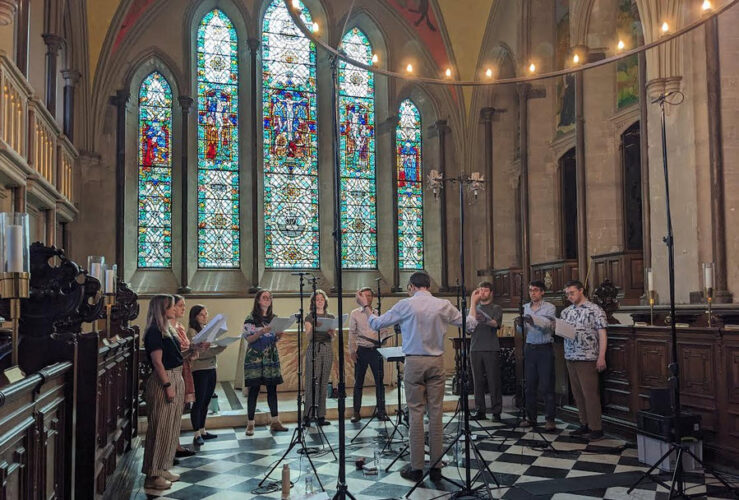
In the early 16th century, an illuminated manuscript containing English sacred music was assembled. It is known both as the Arundel Choirbook, after the college in Sussex where it was created, and the Lambeth Choirbook, after the library where it’s housed. On its pages are important polyphonic Masses and other works by Robert Fayrfax, Nicholas Ludford, and a few lesser-known composers. In this new album by the Iken Scholars, under the direction of Matthew Dunn, the focus is on seven anonymous pieces found in the choirbook. All seven are world-premiere recordings.
The Iken Scholars are a 17-voice SATB chamber choir. Dunn describes the group as committed to performing works from the “hidden corners of Renaissance polyphony.” They even managed to record this album in Lambeth Palace Chapel itself. Whatever logistics that feat required was well worth the effort. The sound flies angelically around that space, its flight captured admirably — reverberant yet not marred by echoes — by producer Jeremy Summerly.
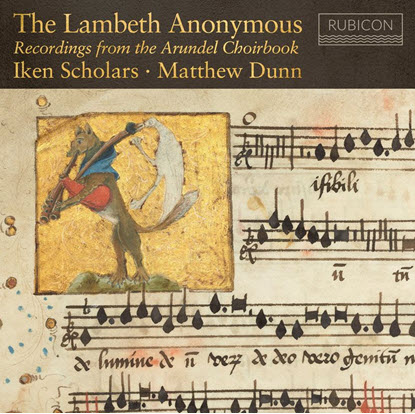
The three-movement setting of the Salve Regina that opens the album establishes the Lambeth anonymous’ material — we’ll never know if it’s by one writer or more — as top-flight compositions of the same quality as those of the known composers. Likewise, the choir proves itself solidly up to the challenge. The sopranos have a motive of a repeating upward jump, at the top of their range; it’s on the nose every time, yet those six high voices don’t overwhelm the four altos whose line they sing in counterpoint with. The performance is confident and balanced.
Arguably the most significant discoveries here are the two Magnificat settings. These are mighty works, with ringing counterpoint designed to fill a church’s nave clear up to the dome. Magnificent, indeed, is the soaring high-voice writing in the line “Fecit potentiam in bracchio suo” (He has showed strength in his arm) in Magnificat I. The gifted unnamed composer knew how to create effective contrast by giving “Esurientes plevit bonis” (He has filled the poor with good things) to just the tenors and basses. Magnificat II applies more complex imitative techniques and modal switches, especially in the final section.
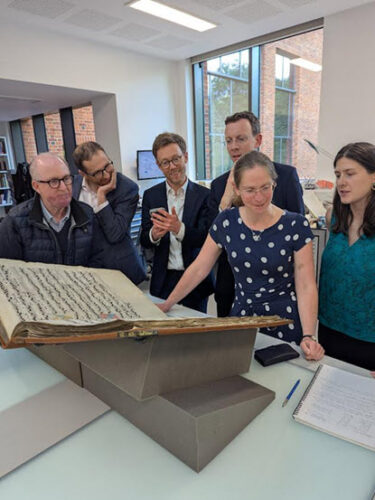
The other anonymous works are equally well crafted and finely sung: an Ave dei patris in three sections, and settings of Ave mundi spes Maria (its first movement has some brief but fun dissonances), Vidi aquam egredientem, and Gaude flore virginali. All are lustrous examples of the flowering of the Renaissance in English music.
Early-music enthusiasts may be surprised by the Iken Scholars’ use of vibrato, which is practically deemed a poison by some in the “authenticity” business. But this vibrato sounds natural and not at all egregious or disruptive. The singers’ intonation is generally quite reliable and, surely most important, the singing is always fluid and expressive.
This album is worth listening to purely for its beauty. But by sharing these pieces with the world, Dunn and company have also made an important contribution to our understanding of the development of English sacred polyphony, which always had a special richness, distinct from what was being written on the European continent. Too bad we can’t credit the artists who wrote these fine works.
Anne E. Johnson is EMA Books Editor and frequent contributor to Classical Voice North America. She teaches music theory, ear training, and composition geared toward Irish trad musicians at the Irish Arts Center in New York and on her website, IrishMusicTeacher.com. For EMA, she recently reviewed Ensemble Galilei’s mix of trad and early music.