by Aaron Keebaugh
Published March 2, 2026
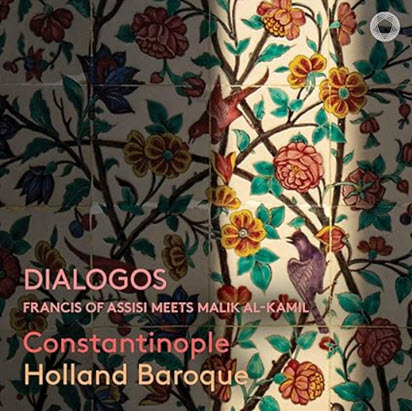
Dialogos: Francis of Assisi meets Malik al-Kamil. Constantinople and Holland Baroque. Pentatone PTC 5187493
The lower level of the Basilica of Assisi houses a peculiar relic that symbolizes a miraculous meeting between leaders of opposing faiths during a time of war. An ivory horn, used to announce battles and major events in Islam, had been a gift to Francis of Assisi from Sultan Malik al-Kamil, leader of the Muslim forces defending a city at the edge of the Nile from invading crusaders.
Saint Francis had preached against the Crusades and had ventured to Egypt, barefoot and unarmed, in mid-1219 to halt the fighting. When few listened to his pleas, he crossed the Nile in September to meet the sultan at his camp in Fariskur. What transpired at their meeting has been lost to history, though several Christian sources reported vastly different outcomes. In some, Francis tried to convert al-Kamil to Christianity. In another, he tested the sultan to an ordeal of fire. But the meeting has survived as a symbol itself: Francis remained in the sultan’s presence for several days, and they parted on good terms.
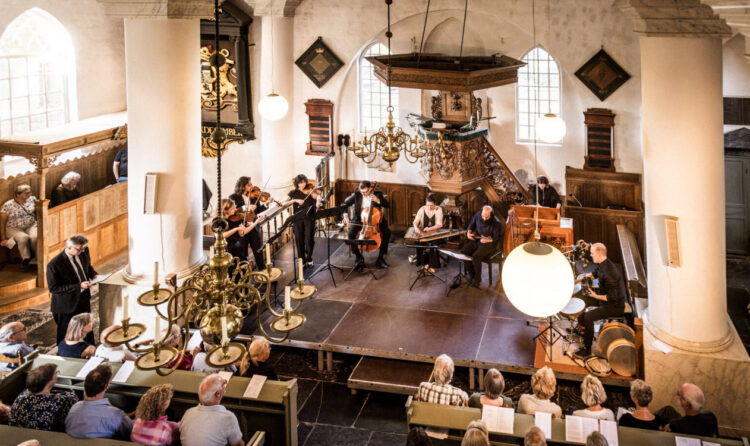
It’s no surprise that many still view the event with hope that reaching across divisions formed by vastly different politics and faiths is never time wasted. So think the period-instrument ensembles Constantinople and Holland Baroque, who join forces with Dialogos, which seeks the common ground between East and West as much as the old and new. Played with verve, the music on this disc suggests that bridging gaps takes humility and courage.
Many of the newly composed pieces on the album are based on Medieval poems, like the 13th-century writer Laudario di Cortona, Arabic poet Sa’di, and Francis’ own Canticle of the Sun. Yet the music remains as fresh as today’s news. Composers Judith and Tineke Steenbrink, who perform with Holland Baroque, treat the texts sensitively as they combine the sounds of the Baroque orchestra with Middle Eastern instruments like the setar (a Persian three-stringed lute) and kanun, both of which produce a haunting twang. Constantinople’s Didem Başar and Kiya Tabassian also explore these vastly different worlds through pieces that never come across as overly sentimental or cliche. Rather, the essence of these musical syntheses shines through themes of love, praise, and developing trust.
Each work reflects a conversation geared toward peace and reconciliation. Tineke Steenbrink’s Walking in the Desert, based on texts by Sa’di and Francis, suggests that the task will be far from easy. Undulating strings support free-flowing vocals before everything builds to a din. The tensions conveyed in this song of praise even carry into the ensuing silence. But Judith Steenbrink’s Welcome finds sudden joy through its 14th-century text that recalls the opening to Benjamin Britten’s Ceremony of Carols. Steenbrink’s canvas is pricklier, even as the music dances in its rollicking mixed meter.
Other works generate solace and mystery. Heaven lives in the other, Judith Steenbrink’s refashioning of music by 17th-century composer Dimitrius Cantemir, tells of two people leaving as friends following bitter conflict. Glistening harmonies frame the setar’s plucked figures to celebratory effect. Similarly, the sweeping assurances of Tineke Steenbrink’s Frate Vento, based on texts by 20th-century poet Forough Farrokhzad, creates an uneasy stasis. Vocalist Tabassian eases these tensions with a warm but distant tone. Angelus Bells, a hymn to the Virgin Mary, suggests both yearning and reverence through its washes of dissonance.
Tabassian’s Bood Amma Naboud relays the pains of lost love. Strings and percussion channel the emotional turbulence through slowly churning rhythms. Overhead, Tabassian’s gravelly voice captures as much longing as lingering desire. Dream of Hope, another of Tabassian’s scores, balances calm and exuberance as the music builds and fades. Yet the energy never abates; rhythms course like an electric shock.
That’s also the effect conveyed in Başar’s Echoes of the Throne Room, a musical meeting-of-the-minds that never quite settles into an equilibrium. A steady rhythm emerges from silvery string harmonies that only heighten the musical restlessness. Rippling harp figures lighten the emotional load by adorning the line like gold trim on marble. Ali Ufki’s Muhayyer Semai also blazes at a slow burn. Free-floating passages generate suspense before the strings break into whip-crack filigree. The musicians play it all with the verve of a village band.
Two more works by Judith Steenbrink conclude this musical meeting in prayerful serenity. Lauda, with its smooth sonorities, is a plaintive cry for peace. Sia laudatory San Francesca turns the focus back on Francis as it compares his deeds to those of Christ. Playful and joyous, the music is both a parting gift and timeless reminder: when faced with overwhelming differences, the bravest thing one can do is just listen.
Aaron Keebaugh’s work has been featured in The Classical Review, Corymbus, The Boston Musical Intelligencer, The Musical Times, and The Arts Fuse, for which he serves as regular Boston critic. For EMA, he recently reviewed forgotten treasures from Quodlibet Winds.