by Steven Silverman
Published March 6, 2026
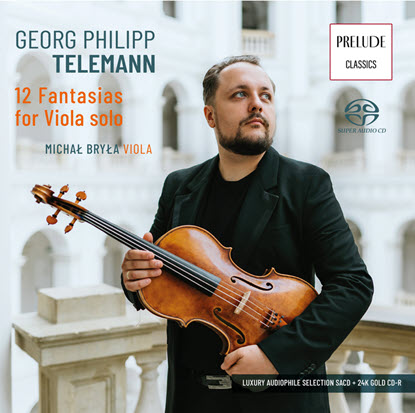
Georg Philipp Telemann: 12 Fantasies for Viola Solo. Michał Bryła, viola. CD from Prelude Classics; download from NativeDSD.
This recording is Michał Bryła’s highly rewarding transcription for viola of Telemann’s 12 Fantasies for viola de gamba (TWV 40: 26-37). For Baroque violists looking for new solo repertoire for their instrument, this is a rather stunning find.
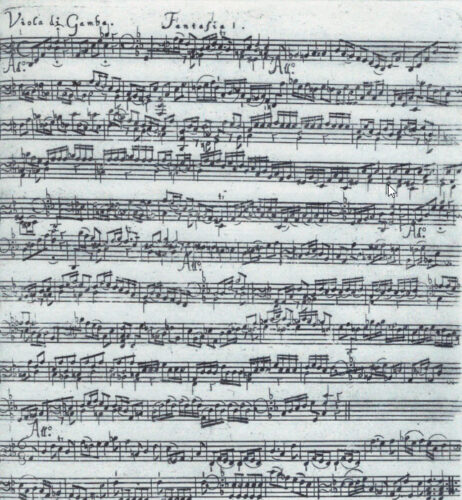
The gamba fantasies were published in 1735-36, roughly contemporaneously with the composer’s sets of a dozen fantasies each for solo flute and for solo violin. Notwithstanding their known publication, the gamba fantasies disappeared until rediscovery of a copy in 2015.
The gamba fantasies are musically strong. Each of the dozen is a multi-movement work, of contrasting moods and contrasting tempi — sometimes fast-slow-fast, but also slow-fast-fast or, as in the E-Major Fantasy, multiple tempi within a single movement. Each fantasy is in a different key (covering every degree of the scale except C-sharp and A-flat), and all of the slow middle movements are in a contrasting key from the fast outer movements.
The title “fantasy” seems to refer to a form outside the norm of the sonata da chiesa or the dance suite, although a number of Telemann’s movements have dance qualities, and the final movements of the C and D minor fantasies are gigues. These are not fantasies in the declamatory, quasi-improvisatory style of, say, C.P.E. Bach. Rather, each movement (with the exception of certain slow movements serving as a bridge) has a return to the opening theme in the home key, sometimes in a bi-partite form, sometimes in an A-B-A form, and sometimes after quasi-development of the opening material.
What is fantasy-like is the range of harmonic interest, where remote keys get more than the occasional visitation. The Grave movement of the F-Major Fantasy, for example, begins with a sequence starting with tritones which resolve ambiguously, and it follows an opening movement with a markedly chromatic main theme. The “fantasy” writing also includes multiple affects within a single movement, and the extended passages of virtuosic writing — complex chords, extended arpeggios, rapid figurations — often bursting suddenly out of seemingly staid surroundings.
The range of emotion in these pieces is striking: lyric Andantes (e.g. the B-minor inner movement of the D Major Fantasy; the G-minor Fantasy’s opening movement with a refrain which sounds like Domenico Scarlatti; finales which are jaunty or even whimsical; and even some borderline despair, such as the inner movement of A-Major Fantasy. And all this in pieces whose total duration (i.e. of all movements combined) is a mere 5 to 7 minutes!
Michał Bryła’s transcription is strong, despite the limitations of moving from a six-stringed gamba to a four-stringed viola. In his program notes, he mentions the necessity of certain modifications, including to notated chords, and to passages outside the viola range which he transposes to upper octaves. The chordal variants all worked naturally, although we do get several movements ending, delicately, on a dissonance — a fourth — where the gamba chord could not be fully realized.
The upper octave extensions work brilliantly: the finish of the opening movement of the B-flat Major Fantasy in a high octave being especially effective. (One curiosity was his decision not to observe a notated de capo in the opening movement of the F-Major Fantasy, so that his performance ends in D minor without a return of the original thematic material or of the home key.)
A Polish violist, chamber musician, and record producer — he owns the Prelude Classics label — Bryła’s playing also works brilliantly. These performances are alive. His playing is virtuosic as all get-out, and not just in matters of dexterity (impeccable), projection of polyphonic writing (clear as day), and intonation (also impeccable, including in the many double stops). He has enviable control of dynamics, nuance, and color as well, to notably expressive effect. Plus, he’s got imagination to burn.
In Bryła’s hands, these movements have markedly different affects. Kudos also for the vivace second movement of the G-minor Fantasy: big conception, climactic playing, exciting. (One of the recorded gambists I’ve heard does manage to do him one better on the color front, once, playing the repeat of the slow movement of the C-Major Fantasy pizzicato.)
As a modern player, Bryła uses a lot of vibrato, pretty much everywhere, and takes bracingly fast tempi. He likes to speed up when arriving at rapid figurations. Indeed, this gesture becomes a little too predictable, notwithstanding all the associated verve. He also may regard the title “fantasy” as a signal for rhythmic license. His rubatos mostly work, since rhythmic freedom is usually preferable to metronomic regularity.
However, he starts some of the movements with rhythmic instability from the get-go which is problematic. Telemann begins the dolce movement of the G-Major Fantasy with three eighth notes going over the bar to a longer note, but Bryła varies the length of the individual eighth notes. Something similar happens in the opening Andante of the Eb major Fantasy, which starts with a stately theme in even eighth notes, but Bryła varies these notes’ lengths. I found this to be confusing.
These minor reservations do not diminish a stellar overall achievement. Bryła comes from a family of fine musicians — violist grandfather (whose arrangement of a movement from a Telemann violin fantasy graces this recording as a sort of coda), and parents, sister, and wife all of whom are performing musicians. This fine recording is thus in the great family tradition.
Steven Silverman is a pianist and harpsichordist whose performances include concerts at Weill Hall in New York City and the Salle Cortot in Paris. He and his wife, the violist Nina Falk, are co-founders of the Arcovoce Chamber Ensemble, now in its 26th season. For Early Music America, he recently reviewed Jean Rondeau and the complete Louis Couperin.