by Karen M. Cook
Published December 15, 2025
Summa Leticia: A Survey of Nova Cantica in France, c.1100-1300. Ensemble Peregrina & Ensemble Gilles Binchois. Ediciones Singulares ES 9001, a two-disc set.
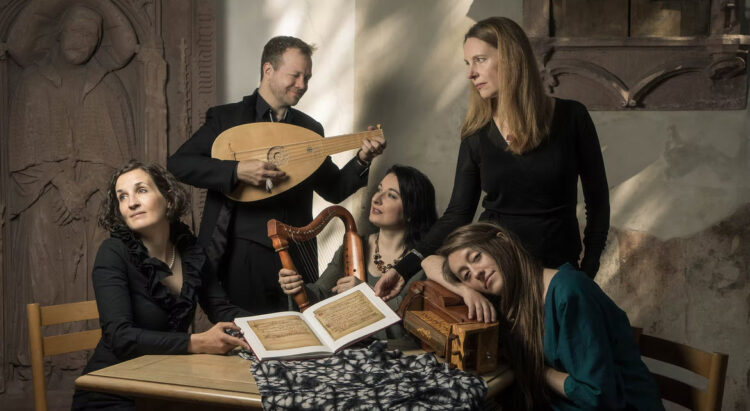
In the press surrounding the latest release by the esteemed Ensemble Peregrina and Ensemble Gilles Binchois, Peregrina’s director, Agnieska Budzińska-Bennett, described the double recording as “a sleeper agent.” An unusual announcement, but not inappropriate — especially given that the combined tracks were recorded in 2015 and 2018, respectively. Budzińska-Bennett even noted that in the decade since its recording, she has taken part in almost 30 other albums. It is unclear why this new release took so long to enter the public ear. Whatever the reason, the result is nothing short of impressive.
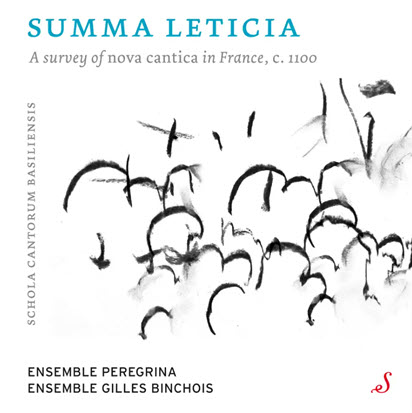
In equal parts homage to the landmark 1990 album Nova Cantica (which drew in particular on the work of scholar Wulf Arlt) and to the decades of subsequent scholarship (Arlt’s included) that elucidates this repertory, each ensemble in this recording presents its own full album. Disc 1 is Peregrina’s Nova gaudia — new songs from the earliest Aquitanian sources. Its material is drawn from one manuscript, Paris 1139, which is generally thought to be the oldest surviving witness to this new musical repertory. The second disc, Res iocosa, is the contribution of Ensemble Gilles Binchois. Their array of repertory, however, stems from across what we now know as France and was transcribed from a variety of manuscript sources.
Outside the difference in repertory, the albums have another fundamental difference, in that disc 1 features only female voices (inspired by possible links to convents such as Las Huelgas), whereas disc 2 has mixed voices, since this material might originally have been shared between male and female establishments. Such possible historical contexts are reviewed in admirable depth in the accompanying materials, which are more of a short book than what one would consider liner notes.
The primary consultants, including scholars Wulf Arlt and David Catalunya, contributed individual essays that speak to the nature and contexts of the manuscript sources, the repertory and its texts, the choices made in performance, and so forth. What the careful reader will glean from this treasure-trove of essays is that the material presented on these albums really was new: new song forms, new texts, novel approaches to harmony before rules for rhythm and organization became more fixed, even new approaches to written notation. Such music flourished only for a short time, later eclipsed by even-newer musical approaches; the ambiguity in the notation for the works on these albums has proved a barrier toward more frequent performance.
But such ambiguity also offers modern performers a delightful opportunity for play and experimentation, for imagining what might have been possible then and what might be musically convincing now.
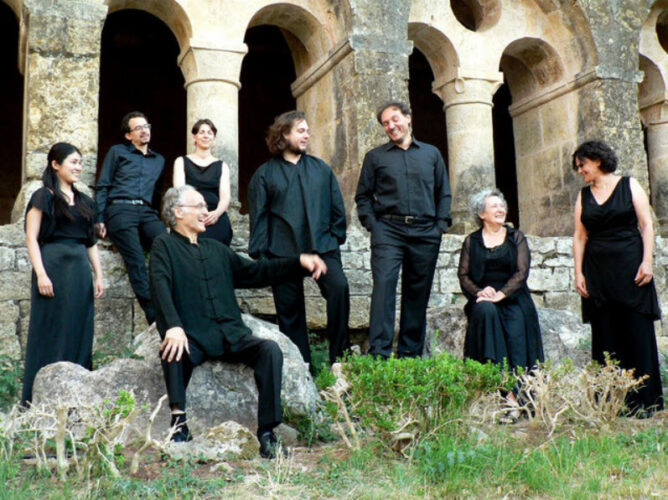
Steeped in decades of careful exploration, these performances are rich and robust. Budzińska-Bennett’s voice soars, flexible and strong, over the deliciously united ensemble (listen, for example, to the opening “Promat chorus hodie,” or the stunning “Lectio Libri Sapiente/In omnibus requiem—Be deu hoi mais”). Ensemble Gilles Binchois, in comparison, feels a bit more emotionally reserved at times, but certain tracks like “Quanto decet honore” and “Dulce melos” nicely bring out the novelty of this repertory, and the alternation between monophony and polyphony in “Lux optata claruit” is particularly effective. It’s a most welcome set of discs, and may we hope it does not take them another decade to approach this material again.
Karen M. Cook is associate professor of music history at the University of Hartford. She specializes in late-medieval music theory and notation, focusing on developments in rhythmic duration. She also maintains a primary interest in musical medievalism in contemporary media, particularly video games. For EMA, she recently wrote about Musica Secreta’s Record of Love