by Eli Jacobson
Published February 17, 2026
Performance Review: the U.S. premiere of Death of Gesualdo, performed by the Gesualdo Six and Concert Theatre Works at New York’s Cathedral of St. John the Divine. Conceived and directed by Bill Barclay.
In recent seasons, writer-producer Bill Barclay’s Concert Theatre Works has collaborated with the British vocal ensemble the Gesualdo Six in Secret Byrd, dramatizing Catholic persecution in Tudor England. That production, often performed in church crypts by candlelight, traveled across the U.S., selling out seemingly everywhere. Their newest project, Death of Gesualdo, a biographical fantasia on the life of the notorious Renaissance composer, had its American premiere last week, on Friday the 13th, at New York’s Cathedral of St. John Divine. It was under the auspices of the Music Before 1800 series, which Barclay briefly led. Co-commissioned by MB1800, London’s Church of St. Martin-in-the-Fields, and York’s Centre for Early Music, Death of Gesualdo was first performed last month at York Cathedral. As anticipated, the New York performance was sold out.
Carlo Gesualdo is the dark prince of Renaissance music. Knowledge of his sordid life is essential to appreciating this show, which is set to music from his secular madrigals and sacred works. Born to the Prince of Venosa and originally destined for an ecclesiastical career, he studied music passionately from a young age. The death of his older brother made him the successor to the throne. He married his first cousin, Maria d’Avalos, with whom he had one son. In 1590, tipped off by servants about his wife’s affair with the Duke of Andria, Gesualdo caught them in flagrante delicto and murdered them both, mutilating their corpses. But he was found not guilty by reason of his noble status and the crime being labeled an “honor killing.”
Despite a horrible reputation, Gesualdo went on to form new political alliances, marrying a second time to Leonora d’Este and fathering another son. But Gesualdo descended into bouts of severe depression with his obsessive guilt and religious penitence assuaged by ritualistic, perhaps sadomasochistic, beatings by his servants. He kept two mistresses — both were later accused of witchcraft by the Inquisition. The only thing that kept him relatively sane was his music: mostly dark, brooding mannerist madrigals sung by a consort of singers he maintained in his palace. These madrigals often depict the Passion of Christ and it seems that Gesualdo identified his own anguish with the sufferings of Christ, somewhat ironic given the differences in their class status and moral character.
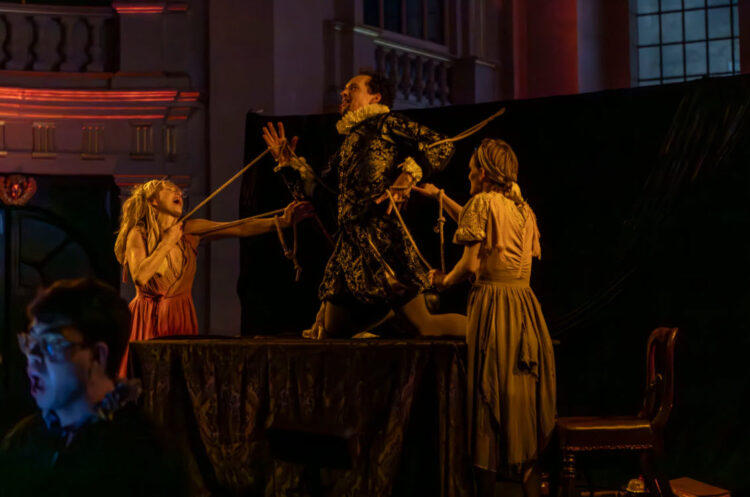
As writer and director, Barclay depicts these life events using six silent actors (three women, three men) elegantly costumed in Renaissance attire by Arthur Oliver, with choreography by Will Tuckett. The story unfolds in a series of tableaux vivantes against a musical backing of melancholy minor-key madrigals on religious texts (with one interpolated piece, Monteverdi’s “Piagn’e Sospira”). The show begins with Gesualdo (actor Markus Weinfurter) laid out on a bier, either dying or freshly expired, while his second wife and a cardinal stand vigil. A puppet depicting the young Carlo Gesualdo appears (puppetry by Janni Young) and enacts his childhood and adulthood in flashback, taking our composer from cradle to grave, from innocence to depravity, in 85 minutes.
I found these tableaux illustrative rather than dramatically illuminating — it was a series of episodic events with no insight given as to Gesualdo’s character or development. The religious texts of the madrigals had no correlation to specific events occurring onstage, merely providing a sinister and brooding movie soundtrack. It looked pretty but the lighting was low and, given the distance from the stage and the lack of unblocked sightlines — a low stage and unraked seating in the cathedral’s nave — it was hard for the audience to make out much of what was going on. One saw and listened, one admired, but one did not feel emotion. Prior knowledge of the composer’s tortured life was needed to identify who the actors were playing and what was transpiring.
Indeed, ahead of the show’s world premiere, Barclay published an essay in the Guardian, reprinted as program notes, outlining his aims: “As for Death of Gesualdo, it may reveal nothing about him. It could reveal something about me. If it’s any good, neither should matter, because it will reveal something truly important about you.”
Smart use of props (designed by Justin Seward) helped matters — a wooden cruciform provided the protagonist with a crucifix, a lute, a sword, and even a phallic symbol representative of the warring elements of religion, sex, violence, and music in his life.
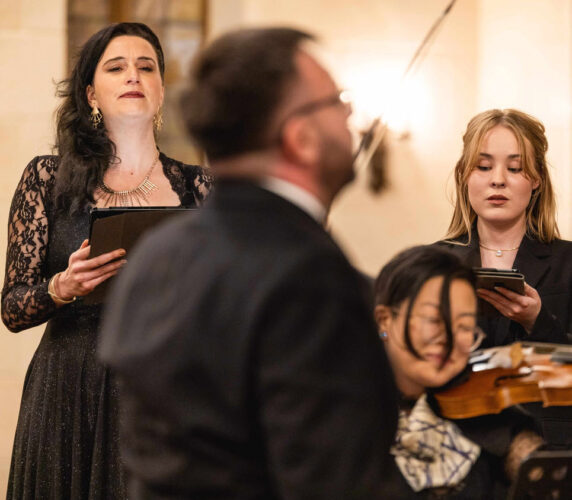
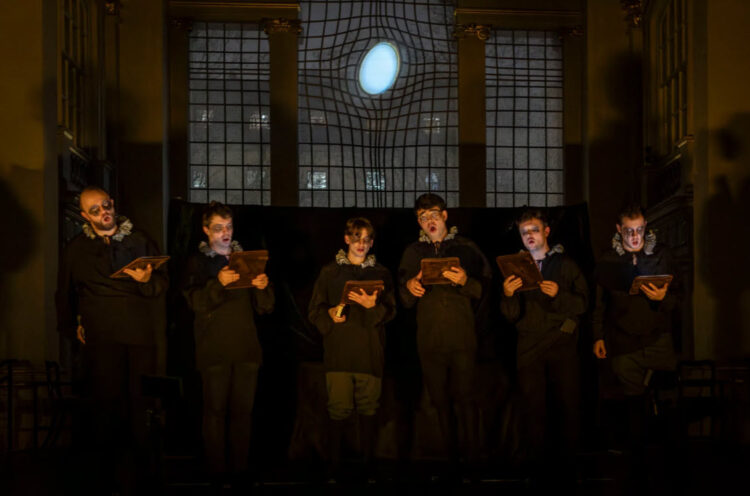
Musically things were much better. I was surprised and delighted by the rich sonority and harmonic complexity of the purely vocal accompaniment of the six voices (two sopranos, one alto, two tenors, and one bass) which provided a complete musical palette with no need for instrumental support. The pure tuning of the Gesualdo Six, dressed in black with ghoulish dark eyes like ghostly witnesses, and the cathedral’s resonant space illuminated the composer’s stark chromaticism and advanced use of dissonance.
Eli Jacobson has written reviews and articles, mostly on opera, for Gay City News, New York Press, Opera Britannia, Opera News, Opera (UK), and Parterre Box.