by Ken Meltzer
Published March 12, 2026
Arcadian Dreams. Soprano Hannah De Priest and Les Délices, led by Debra Nagy. Avie Records AV2831
In a splendid new recording from Cleveland-based period-instrument ensemble Les Délices and headlined by soprano Hannah De Priest — making her solo recording debut — Arcadian Dreams refers both to the 18th-century concept of Arcadia as “a kind of pastoral perfection; an idealized vision where nature and humanity hung in perfect balance,” and Rome’s Arcadian Academy, founded in 1690, “an intellectual home for poets, visual artists, and musicians who dedicated themselves to aesthetic values like truth and simplicity inspired by Classical form and function.”
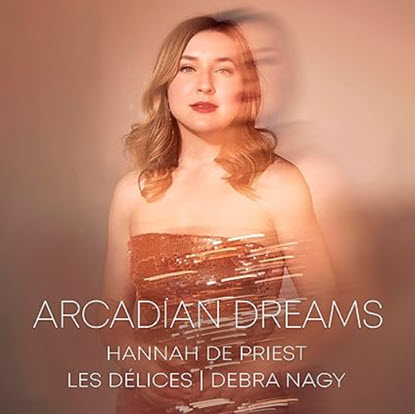
Indeed, the repertoire of Arcadian Dreams holds deep pastoral truths, with four solo secular cantatas and two instrumental works.
In Rameau’s Le Berger fidèle (The Faithful Shepherd), Mirtil has been commanded by the goddess Diana to kill his beloved Amaryllis. When the shepherd offers to sacrifice himself to save Amaryllis, Diana takes pity and allows Hymen, the god of marriage, to bless the couple’s union. Mirtil is the protagonist throughout, declaiming text set in recitative (secco and accompanied) and aria form. The expressive vocal and instrumental writing of this 1728 cantata (composed five years before Rameau’s first opera) suggests the kind of tunefulness and harmonic daring that are the hallmark of his major operas.
The narrator of Handel’s 1722 cantata Mi palpita il cor (My Heart Flutters) anguishes over unrequited love, expressed both in agitated coloratura and plaintive cantilena.
Thomas-Louis Bougeois, a high tenor and opera house director, composed more than 40 cantatas, including Diane et Endimion. In this brief work, designated a “cantatille,” the goddess Diana happens upon the shepherd Endymion, who is asleep. Diana falls in love with him, but when the exhausted shepherd continues to sleep, the incensed goddess flies away in her chariot. Endymion finally awakens, but it is too late. The opportunity is lost. Diana’s initial yearning and subsequent fury are contrasted in the two arias “Des plus doux plaisirs” (From the sweetest pleasures) and “Une frayeur mortelle” (A mortal fear).
Louis Lefebvre’s cantata Le Lever de l’Aurore (The Rising of Dawn) is a pastorale, culminating in the union of the shepherds Phylis and Titire. Lefebvre’s colorful and attractive instrumental writing includes an introduction evoking the arrival of dawn, and the suggestion of bagpipes that summon the lovers.
Hannah De Priest and Les Délices in ‘Jeune Titire, eveillez-vous’ from Louis Antoine Lefebvre’s cantata Le Lever de L’Aurore. (Video by Ken Wendt)
Two instrumental works are interposed between the cantatas: Albinoni’s Sonata in C for oboe and continuo (Mi4), a starring turn for Debra Nagy, and Domenico Scarlatti’s Keyboard Sonata in D minor (Kk. 213) from Mark Edwards. The performances are superb throughout.
But the center of this album is Hannah De Priest, a fast-rising soprano who is performing on some of the biggest stages in the country. (She’s a talented writer, too, and for EMA described the thrill and anxiety of performing at the Boston Early Music Festival.)
On Arcadian Dreams she sings with radiant tonal beauty, occasionally employing focused vibrato such as at the close of sustained passages, and always with compelling expressiveness. Her coloratura is both fluent and effortlessly produced. Her diction, in French and Italian, is mostly clear, although she often seems to be singing the notes rather than the words, hampering her abilities as a storyteller.The tight bond with her colleagues in Les Délices — Baroque oboist Nagy, violinists Shelby Yamin and Kako Boga, harpsichordist Edwards, and Rebecca Landell on cello and viola da gamba — helps creates vocal chamber music of the highest order.
Together, their embrace of a variety of colors and subtle flexibility of phrasing add immeasurably to the quality of this recital. Beautiful, lifelike recorded sound, full texts with English translations, and informative program notes by Nagy enhance the project. A most welcome release.
Ken Meltzer, based in Los Angeles, has served as program annotator for the Pittsburgh and Atlanta Symphony Orchestras, among others, and reviews recording for various publications. For EMA, he recently reviewed Mahler and Tchaikovsky, refreshed on period instruments.