by Andrew Appel
Published April 26, 2026
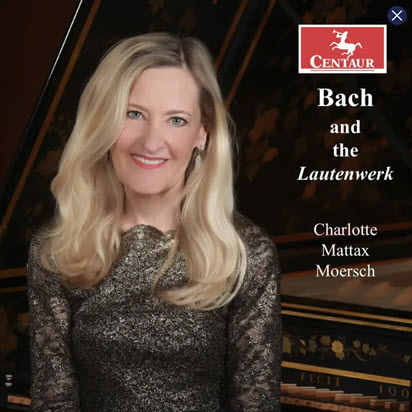
Bach and the Lautenwerk. Charlotte Mattax Moersch, lautenwerk. Centaur CRC 4127
When I was a teenager, already a harpsichordist, I was astonished by the gifts and prowess of a friend, a pianist, who ultimately became a successful opera conductor. To wow his audiences, he’d played the well-known transcription of Bach’s violin Chaconne by Busoni. It was a staple of a pianist’s repertoire and, for many, the familiar sound of Bach. This modified version created a stew of the 18th-century masterpiece — a post-Lisztian approach to the piano and to the works’ potential. It led to a tradition of comfortable manipulation of Bach, from the end of the 19th century through today. Intelligently digested, the Bach-Busoni is a castle with many wings.
We know and appreciate that Bach transcribed, revised, and rewrote his own music and the music of others. How much we learn about Bach’s values when looking over his corrections to DeGrigny, Vivaldi, and his own early and later versions of arias and concertos…all to be carefully admired and studied.
In recent years, we have been offered printed editions of Gustav Leonhardt’s workings for keyboard of the Bach sonatas and partitas for violin. These reworkings are elegant, respectful, subtle, and (to follow Richard Taruskin) tell so much more about ourselves and about our attitudes towards the text than they do about Bach himself. We are also fortunate to have other approaches, not so very different, from our colleagues Skip Sempé and Jean Rondeau. Thrilling and valuable versions.
Now, Charlotte Mattax Moersch, a respected colleague whose work I have enjoyed over decades, offers a disc of transcriptions and original works of Bach for lautenwerk—a mellow-voiced keyboard instrument with undamped gut strings, sometimes known as a lute-harpsichord. Bach owned two of them; apparently no original examples of the instrument exist today.
Mattax Moersch is an important American keyboardist and has spread her career over solo and chamber performances, teaching, and continuo playing. She has something valuable to say about any repertoire she approaches. Her latest recording, Bach and the Lautenwerk, is more than an hour of sensitive and poised playing. The album includes Bach’s own transcription of the D-minor Sonata (BWV 964; after the A-minor Violin Sonata, BWV 1003) and the Suite in E minor für das Lautenwerk (BWV 996) plus sonatas transcribed from the violin originals by one of her teachers, Gustav Leonhardt. She plays an instrument built by Anden Houden in 1997.
Now I must be transparent! I have never been enamored of the lautenwerk and though I have read in sources that Bach may have preferred it to all other keyboards, I am not convinced. The instrument, unlike the harpsichord, doesn’t have much shimmer or thrill. Unlike the clavichord, it doesn’t boast a moonlit delicacy that is not found on other keyboards. And so, while I take in Mattax Moersch’s performances, I feel she is working against some sonic odds.
Nevertheless, she plays with a palate of expressive devices that is elegant and organic. Here rubato is believable and her articulations and phrasing are clear. Her playing is not mechanical. And I believe she has given us the most convincing of lautenwerk performances.
My caveat is that I never feel, with all its delicate beauty, that Mattax Moersch ventures out onto musical limbs. I don’t get a sense of risk, and this may be caused by the performer’s poise, a quality of her playing, or by the instrument itself that does not have the qualities of sound to explode in feeling. Although she plays with sensitivity, I miss both a varying of tempos that might add to an accumulation of energy and sonority with which a harpsichord can partner. If it were painting, I might want more Bernini or Rubens at times and less Poussin!
Caveat aside, I recommend this as fine collections to present the lautenwerk and these transcriptions and original works for what is possibly Bach’s preferred keyboard.
Andrew Appel came to the harpsichord in 1965 and has studied and performed Bach across many decades. Winner of the Erwin Bodkey competition, he is director of the Four Nations Ensemble and has served as President of the Board of Chamber Music America. For EMA, he recently reviewed Nevermind’s Goldberg Variations.