Music, much of it performed by military bands, is inextricably linked to the mythology of the American Revolution
One of early America’s most coveted musical ensembles, the regimental band has been obscured from the late 18th-century’s soundscape
This article was first published in the January 2026 issue of EMAg, The Magazine of Early Music America
On November 21, 1758, Britain’s 47th Regiment of Foot, stationed at Perth Amboy, in the Province of New Jersey, placed a help-wanted ad in the New York Gazette:
ANY Performers upon the Hautboy, French Horn, Clarinet or Bassoon, who are willing to engage themselves for five or six Months, will meet with good Encouragement by applying to the Commanding Officer of General Lascell’s Regiment at Amboy.
These few short lines reveal to us one of early America’s most coveted musical ensembles and one that has been almost totally obscured from the late 18th-century’s soundscape: the regimental band of music.
Military bands were heard throughout American society from the late 1750s through to the end of the Revolution in 1783 and beyond. The heightened activity of the British Army in North America, starting with the French and Indian War (1754-63) and continuing through the Imperial Crises (1760s and ’70s), resulted in significant deployments of infantry, cavalry, and artillery regiments to the continent. Accompanying the tens of thousands of redcoats were these small musical bands of oboists, clarinetists, horn players, and bassoonists that had become fixtures of regimental culture.
While fifers and drummers had official military responsibilities — as signalmen in camp and on the battlefield — the musicians serving in British regimental bands were, first and foremost, professional performers. In many cases, bandsmen weren’t even formally enlisted, but rather civilian musicians employed for finite periods of service and funded by regimental officers to serve in “private bands reflecting current tastes in sophisticated entertainment,” as Trevor Herbert and Helen Barlow write in Music & the British Military in the Long Nineteenth Century.
‘Private bands reflecting current tastes in sophisticated entertainment’
Composed of between five and eight musicians who typically doubled on wind and string instruments, regimental bands performed for a variety of martial and civilian occasions. These ensembles helped recruiting sergeants capture the attention of young men, dazzled the public on parade, and provided martial gravitas to military exercises and funerals. They also played the latest wind serenades and divertimenti at balls and dinner parties, concertized side-by-side with civilian orchestras and theater troupes, and even played the occasional college graduation.
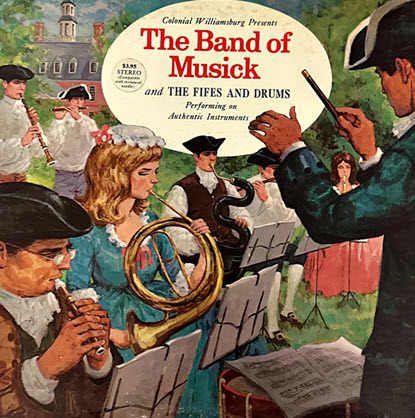
The revival of the 18th-century regimental-band tradition preexists the celebration of America250. Colonial Williamsburg, for instance, released an album in 1970 titled The Band of Musick and The Fifes and Drums brandished with the now passé marketing hook (or possibly threat), “on Authentic Instruments.”
The album features an eclectic mix of selections by Handel and Mozart interspersed with tunes associated with the British military, such as “Rule Britannia” and the “British Grenadiers,” performed on early woodwinds and horns. It is a fascinating artifact of our current early-music revival and an earnest investigation into what remains an underexplored chapter in the history of wind bands.
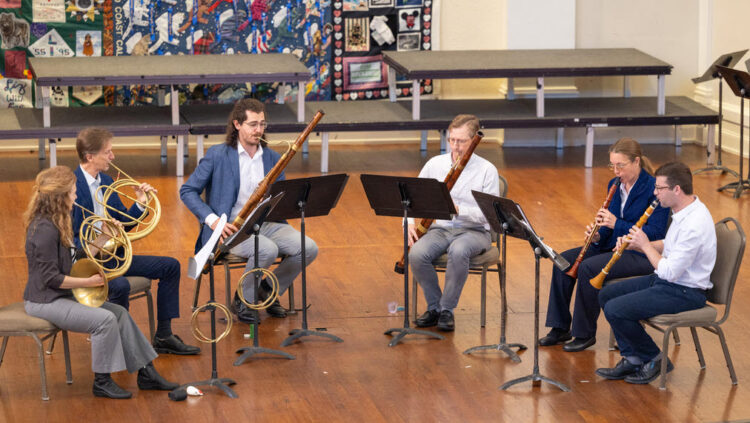
Chris Troiano and I, a low brass player and a clarinetist, founded the ensemble Music of the Regiment (MotR) in 2023 to engage with the early history of wind bands. MotR participated in several America250 events this year, including Tempesta di Mare’s “Soundtrack of Independence” festival in Philadelphia and the 2026 Bloomington Early Music Festival on the theme of “Early Music & Early America.” Our ensemble also toured a program called Equal to any Band in this Country: Christian Febiger and the 2nd Va. Regimental Band throughout Maryland, Virginia, and West Virginia (April 2026). Through this program, with music composed and arranged by J.C. Bach, F.-J. Gossec, Valentin Roeser, James Reid, and Timothy Olmsted, we hoped to offer new insights into the sounds of the history of the regimental band. What follows is a glimpse into that history.
Yankee Doodle Dandy
Music is inextricably linked to the mythology of the American Revolution. In a talk from April 2025 hosted by Boston’s GBH Forum Network, documentarian Ken Burns — ahead of his recent PBS documentary, The American Revolution — observed that “most Americans have protected their knowledge” of the United States’ origin story by “drown[ing] it in fife and drum treacle.”
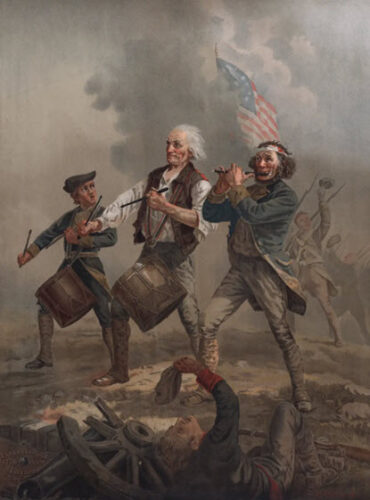
Indeed, “Yankee Doodle,” as we’ll see, has always played an outsized role in the American story and has long been a popular favorite. But listening past the fifes and drums of 1776 will reveal a more nuanced and complex musical culture.
Listening past the fifes and drums of 1776 will reveal a more nuanced and complex musical culture
Despite scarcely a mention in histories of the Revolution, historian Raoul Camus claims that “of the seventy regiments of foot that were on the British establishment in 1775, forty-nine, or 70 percent, had bands of music.” A handful of these bands were already serving in America when hostilities broke out at Lexington and Concord.
As the Revolution unfolded, America’s martial soundscape would be further enhanced by Hessian, French, and American bands.
Newspapers, journals, and letters from the period offer rich stories of wind-band activity. American newspapers recall British bands performing in a variety of contexts during the French and Indian War. Examples include accompanying a fireworks display in New York City celebrating the capture of Cape Breton in 1758, processing into Montréal following the city’s capitulation in 1760, and even providing some pomp and entertainment after a city election in Alexandria, Va. in 1762. A decade before this, wind ensembles would have been nearly non-existent in British America. But by the French and Indian War’s end in 1763, most Americans in major port cities had likely heard one.
Following the war, the British government maintained a permanent military presence in North America to enforce King George III’s Proclamation of 1763 and newly drawn colonial borders. This previously unprecedented peacetime army meant that British regimental bands naturally continued to commingle with American civil society throughout the interwar period. The band of the 18th Regiment of Foot was particularly popular with Philadelphians. Soon after arriving in 1767, the ensemble performed as the back-up band to the American Company of Comedians at Philadelphia’s Southwark Theatre. The ensemble accompanied songs performed by two of America’s earliest theatrical trailblazers, Stephen Woolls and Nancy Hallam.
In November of the same year, the band performed at the commencement ceremony of the College of Philadelphia (now the University of Pennsylvania). The Pennsylvania Chronicle reported:
an Ode, set to music, was sung by Mr. John Bankson, with great sweetness and propriety, accompanied by the organ, &c. under the conduct of a worthy son of the college… The band belonging to the 18th, or Royal Regiment of Ireland, was kindly permitted by the Colonel to perform in the instrumental part.
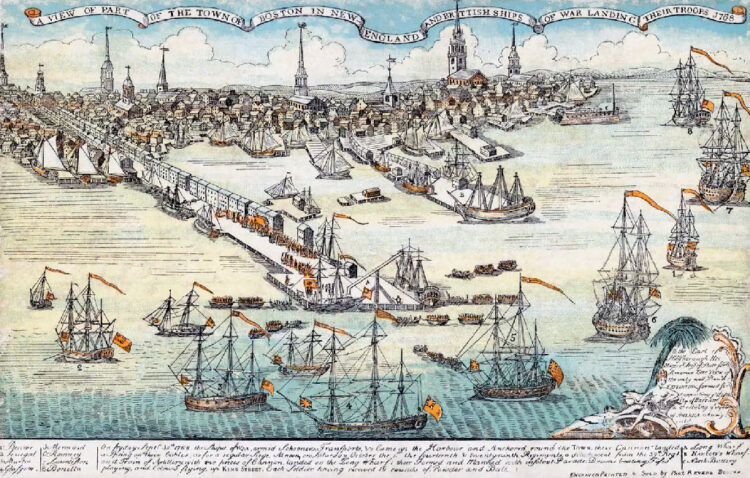
While relations began to deteriorate between Britain and its colonies, the increasing number of bands with regiments sent to subdue disobedient colonists provided a joyful soundtrack to the escalating anxiety. When a British fleet arrived in Boston in late September of 1768 to enforce the Townshend Acts — a series of laws that sought to assert Parliament’s fiscal authority over the colonies — observers noted that “the Yankey Doodle song was the capital piece in their band of music.” On Oct. 1, soldiers from the 14th, 29th, and 59th Regiments of Foot, “landed under cover of the cannon of the ships of war, and marched into the common, with muskets charged, bayonets fixed, colours flying, drums beating, and fifes, &c. Playing.” Music always accompanied the occupying force.
Regimental bands sent to subdue disobedient colonists provided a joyful soundtrack to the escalating anxiety
Yet there was tension in Boston between the people’s natural appreciation for musical entertainments and disdain for military authority. The Journal of Occurrences — a series published by the New York Journal and Packet that covered the British occupation of Boston in the late 1760s — reported that during a changing of a guard in July 1769, “a considerable concourse of people” assembled “to partake of the entertainment given by [the guard’s] band of music.” To maintain military decorum, the soldiers endeavored to disperse the crowd but were met with protest. As the situation escalated, “the Officer of the Guard, in a sneering manner called upon the musicians to play up the Yankee Doodle Tune,” diffusing a potential melee and calming the crowd.
Despite increased clashes between Bostonians and redcoats, British bandsmen themselves seemed to avoid the animosity. They would perform side-by-side with civilian musicians on a number of occasions in the years leading up to the War for Independence. Less than a year after the Boston Massacre, Justin Morgan of West Springfield produced a benefit concert for himself in Boston with the assistance of the “French Horns, &c” belonging to the band of the 64th Regiment of Foot. William Selby, organist of the King’s Chapel Boston, employed the same band for a concert in 1772 featuring works by J.C. Bach, Handel, Corelli, Abel, and Piccini.
Colonists Get in on the Act
Taking from the example of their occupiers, the Bostonians eventually formed their own military bands. By 1773, Josiah Flagg, a Boston printer, engraver, and musician, had “at great expense of time and trouble, &c. instructed a band of music to perform before [Boston’s] regiment of militia.” Little is known about this band, but it is safe to assume that the ensemble reflected the martial and musical example of the 64th Regiment of Foot’s band. To recoup his personal losses, Flagg advertised for a benefit concert at Faneuil Hall on Oct. 21, 1773 featuring both instrumental and vocal music. One month earlier, the band was on full display for an all-day celebration honoring the 10th anniversary of King George III’s coronation, capping the festivities with a “grand concert of musick” at the city’s Concert Hall.
When war broke out at Lexington and Concord on April 19, 1775, it seemed to catch everyone by surprise. In the months before “the shot heard around the world,” newspapers reported British bands playing for jubilant celebrations of the queen’s birthday and Boston’s St. Patrick’s Day parade. By July, America’s widely improvised Continental Army had trapped the redcoats on the Shawmut Peninsula. During the ensuing winter, the band of Britain’s 5th Regiment of Foot attempted to maintain an air of normalcy in the besieged city with performances of serenades.
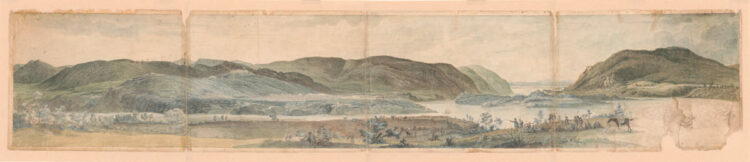
Meanwhile, the Americans attempted to capitalize on their momentum by invading Canada via the Hudson River/Lake George/Lake Champlain corridor. Although the expedition ultimately ended with a disastrous New-Year’s Eve assault on Quebec City, early victories were flaunted in American newspapers. News of the capture of Fort Chambly was published up and down the eastern seaboard. Most reports focused on the valuable military stores won by the Continental Army. The Norwich Packet for the week of Nov. 27, 1775 shared news of possibly the first musician POWs of the war:
On Friday last Major Stopford and other officers [of the 7th Regiment of Foot], with their band of music, taken at Chamblee arrived at Trenton in New-Jersey, where they are to remain prisoners of war till exchanged.
It wouldn’t be until the Spring of 1777 that bands of music in the Continental Army began to appear in earnest. Although more efforts were made, in all just four American colonels were successful in raising and sustaining bands during the war. They were Colonel John Crane of the 3rd Regiment of Artillery, Colonel Thomas Proctor of the 4th Regiment of Artillery, Colonel Samuel Blanchley Webb of an “Additional” Regiment, and Colonel Christian Febiger of the 2nd Virginia Regiment.
The function of the American bands was identical to that of their British counterparts. Webb’s band, for instance, performed for at least four private parties hosted by the colonel throughout the Autumn of 1777. From his journal:
October 24. His Excellency the Governeur gone over the River, orders for us to be in readiness to march on the shortest notice; spent the day riding, the Evening the Miss TenEycks & Miss Betsy Elmondorph — with several Gentlemen — were at my quarters — pass’d it sociable with the Band of Music…
The band of Proctor’s regiment accompanied the artillery to the front lines during General Sullivan’s punitive expedition against Britain’s Iroquois allies — the Seneca, Onondaga, Cayuga, and Mohawk nations — in 1779. After coming across the sight of a previously fought battle, “Colonel Proctor, out of respect for the deceased, ordered the music to play the tune Roslin Castle, the soft and moving notes of which, together with what so forcibly struck the eye, tended greatly to fill our breasts with pity, and to renew our grief for our worthy departed friends and brethren.”
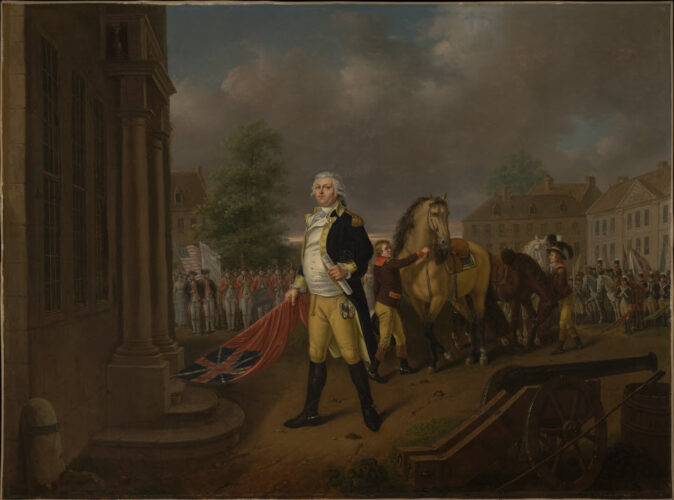
An American band, very likely Colonel Febiger’s, even performed as the defeated British marched out of Yorktown on Oct. 19, 1781. The diary of Johann Conrad Döhla, a soldier from Ansbach-Beyreuth serving with the British, described the scene:
On the right of each French regiment a white silk flag, decorated with three silver embroidered lilies, was paraded. Behind the flag stood the drummers and fifers, and before the flag, the band… the Americans were on our left… They stood in three ranks. First, the regulars, who also had a band and musicians making beautiful music and who presented a decent appearance.
With the end of the Revolutionary War in 1783 came mass demilitarization. The British evacuation of their former colonies was complete by Nov. 25, and the American Army shrunk to approximately 600 soldiers. Unemployed bandsmen, like Timothy Olmsted (the leader of Col. Webb’s band and later known as “the Mozart of America”) and Philip Phile (a Hessian musician captured at Trenton in 1776 who naturalized after the war) formed a foundation of a new professional class of musicians in the nascent republic.
Many others, such as Andreas Michler, a musician from the French Royal Deux-Ponts band who also naturalized after the war, left little trace of their musical lives and melted into America’s western frontier.
Understanding the early history of these regimental bands reveals an almost gentler world of military music-making, where the purpose of a regimental band was to add an aspect of humanity to a profession that, at times, called for severe brutality. In many ways, these bands sought to inspire peace, such as found in a wilderness scene from the journal of Second Lieutenant James Murray Hadden of the 2nd Battalion of Royal Artillery of the British Army during the Saratoga Campaign of 1777:
The river… was in a manner covered with Boats or Batteux’s; some of the Armed Vessels accompanied us, the Music and Drums of the different Regiments were continually playing and contributed to make the Scene and passage extremely pleasant.
The lasting legacy of 18th-century regimental bands in America is evidenced by the many military ensembles funded by the government today. Indeed, the country’s oldest continuously active musical organization is “The President’s Own” United States Marine Band, founded in 1798 by an act of Congress. This continuous musical tradition — which merged with civilian life in the 19th-century in the form of civic, school, and community bands — has become inextricably linked to the American identity. After all, what would a Fourth of July celebration be today without a wind band striking up Sousa’s 1896 hit, “The Stars and Stripes Forever”?
Dominic Giardino is a New York City–based arts administrator, public historian, and historical clarinetist. He is executive director of Gotham Early Music Scene, Inc., teaches historical clarinets at the University of North Texas, and performs throughout North America. His research examines European military cultures and their influence on music in the 18th-century Atlantic world, a subject he also explores with his ensemble, Music of the Regiment. For EMA, he has written about The Characters of Colonial Williamsburg and Timothy Olmsted, the “Mozart of America.”