by Anne E. Johnson
Published July 31, 2026
The Open Gate. Music of Frauenlob. Anna O’Connell, voice and harp. Available on major streaming services. Self-released, 2026.
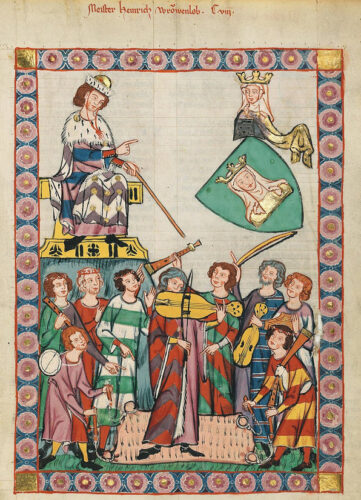
Harpist, soprano, and arranger Anna O’Connell describes The Open Gate as “a year of celebration of Mary: as the ‘Open Gate’ through which salvation is close at hand.” At its center are the Marian songs by Heinrich von Meissen (1250s-1318), also known as Frauenlob. That special moniker, meaning approximately “Praise for the Woman,” might have indicated his devotion to the Virgin Mary. O’Connell and an impressive gathering of colleagues offer a gorgeous presentation of this little-known religious music. (In support of her fascination with Frauenlob, O’Connell received EMA’s 2021 Barbara Thornton Memorial Scholarship, given to a “highly motivated — and possibly unconventional — young performer of medieval music” for advanced study in Europe.)
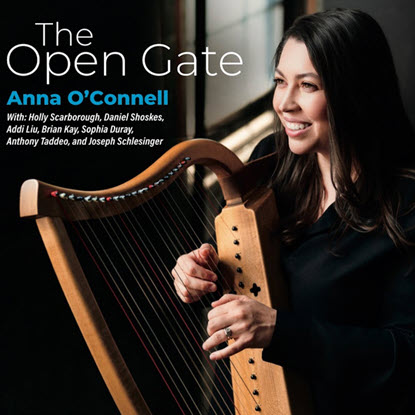
Frauenlob, a minstrel poet in Saxony and one of the original Meistersingers, set his own verses to music; they are often spiritual or mystic, but not technically liturgical. O’Connell was drawn to his work by Barbara Newman’s book Frauenlob’s Song of Songs (2007). With major contributions by flutist Holly Scarborough, O’Connell has created arrangements that variously include harp, flute, vielle (Addi Liu), medieval lute and gittern (Daniel Shoskes, who also produced the album), and percussion (Anthony Taddeo).
“Mater bonitatis” (Mother of goodness) opens with Scarborough’s plaintive flute version of the melody. When O’Connell enters singing the text in praise of Mary, she maintains the same rhythmic freedom and sonic spaciousness, her harp used both for chordal support and to emphasize the beginnings of phrases. Frauenlob’s “Würgendrüssel” wishes joy to Mary and praises her beauty with a captivatingly angular melody. His “Gefiolierte blüte kunst” (translated as “Exquisite art”) begins sweetly with voice, harp, and flute obbligato. But in a dark and surprising modal switch, the text laments “Ah, art is dead!”
The Frauenlob songs are nestled among religious works from other German medieval sources. Hildegard of Bingen’s setting of the Marian text “Nunc aperuit” opens the recording and provides the album’s title with the text “Now has been opened for us the closed gate.” While geographically correct, Hildegard (1098-1179) is much earlier than the other composers. While the determination to include a woman composer is laudable, it feels like an odd choice. Still, the arrangement with swirling harp flourishes, drones, and rattles under O’Connell’s soaring voice is mesmerizing.
Oswald von Wolkenstein (1376/7-1445) is represented by three songs. A highlight, both for its high, meandering melody and O’Connell’s gradually burgeoning arrangement, is “Wer ist die da durchleuchtet” (Who is it, who is more translucent). This is followed, strikingly, by an a cappella version of the Frauenlob song “Küng herre, hochgelopter Got” (King Lord, high-praised God).

There are two examples from the Buxheimer Orgelbuch (c. 1460), which contains over 250 pieces, mostly organ arrangements of songs. Eschewing the more famous names therein, such as DuFay and Dunstable, O’Connell chose two anonymous works. The first is a Magnificat which in this arrangement becomes a charming duet between harp and lute.
O’Connell’s own rousing “Würgendrüssel Estampie,” clearly inspired by the Frauenlob songs, concludes the album, giving percussionist Anthony Taddeo a chance to shine. With the harp’s melody answered by the band at each phrase, it’s neo-medievalism at its best.
Listening to this album brings to mind the groundbreaking recordings by harpist Andrew Lawrence-King and singer Paul Hillier. O’Connell has embraced and developed that tradition in this imaginative recording.
Anne E. Johnson is EMA Books Editor and frequent contributor to Classical Voice North America. She teaches music theory, ear training, and composition geared toward Irish trad musicians at the Irish Arts Center in New York and on her website, IrishMusicTeacher.com. For EMA, she recently reviewed Sonnambula’s Passing Fancy: Beauty in a Moment of Chaos.