by Karen M. Cook
Published September 18, 2026
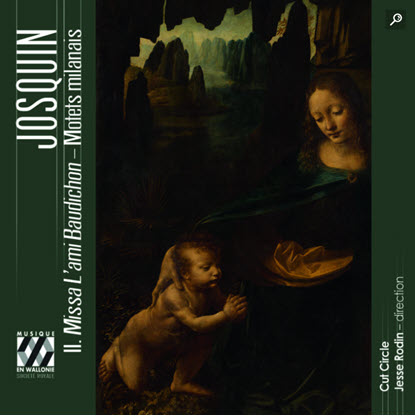
Josquin: II. Missa L’ami baudichon – Motets milanais. Cut Circle, directed by Jesse Rodin. Musique en Wallonie MEW2514, 65:42
In 2023, the ensemble Cut Circle launched an ambitious project: a complete cycle of the entire works of Josquin des Prez (c.1450-1521), to include known and “provisionally attributable” works, a total of about 102 pieces which would fit onto 13 albums.
Their first album in the series was quite well received, including in my own review for Early Music America. There, I remarked that the ensemble “compels you to listen to these works as though for the first time, creating an almost visual — and visceral — experience.” On this new release, the second in the Josquin cycle, my statement stands.
As with the prior Josquin album, director Jesse Rodin deliberately crafts a small, intimate soundworld filled with historical pronunciation, straight (almost nasal) tones, and a wealth of dynamic contrast. This timbre, the intimacy and blend of the five singers, is both effective and affective, capturing the listener’s attention right from the jump. (Rodin is co-founder of the Josquin Research Project at Stanford Univ., where he teaches.)
Take the opening of the recording, which drops the listener instantly, almost abruptly, into this ambient world: the opening Kyrie begins with no audible intake of breath, no dramatically emphasized “K,” just two voices perfectly in sync, perfectly in tune. After the careful restraint of the first Kyrie, the volume slowly increases as the music grows ever more active, and the final syllable of the last “eleison” rings out like a bell.
Throughout the remainder of the album, this approach rarely wavers, with occasional tiny hints of vibrato only momentarily distracting from the compelling sound. The rest of the Mass is tastefully shaped, with great use of dynamic contrast; compare the forceful intonation of the Gloria, or the swells of the Sanctus and Hosanna, with the more hushed tones of the “Et incarnatus est” section of the Credo or of the Agnus Dei. Putting the origin song, “L’ami baudichon,” after the Mass asks the listener to think back through what they have just heard. But it’s quite a simple, in fact rather naughty little song, reminiscent of “Three Blind Mice,” and in hindsight (or upon repeat listen) it is not difficult to hear how the tune is threaded through the Mass.

Following on its heels are the chanson-motet Que vous ma dame/In pace anda set of Milanese-style motet cycles. Like the Mass, they possibly represent some of Josquin’s earlier works connected with his time in Milan in the 1480s. Que vous is sweet and thoughtful, its lilting pace evidence of the ensemble’s fine sense of momentum and phrasing. Vultum tuum deprecabuntur, however, sends the listener to the basement, its deep dark tones effective here. The cascading bits of the “Ora pro nobis” section are particularly lovely, as are the more homophonic sections of the “Christe, fili dei.” Qui velatus facie fuisti similarly plummets into the depths, but the moving lines of “Hora qui ductus tercia” are uplifting, and the overall softness and shape of “Qui jacuisti mortuus” is compelling.
This is a visceral album, one that impacts body, mind, and ear — the language in Rodin’s descriptive liner notes makes that intention utterly clear, using words like tangle and writhe and fleshy and mouthwatering and passionate and sensual. The historical pronunciation might be jarring at first, but the music is performed superbly and, on the whole, the album challenges, entices, and edifies. I look forward to Volume 3.
Karen M. Cook is associate professor of music history at the University of Hartford. She specializes in late-medieval music theory and notation, focusing on developments in rhythmic duration. She also maintains a primary interest in musical medievalism in contemporary media, particularly video games. For EMA, she recently reviewed Legends of the Round Table.