by Emery Kerekes
Published January 30, 2023
Toutes les nuits, Dulces Exuviae (lutenist Bor Zuljan and baritone Romain Bockler). Ricercar RIC44

Nighttime routines of the common folk made surprisingly fruitful topics for Renaissance poets.
Some heartbroken subjects lie awake in cold sweats, pangs of longing, and lost love eating away at their psyches—“Instead of your lips, I cover the pillow with kisses.” Other young cads take dark’s cover as a shining opportunity where “the gleam of their eyes [is] hidden,” stealing away for fiery flings with illicit lovers. And yet, even in the shadow of torment and debauchery, night reigns as a time of peace, an idyllic beauty that punctuated days of toil. Some narrators spend an entire work admiring the moon’s soft glow.
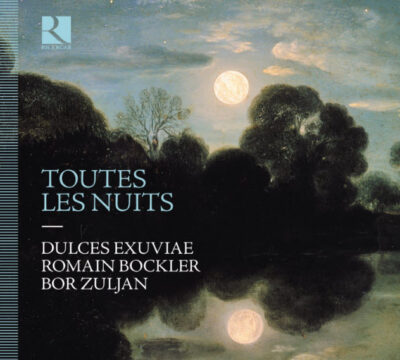
The duo Dulces Exuviae—Bor Zuljan, lute, and Romain Bockler, baritone—paint the vast expanse of a night in Renaissance Europe in their newest album, Toutes les nuits. It’s the duo’s second recording, following a 2019 program that pared Josquin’s resplendent motets and chansons to intimate, proto-Dowlandian lute songs.
Here, a delightful grab-bag of nocturnal vocal works receive similar treatment; the duo makes cozy lullabies of Italian frottole, French chansons, Spanish villancicos, pan-European madrigals, with a charming bit of Lennon-McCartney.
Dulces Exuviae’s exceptional feel for Renaissance embellishment is on full display in this recording. In that niche, Bockler is a noted force; his own divisions on Lassus’s Susanne un jour garnered a special nod at the 2020 virtual Bovicelli Competition for 16th- and 17th-century diminution practices, where he placed second among a fierce pool of global competitors.
Here, Bockler simultaneously approaches each phrase with a bird’s eye and a magnifying glass. He sculpts phrases, beats, even individual notes with care, always highlighting the plain, unadorned melody that lies beneath his agile divisions. Every note, however small, receives its own tender crescendo, ushering his broad phrases ever forward in slow, stretchy tempos. Some longer notes finish with a rich wiggle of vibrato, an almost unnecessary affect for a voice of such honest profundity.
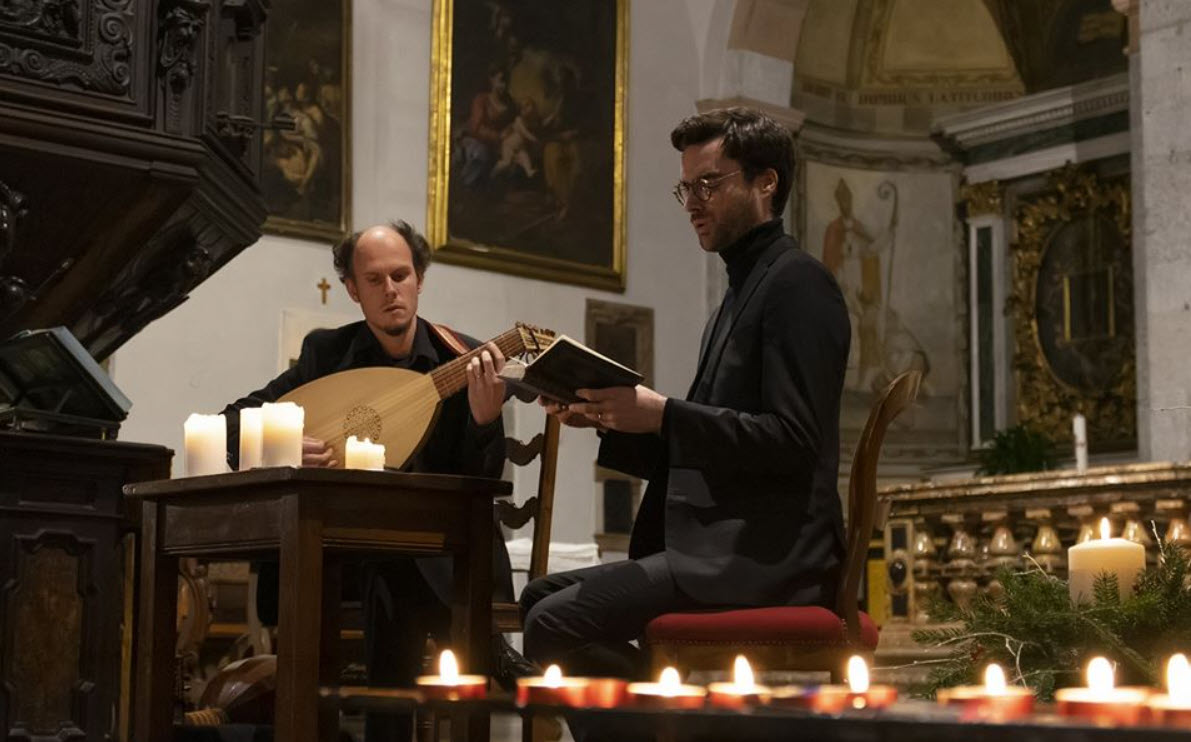 While Bockler’s diminutions decorate his lush sostenuto, Zuljan’s serve an opposite purpose. The Renaissance lute’s short, stocky body limits its resonance—it is, after all, a parlor instrument at heart. (Once the lute moved from living room to concert hall, it quickly evolved into the archlute and theorbo, whose bass strings allowed for fuller sonority and additional sympathetic vibration.) Zuljan, though, takes full advantage of his instrument’s shortcomings. While Bockler’s voice rings naturally in the 13th-century Occitan chapel that served as the duo’s studio, Zuljan engineers no additional reverb into his sound. His divisions selectively fill the space between anchor chords, painting a stark, but unfussy backdrop over which Bockler soars. As the two weave their melodies around each other, happenstance counterpoint vanishes as suddenly as it appears.
But Zuljan, armed with a secret weapon, flouts the Renaissance lute’s obstacles as easily as he embraces them. An avid historian, Zuljan often experiments with prototype instruments on his recordings—for Dulces Exuviae’s Josquin album, he and luthier César Arias reproduced a 16th-century Bolognese “bray lute,” whose frets lie so close to the strings that they produce a strident buzz.
For Toutes les nuits, Zuljan contrasts his gut-strung Renaissance lute with another Arias mockup, a Bolognese instrument strung in metal harpsichord wire. Whereas the plump gut sound peters out quickly, the brassy wire vibrates more freely, producing a brighter, more nasal sound with overtones of hammered dulcimer. The difference is subtle, but Zuljan makes it easy to compare apples to apples. He alternates instruments for four tablatur fantasies of court lutenist Jean-Paul Paladin—the third and fourth start similarly, spotlighting the two instruments’ unique timbres.
And then, for dessert, we get Lennon-McCartney’s “Blackbird.” Sure, Bockler’s high elocution—“buh-lackbird singin’ in the dead of night”—immediately gives away his haute classicism, but after he nails an hour of historically informed Renaissance dialect in three languages, who are we to complain? (Besides which, I’ve always liked his pop-rock sensibility, even if it remains a touch operatic.) The Beatles are a warm, familiar hug at the end of an album that could calm any restless mind, what’s become a signature quality for a powerhouse duo.
 Emery Kerekes is a writer and arts administrator based in New York City. Winner of the 2022 Rubin Prize in Music Criticism, he is a founding editor and contributor for Which Sinfonia. He’s also written for Musical America, Opera News, and on his own site, Classical Music Geek. He works in The Metropolitan Museum of Art’s Department of Live Arts.