It’s hard “to figure out how to be suitably historical — staying within the guardrails of the performing style — and stylishly individual at the same time.”
This Musings column was first published in the May 2026 issue of EMAg, the Magazine of Early Music America
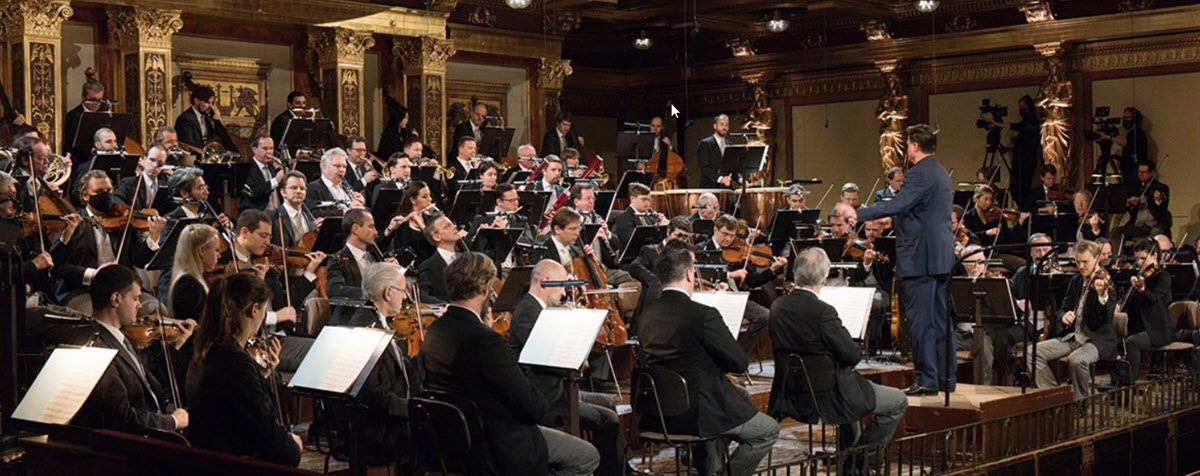
A recent review in the New York Times spoke of the Vienna Philharmonic and its long history, its warm sound, its inimitable style — there’s something about that ensemble that speaks of Vienna, of tradition, of a certain something, hard to put your finger on, that makes that orchestra singular and noticeable.
Clearly, it’s something in the sound, in the style, in the performance. But what? It makes me think of other places, times, ensembles, that have a certain something. The concerto delle donne of Renaissance Ferrara; Lully’s vingt-quatre violons du roy, with their premier coup d’archet; the renowned Mannheim orchestra with their famous precision; François Habeneck’s Concerts du Conservatoire, perhaps the first really modern orchestra, with a real conductor. These ensembles were famous in their time for a special sound, a special way of performing, something not found elsewhere at the same time.
It makes me wonder a bit about what we early-music people concern ourself with so much — what we call “style.” We play in “Baroque style,” “Classical style,” and so on. And by “style” I think we mean two things. On the one hand, the style in which the music is composed: like a Bach fugue, a Corelli trio sonata, a Vivaldi concerto. Music in Baroque style. And on the other hand, we mean the style in which we play, “period” style: We read the treatises, we study the instruments, we look at the pictures, we try to retrieve and recover and re-create the way that music was performed. That, I guess, is what the Times reviewer meant about the Vienna orchestra: They play music composed in Viennese style, and they perform it in Viennese style.
That raises the question of what we’re doing when we study all those treatises and try to play like Couperin. Probably not everybody sounded like Couperin in Couperin’s day, or wanted to. And maybe we don’t actually want to sound like Couperin, either — we want to sound like a plausible, tasteful, expressive (if we think that’s part of the style) but individual performer. It’s very hard, I think, to figure out how to be suitably historical — staying within the guardrails of the performing style — and stylishly individual at the same time.
And that Vienna orchestra raises another question, doesn’t it? Is it possible that an ensemble can retain its style, its sound, its way of sounding, over a long time, or even a short one, as the musicians on stage change over the years? Now that we live in the age of recording and can listen to more than a century of recorded music, we can be pretty sure that things do change, that Viennese music was not played the same in 1890 as it is in 2026. And that’s as it should be, I guess. Even when we think we’re doing it just the same as yesterday, or, at least, the way our teacher taught us — after all, she studied with Schildkraut, who studied with Liszt, who studied with Czerny, who studied with Beethoven. So don’t tell me how to play the Moonlight Sonata: I play it Beethoven’s way, as passed down to me.
That raises the question of what we’re doing when we study all those treatises and try to play like Couperin. Probably not everybody sounded like Couperin in Couperin’s day, or wanted to.
We know perfectly well that norms of interpretation and performance have changed over the now fairly long history of recorded music. Vibrato is different (nobody sings now with those doorbell vibratos we hear in early operatic recordings), portamento isn’t widely used nowadays, not many gut strings in a modern symphony orchestra, and so on.
Thinking along these lines ought to be liberating. People differ from each other; times change and so do tastes; nothing is the same as anything else, so do what you like. Maybe it’s liberating for some performers, and some listeners. But that’s where the slippery concept of “style” comes in for us: It’s our guardrails, our leader, our guiding star. If everybody does it this way, we should think long and hard about what it might mean not to follow along. How far out of the groove do we want to wander?
Thomas Forrest Kelly is Morton B. Knafel Professor of Music at Harvard. He previously directed early-music programs at Wellesley, the Five Colleges, and Oberlin. He is past president and a longtime board member of Early Music America and the author, most recently, of Capturing Music: The Story of Notation (W.W. Norton).