America250: A scholar of American musical history reflects on Niagara, a symphony that connects centuries of our nation’s cultural life
The only thing ‘fixed’ about American identity, musical or otherwise, is that it remains in a constant state of flux
This article was first published in the May 2026 issue of EMAg, the Magazine of Early Music America
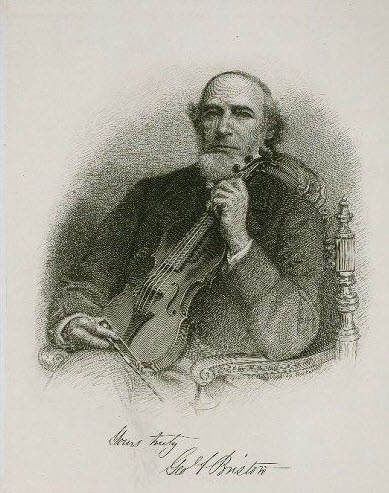
Happily, I attended a once-in-a-lifetime musical event this past January: the second performance ever of George Frederick Bristow’s monumental Fifth Symphony, Niagara. In its own way, the concert was as thrilling as visiting the falls themselves since I’ve been studying Bristow (1825–98) and his world for nearly two decades.
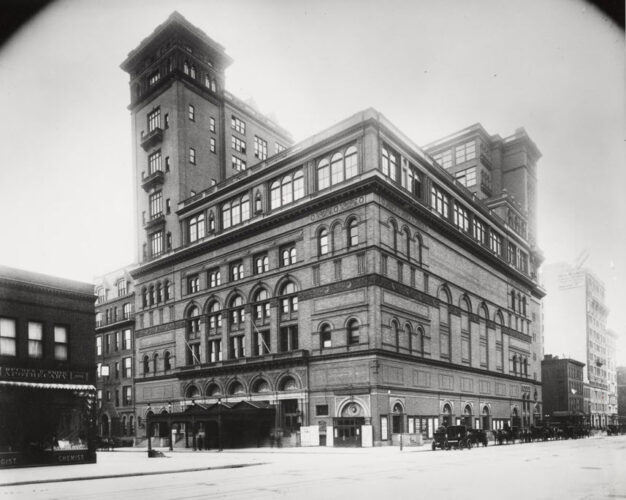
Snow lined the streets along the frigid walk to Carnegie Hall, the same building where the symphony premiered in 1898 under the composer’s own baton. The original concert was sponsored by the Manuscript Society of New York, an organization dedicated to promoting new works by American composers — a sorely needed effort at the time. The concert I heard that January night was by the American Symphony Orchestra, a group founded by the great conductor Leopold Stokowski in 1962 to make classical music accessible to all. The democratizing parallels were apt.
The concert had two important pretexts. Bristow had turned 200 years old a few weeks earlier. Historic anniversaries carry great human interest, and, as a distinguished New York native seemingly lost to time, Bristow was ripe for a return to his hometown stage. The event also captured the spirit of a larger, even more significant yearlong celebration: the 250th anniversary of this country’s founding in 1776. Putting on the performance was a collaborative effort dedicated to spotlighting hidden corners of the country’s immense musical heritage. (‘Niagara’ has yet to be recorded.)
As I listened to the symphony — a strange yet monumental work with a choral finale eclipsing Beethoven’s Ninth in scope — the sonic confluences that have given shape and vibrancy to our national culture for 250 years rushed at me for over an hour. It left me wondering what’s next for music in this country. As I reflect on that full history now, I keep returning to a lesson I hope to teach all my students: the only thing “fixed” about American identity, musical or otherwise, is that it remains in a constant state of flux brought on by the rapid movement of people from all over the world and the cultural practices they exchange.
The sonic confluences that have given shape and vibrance to our national culture for 250 years rushed at me, leaving me wondering what’s next for music in this country
The choral finale of Bristow’s symphony opens with an unusual collage of music from another time and place. The first snippet is a direct quotation of the hymn tune commonly known as “Old Hundredth” — hardly something we’d expect. As a Roman Catholic convert from United Methodism, when I hear this tune it reminds me of my traditional hometown church in central Arkansas, where we sang it to the Common Doxology: “Praise God from Whom All Blessings Flow.” Yet the tune first appeared in the 16th-century Genevan Psalter and came into near universal English-language Protestant use after the 1560s in a translation by William Kethe with the first line, “All People That on Earth Do Dwell.”
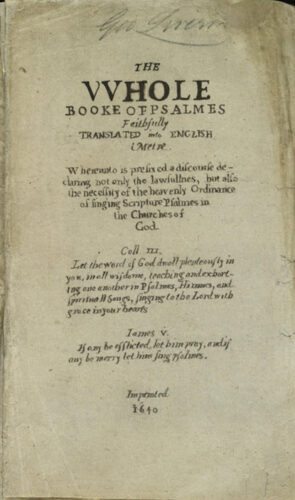
Of course, the 1500s witnessed a quickening age of European exploration, colonization, and, tragically,enslavement of African and Indigenous peoples, that had begun during the second half of the previous century. As is well known, each of these groups had well-developed musical practices of their own that became a source of interest (positive and negative) for Europeans seeking to convert others to Christianity and suppress cultural difference. It should be no surprise, then, that “Old Hundredth” appeared in both the Ainsworth Psalter brought by the Pilgrims to Plymouth and the Bay Psalm Book produced by the Puritans as the first book published in an English colony. Scholars Glenda Goodman and Sarah Eyerly have shown that metrical psalm settings became one of the chief tools for European settlers to communicate with, and ultimately to convert, local Indigenous populations.
During the 17th century, English-speaking and German-speaking Christians like the Puritans and Moravians created metrical psalters with translations into Indigenous languages that underlay common hymn tunes like “Old Hundredth.” The latinized transcription of these languages led to performance challenges that remain a mystery. The number of syllables in dialects of the Massachusett Tribe, for example, often greatly exceeded that in English, raising questions about how exactly the words would align with the tunes written with one note per syllable in mind. Goodman has proposed that congregations would retain the general melodic contour of the tune by placing multiple syllables under each note in what she calls “declamatory” style.
Centuries of displacement and cultural suppression have also raised fresh questions about the spiritual significance of hymnody for Indigenous Christians with cultural lineages tied to these early missionary efforts. In a public-facing digital humanities project, Eyerly worked with Mohican musicians to make sense of a Moravian–Mohican hymn tune with German origins. Together they created three different versions: one suited for the concert hall, one suited for everyday congregational worship, and one capturing the style of Indigenous music-making in sacred contexts outside a Christian church.
The Diné-American composer Raven Chacon’s 2022 Pulitzer Prize-winning Voiceless Mass, a reflection on the effect of Catholicism on Navajo culture, shows that the resonances and echoes of European–Indigenous contact remain relevant in our contemporary world.
***
Almost directly following “Old Hundredth,” Bristow’s finale launches into a full-throated quotation of the “Hallelujah Chorus” from Handel’s Messiah: “King of Kings!” When I was still a playing viola professionally in the 1990s, one of my favorite annual performances was a Christmas pageant at a Baptist church in the small southwest Arkansas town of Nashville (not Music City!). The congregation put a lot of resources into it — not only with a professional chamber orchestra, but camels, hay, and all the other trappings. Fittingly, it closed with everyone standing for the “Hallelujah Chorus.”
Messiah, which premiered in Dublin in 1742, has one of the most enduring American performance histories of any large-scale European musical work. It first appeared in the English colonies in 1770 at a tavern in Manhattan — not exactly the reverential atmosphere it typically commands. Because of Handel’s prominence as an oratorio composer, he remained a favorite among amateur choral societies in the new country and became the namesake for the oldest performing arts organization still in existence today: Boston’s Handel and Haydn Society, founded in 1815. Indeed, an organization that George Frederick Bristow himself conducted, the Harmonic Society of New York, popularized Messiah as a Christmas Eve staple.
Messiah made its Carnegie Hall debut on December 29, 1891, and, according to the venue’s performance archive, has been performed by the same ensemble every year since, save for a hiatus in 1960 — a total reaching over 380, making it the second most popular piece performed in the hall except for “The Star-Spangled Banner.” As ubiquitous as the oratorio has become, however, Handel himself came under a cloud of suspicion in recent years after librarian David Hunter raised questions about the extensive involvement of Handel’s one-time patron, James Brydges, in the transatlantic slave trade, and musicologist Michael Marissen uncovered the oratorio’s alleged anti-Jewish content. Framing Handel’s problematic biography remains a challenge.
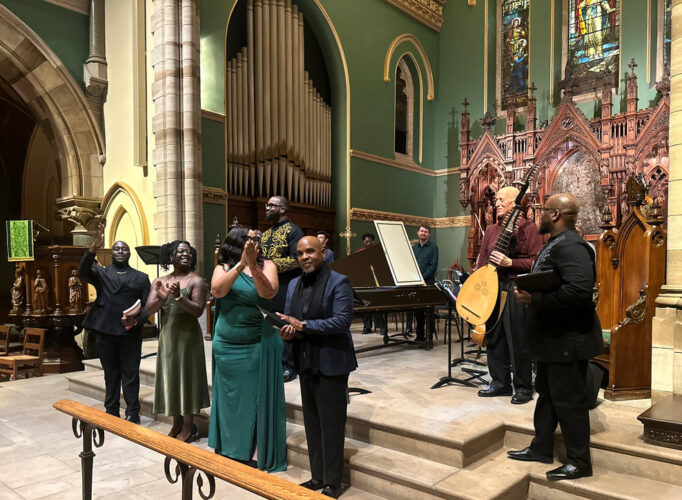
In Nashville (this time the actual Music City), I have occasionally partnered with an ensemble called Early Music City to host a program called “Handel’s Messiah and the Black Church.” As in other corners of American life where the work has received widespread fame, historically Black churches have often hosted full-scale performances or, in some cases, a community sing-in. In this program, community members, scholars, professional musicians, and faculty from a local HBCU convene to discuss Handel’s biography candidly while reminding participants that performers and listeners today can reclaim and reshape the work’s meaning — including that of its text — for whatever purpose suits them. “And he shall reign forever and ever” takes on a specific resonance when sung by voices that have faced political oppression for generations, even under democratic governance proclaiming equality for all.
***
One of the strongest cultural confluences moving throughout the entire Bristow performance was the 19th-century European symphonic tradition itself — a consequence of the multi-generational immigration of highly trained classical musicians looking for friendlier shores. Listeners expecting something more sonically “American” in Niagara were probably disappointed on that front, because Bristow, even in his later career, leaned toward the Mendelssohnian side of the stylistic coin over the Wagnerian, where certain stylistic devices like chromaticism and lush orchestration could become expressive tools for constructing dramatic scenes of national import. (Think Smetana’s The Moldau.)
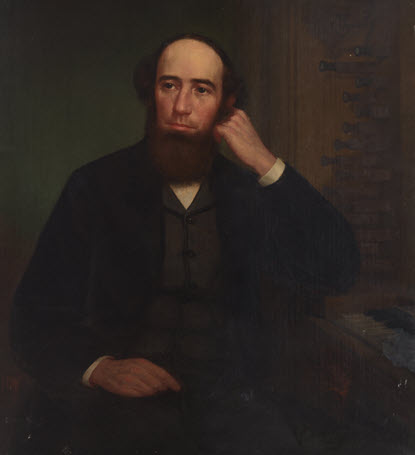
In this case, Bristow clearly evoked Beethoven’s Ninth, with an epic first movement, emotionally rich second, lively third, and gigantic choral finale that gestures to the other three at various points. Beethoven, of course, has always loomed large in the United States since performances of his music occurred here while he was still alive. (His First Symphony was allegedly performed in Lexington, Ky. in 1817!) The oldest surviving orchestra in the U.S., the New York Philharmonic, founded in 1842, has performed the Fifth Symphony on nearly 500 distinct programs.
Symphonic composition in this country faced stiff competition from, on the one hand, older German composers preferred by German-speaking immigrants with deep knowledge of the repertoire (think Beethoven and Mendelssohn) and, on the other, conductors who gained social and artistic cachet for leading the U.S. premiere of a fresh European work (think Dvořák or Brahms). With these European-dominated institutional forces aligned against them, American composers faced extraordinary difficulty finding a hearing for their music, much less a good hearing from a high-quality orchestra. The historical record shows, however, that American audiences often loved music written by people from within their own communities.
Bristow was no exception, nor was his sharp-witted contemporary, the New York-based composer and critic William Henry Fry, who frequently used his newspaper column to pillory his German contemporaries. In the mid-1850s, Fry even led a rebellious charge against the Philharmonic for not programming American works, contrary to a stipulation in its by-laws. A virtuosic orchestra led by Frenchman Louis Antoine Jullien had recently premiered American works to great audience acclaim, proving that local orchestras like the Philharmonic had no excuse for the neglect. Some of these works, like Fry’s Santa Claus: Christmas Symphony, had a populist bent designed to shirk the symphonic tradition altogether while appealing to a broad public. Though written much later in the century and with more traditional means, Bristow’s Niagara clearly drew from the same populist impulse.
***
Though light and quick, the third movement of Niagara struck me as no less profound than the finale in terms of its cultural import. Following the typical scheme of a dance followed by a contrasting trio, it quotes a popular tune that would have been familiar to Bristow’s original audiences: a parlor song from the 1830s called “Near the Lake Where Droop’d the Willow,” composed by Charles E. Horn. At one point, some of my friends (all 19th-century Americanists) quietly mouthed the words. But the song’s origins reveal a slice of American musical history that we were all unwilling to celebrate.
One side of the debate, which included Black intellectuals, argued that the music of enslaved Africans, especially spirituals, was truly representative of the country.
As Bristow was finishing his symphony, in 1893, the country was in the middle of a furious public debate about African American music’s place within the larger fabric of American culture. One side of the debate, which included Black intellectuals, argued that the music of enslaved Africans, especially spirituals, was truly representative of the country. It had roots here, they argued, and arose from the distinctive experience of enslavement in America. The far other side of the debate traded in viciously racist beliefs about the supposed lack of African American musicality or creative capacity.
Although the topic had been discussed occasionally in the musical press for several years, the 1893 debate was catalyzed by the famous Bohemian composer Antonín Dvořák, the newly hired director of a New York conservatory who claimed in a widely publicized newspaper interview that American composers should draw inspiration from African American folk music to develop a truly national classical style. One commentator remarked that Bristow had already taken this approach in his latest symphony — of course, Niagara.
Niagara does not quote or even resemble the spirituals at any point, as Dvořák had recommended. Instead, the comment drew from a source of confusion in the debate about a term Dvořák had used to describe the spirituals: “Negro melodies.” While the composer certainly meant folk music, many people at the time interpreted the phrase to mean music for the minstrel stage — tunes loosely inspired by African American musical practice but designed to demean Black culture and reinforce white supremacy. Blackface minstrelsy was so common throughout the country by that point that it was often considered authentically African American.
Horn’s parlor song was itself inspired by a tune popularized by the founding father of blackface minstrelsy: “Long Time Ago” by Thomas “Daddy” Rice. A writer named George Pope Morris rewrote the text to the minstrel song to make it appropriate for the parlor, while Horn adapted the melody to make it more Italianate, giving it the singable character that my friends enjoyed miming during the concert. But, with its ties to Rice, this moment in the symphony sonically crystallized the century-long dominance of blackface as an acceptable form of entertainment in the U.S. on stage, in films, and even in schools. Of course, questions about the place of African American music in American society have never gone away.
***
One of Dvořák’s African American students, violinist and composer Will Marion Cook, expressed his belief that the Bohemian’s pronouncements would lead to a dawning of Black success in classical music, especially composition. Although many organizations, including Black-run ensembles, have championed African American composers over the years, it wasn’t until the murder of George Floyd in 2020 that most mainstream institutions began openly discussing the industry’s long history of racial discrimination, both overt and tacit. To the American Symphony Orchestra’s credit, three of the four vocal soloists in the recent Niagara performance were outstanding African American artists.
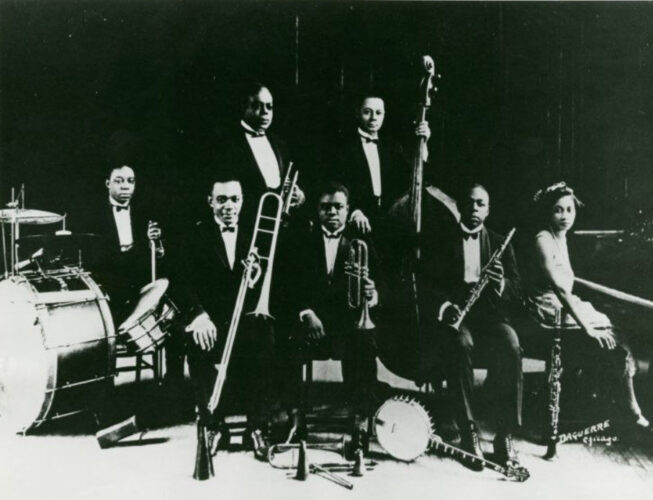
The story of African American music-making after the turn of the 20th century, as Cook himself experienced, did not follow his vision: It has long been far easier for musicians of color to find public success and, at times, a comfortable living in the commercial music industry than in classical music. At the same time, these successes have often come at the expense of the very types of exploitation marking the origins of blackface — the repackaging of Black musical practices by white artists for predominantly white audiences.
The early history of jazz offers a case in point. An all-Black group called the Creole Band, led by cornetist Freddie Keppard, popularized a style of music called “jass” on a tour that passed through Chicago and ended in New York in 1917. An all-white group called the Original Dixieland Jass Band performed in a similar style and settled in New York at around the same time. For reasons that we may never fully know, Keppard refused a contract with the Victor Talking Machine Company, which then turned to the ODJB to release the first jazz recording. Keppard’s group was left to keep performing on the vaudeville circuit while the ODJB gained immense popularity from the record. This pattern repeated across the century, from the whitening of jazz in the concert hall to the origins of rock and roll.
Just a week after the Bristow concert, the Puerto Rican artist Bad Bunny headlined the Super Bowl halftime show in a performance sung principally in Spanish. When he was announced last September, the decision raised a controversy that echoed the 1893 debate about African American music, with the opposing sides in this case arguing about the place of Latin American music and people in the larger fabric of life in the United States. Bad Bunny sharing the stage with Lady Gaga, a wealthy Italian American from Manhattan, proved once again that the collision of musical cultures is the one constant in this country’s music history. In that sense, Niagara Falls is the perfect visual metaphor.
Douglas W. Shadle is associate professor of musicology at the Vanderbilt University Blair School of Music. He is the author of Orchestrating the Nation: The Nineteenth-Century American Symphonic Enterprise (Oxford, 2016) and Antonín Dvořák’s New World Symphony (Oxford, 2021).