by Jeffrey Baxter
Published April 5, 2026
Johann Sebastian Bach: Johannes-Passion. Pygmalion with Julian Prégardien (Evangelist), Huw Montague Rendall (Jesus), Ying Fang (soprano), Lucile Richardot (alto), Laurence Kilsby (tenor), Christian Immler (bass, Pilatus), Étienne Bazola (bass, Petrus), conducted by Raphaël Pichon. Harmonia mundi HMM902774.7
Pygmalion, the period instrument ensemble founded by visionary conductor Raphaël Pichon in 2006, again leads the way with an incisive and inspired account of the Bach St. John Passion in its final 1749 version. Like their acclaimed B-minor Mass and St. Matthew Passion recordings, this ensemble has once again established its preeminence in the field of historical performance practice.
Bach’s Johannes-Passion continues to challenge and inspire contemporary audiences, despite the historical antisemitic bent of its Lutheran German text. While 21st-century audiences continue to grapple with the problem, the humanity and universality in Bach’s setting still finds its way, often along some surprising and insightful paths, from a 2020 Pandemic-era three-person performance in Leipzig (with virtual choir and one singer covering all the roles) to a 2022 “Queer Passion” of Thomas Höft, whose radical re-arrangement of Bach’s libretto (text only; Bach’s music was left altered) emphasizes human suffering and anti-LGBTQ+ brutality.
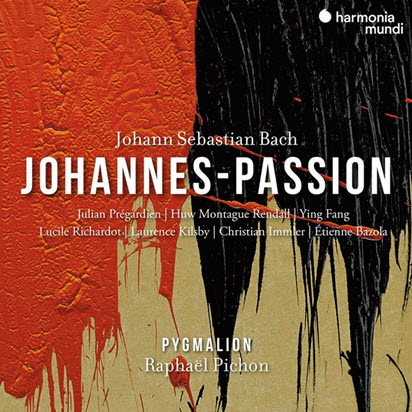
Pichon account, recorded in April 2025, brings Bach’s Passion forward with a near-perfect balance of skillful, historically informed performance practice and an over-arching dramatic vision of the piece as a whole.
Key to the recording is the use of a talented choir of more than one-to-a-part. Like Pichon’s B-minor Mass recording, the chorus is the star. At 19 voices [6-4-4-5], it is large enough to handle a dramatic delivery of the Passion’s “big” moments — its expansive opening and closing chorus (always with controlled and clean contrapuntal lines) and powerful turba choruses of the crowd scenes — yet disciplined enough to bring the listener in for a “freeze-frame” of reflective and hushed contemplation. They possess both the strength of professional solo voices and the rare talent for sounding as one, with no voices emerging from the choral “sleeve of sound.”
Credit goes to Pichon for his continuo choices, employing instruments both plucked (theorbo and harpsichord) and sustained (organ). Also commendable is organist Pierre Gallon’s brilliantly illustrative (and clearly audible) right-hand figuration, thanks in part to the recording’s elegant engineering.
Julian Prégardien’s convincing Evangelist unfolds in bold tones (once maybe too bold, almost losing control at “Barrabas aber war ein Mörder!”), along with many tender and beautifully spun legato lines, as in the description of Peter’s denial, at “und weinete bitterlich.” One interesting detail is the initial recitative sung about Peter (and others) are given with theorbo (or with theorbo only, without any sustaining continuo instrument), drawing a clear characterization.
Alto Lucille Richardot delivers the first aria (“Von den Stricken”) with an otherworldly laryngeal sonority (especially in the lower register) that is reminiscent of a countertenor voice. Her intonation and phrasing are spot-on and convincing. In Part II, however, Pichon takes her on an indulgent journey of such lugubrious Largo in “Es ist Vollbracht” that the movement almost falls apart under its own weight.
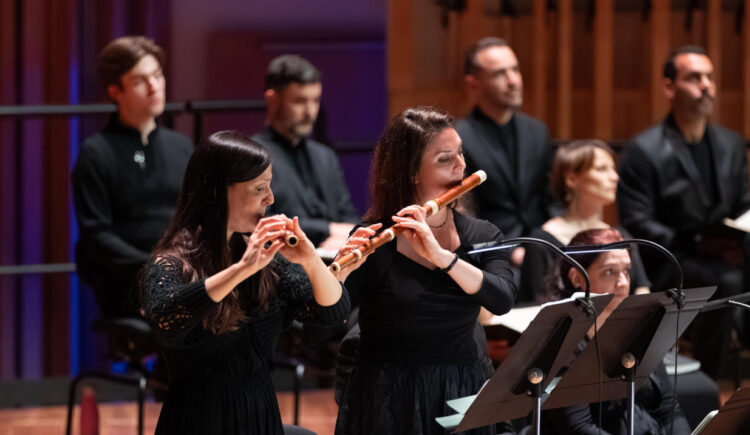
The excellent flute-like lyric soprano of Ying Fang is matched perfectly by a duo of unison transverse flutes, in the aria “Ich folge dir gleichfalls.” This is quite a feat, as many performances — perhaps to mitigate the potential for errors in intonation — often assign this part to a solo flute. Fang’s ability to balance fullness of tone, legato, and lightness is even more impressive in her Part II aria, “Zerfließe, mein Herz,” especially in the sustained heights of “dem Höchsten” and the descent down to “dein Jesus ist tot!”
The noble, youthful, tone quality of baritone Huw Montague Rendall as Jesus is captivating from the first utterance. His steady vibrato and clear Lieder-like delivery strike a very human chord in this characterization. Unfortunately, tenor Laurence Kilsby loses steam quickly and hasn’t the vocal gravitas to sustain the desperate dramatic tone of heavy guilt in his first aria, “Ach, mein Sinn.” The later aria in Part II, “Erwäge” is better suited to his lyric delivery where an undeniable pathos is movingly expressed. Bass Christian Immler’s heartbreaking singing of the arioso “Betrachte meine Seel” — with Bach’s intimate scoring of solo lute and two viole d’amore, along with contrabass — makes time stand still.
One area in this performance that receives a bit too much attention are the reflective chorales, those moving 4-part harmonizations of the familiar hymn-tunes that in the context of Bach’s drama serve as the contemporary listener’s reaction to the unfolding drama. In Pichon’s hands they come across as a bit over-interpreted. Apart from establishing a tempo and dynamic appropriate to each chorale-text and its setting by the composer, Pichon sometimes takes things a bit far with tempo rubato and an overly indulgent leaning into each syllable, often with a too-slow cadential ritardando.
In his Passion settings, Bach is often described not as a witness to the crucifixion but as a witness to the meaning of the crucifixion. While beautifully sung, Pichon’s take of these chorales comes across with the Pietistic fervor of one of the named participants in the drama (such as Peter or Pilate), and not as the intended engaged-but-distanced-by-time contemporary observer. While not dispassionate, the chorales should represent objective observers.
That said, the chorales “Wer hat dich so geschlagen” and “Ach großer König” are two moving exceptions, whose second stanzas are sung in a hushed, quasi a cappella tone, accompanied by only basso continuo and with no doubling orchestral reinforcement. And because the tempo is maintained in the repeat, the effect is breathtaking without losing its context.
Also, one may forgive Pichon’s slightly romanticized take on the Part II chorale “Durch dein Gefängnis,” in a completely unaccompanied (and almost Brahmsian) performance. Again, it is the chorus’ careful, unified sound that keep this indulgence in check while providing the pivotal time-stopping moment at this Passion’s famous structural highpoint — the center of Bach’s carefully constructed palindrome.
The haunting final da capo choral lullaby, “Ruht wohl,” is allowed a moment of genuine intimacy by Pichon, when he employs solo voices in the contrasting B-section (at “Das Grab, so euch bestimmt ist”). And most fortunate of all, Pichon strikes the right balance in the Passion’s final chorale by maintaining an objective, steady tempo amidst a variety of textural and dynamic interpolations. He finds just the right balance to bring the entire work to a fitting close without devolving into overly subjective expression. (In live performances, Pichon sometimes employs dramatic staging “effects,” such as a 2018 Paris performance where his chorus disperses at the end of “Ruht wohl” to face all the corners of the concert-hall as they sing the final chorale.)
The impressive work of Pichon and Pygmalion has clearly placed them in the pantheon of great Bach interpreters. Their high-level music-making is balanced in its passion and preparation, surely inspired by and reflecting Bach’s own Apollonian and Dionysian genius-balance of technique and spirit.
Jeffrey Baxter is a retired choral administrator of the Atlanta Symphony Orchestra, where he managed and sang in its all-volunteer chorus and was an assistant to Robert Shaw. He holds a doctorate in choral music from The College-Conservatory of Music of the University of Cincinnati and has written for BACH – the Journal of the Riemenschneider Bach Institute, the Choral Journal, and ArtsATL. For Early Music America, he recently reviewed the bliss of Lorraine Hunt Lieberson singing Handel Arias.