by Pamela Dellal
Published April 13, 2024
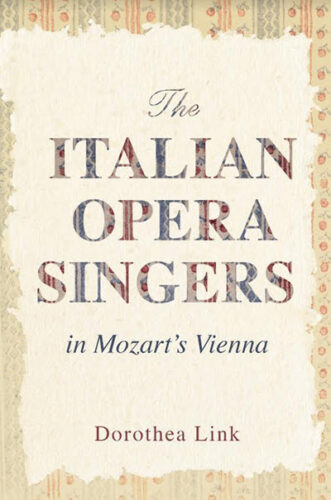
The Italian Opera Singers in Mozart’s Vienna by Dorothea Link. University of Illinois Press, 2022. 470 pages.
Exhaustively researched and impressively detailed, The Italian Opera Singers in Mozart’s Vienna plunges the reader into the vibrant world of the Vienna Court Theater from 1783-1792.
The book is organized chronologically, season by season, narrating the shifting personae in the opera roster, including directors, composers, and librettists. It thus offers a taste of the bustling activity of the Italian opera buffa company as well as its sibling German Singspiel and Schauspiel (spoken theater) companies.
To provide context, the chronological chapters are preceded by three introductory chapters on the history of the Italian opera company as well as 18th-century terminology for voice categories and opera roles and also primary sources that provide cast lists.
In these first sections, Link draws back the curtain on the methodology of her research, offering to the reader a rare glimpse into the minutiae of evidence and conflicting sources that she examines. In assembling her history, Link walks us through a complex web of data derived from archived manuscript scores. She offers lists of performers written in various places in the scores and in other materials, such as published libretti and journal, plus letters and commentaries from contemporaries who closely followed the opera’s activities. These collectively triangulate the cast lists for various operas at their premieres and in subsequent productions. Also of crucial value is a long chapter on the classification of singers in the 18th century, based on the hierarchy of roles and the genre of the opera (buffa or seria) rather than range or vocal color.
Link considers the economics of the opera company as well as the finances of the professional singers. In numerous tables and lists, she provides box office receipts and salary amounts for the shifting rosters of artists per season.
Despite all the fascinating material, the opening chapters can be a bit slow going. The pace picks up as the author organizes the subsequent chapters around the major artists, particularly the prima donnas, who dominated each operatic season. The reader is struck by the quantity of opera performances and the relative insignificance of Mozart’s works among them: The three Italian operas he contributed to the repertoire were competing with upwards of 80 other works, many newly composed, that were produced during the period in question. (Mozart himself is peripheral, as the primary focus is on the singers themselves and the roles they sang.)
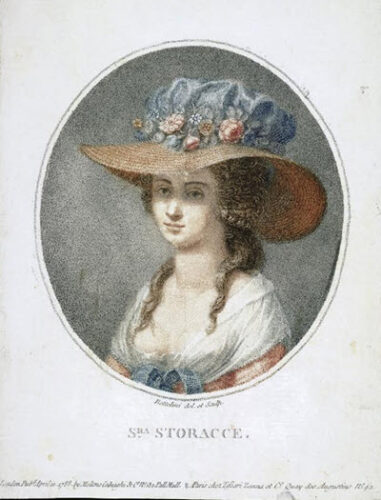
We are provided with detailed descriptions of the major artists, from their physical appearance, acting ability, and vocal prowess to details about their personal lives.
We also learn more about their singing from an examination of scores: it was common practice for singers to substitute arias of their own choosing in place of an aria provided by the composer, and Link gives copious musical examples that help illuminate a singer’s technique, range, and abilities. As a prime example, Link uses “L’impeto calma e i moti,” from Weigl’s Il pazzo perforza to show how a prima donna reworked an aria to suit her vocal preferences.
In all, the book proves to be entertaining, instructive, and eye-opening, providing a valuable insight into the Viennese opera milieu from this era. Figures like Nancy Storace (the first Susanna), Francesco Benucci (the first Figaro), and Adriana Ferrarese (the first Fiordiligi) are vividly brought to life. We witness Lorenzo Da Ponte (poet and company manager), Antonio Salieri (principal music director), and Count Orsini Rosenberg (opera company director) contending for dominance in the administration of the company. Opera lovers will find themselves longing to hear some of the wildly successful operas which are now buried in obscurity. Perhaps new revivals of Marin y Soler’s Una cosa rara and L’arbore di Diana are in the offing?
Pamela Dellal, a Boston-based singer, teaches voice, historical performance, and lyric diction at the Longy School of Music of Bard College and at the Boston Conservatory at Berklee. She translated the complete sacred works of J.S. Bach and vocal works of C.P.E. Bach, the latter for the complete edition of the composer’s compositions published by the Packard Humanities Institute.