by Murray Forbes Somerville
Published May 24, 2026
LETTER TO THE EDITOR: It’s Good That Harvard Baroque Ensemble Returns to Its Roots
May 9, 2026 — It’s sort of a compliment, I guess, that the current re-structuring of the Harvard Baroque Chamber Orchestra is taken in your lead article (David McCormick’s “Warm Up That Pen,” EMAg, May 2026) as a paradigm for the decline in early-music studies in higher education across the U.S.
As that ensemble’s founding conductor, however, I feel a need to rebut some of your underlying assumptions, bringing out facts that might lead to much more hopeful conclusions.
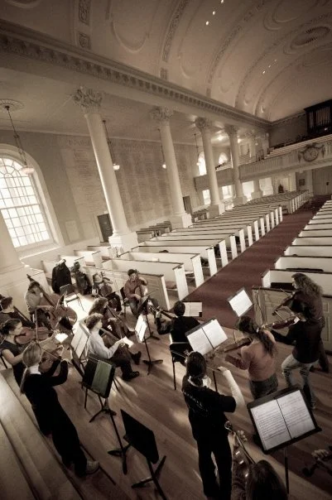
In fact, I see HBCO returning to its roots in a necessary and salutary way. When I started the ensemble in 1995, it was as a small string group (5-2-1-1), purely for Harvard undergraduates. Based on some rather dire experiences in my early years on campus — I’d been working with fine young players who seemed to know nothing of what was being achieved in historically informed performance by Boston’s two professional Baroque orchestras just across the river — I decided I needed something better for performing the lovely Purcell verse anthems in his anniversary year.
From the outset I brought in violinist Robert Mealy as coach, a match made in heaven. Tom Kelly was a major source of support then and now, and Memorial Church was given a magnificent set of Baroque bows by the Business School (!). The original concept grew and flourished as more and more players discovered the joys of HIP.
Then, after both Robert and I moved on, Phoebe Carrai, with her different background from the continuo desk, moved the group in a somewhat different direction, turning it into a very successful free Baroque boot camp for Boston. But as federal funding for Ivy League institutions became weaponized in recent years, cuts had to be made across the board in all disciplines. A Harvard-funded ensemble of 30 players — which last fall contained only three Harvard undergraduates — was simply no longer sustainable.
So HBCO is once again a smaller string ensemble and is now officially recognized as an accredited student group (as it wasn’t before), with guest concertmasters drawn from the vast Boston pool of expert Baroque players. My successor as University Organist and Choirmaster, Edward Elwyn Jones, is very committed to that model, using (as we did then) the financial resources of Memorial Church, and its set of bows, to undergird professional coaching for the student group. It’s an endeavor in which I plan to support him whole-heartedly in every way.
We all wish Phoebe’s new ensemble well. But I believe returning to the 1995 model for HBCO will actually increase the opportunities for Harvard students to engage in HIP studies and performance.
Murray Forbes Somerville was Harvard’s Gund University Organist and Choirmaster from 1990-2003.