by Pierre Ruhe
Published May 11, 2026
Marc Minkowski has long been a marquee conductor of early music, although his repertoire stretches across the centuries. His new appointment with Boston Baroque, on a six-year contract, will pilot the ensemble with ambitious plans for its future.
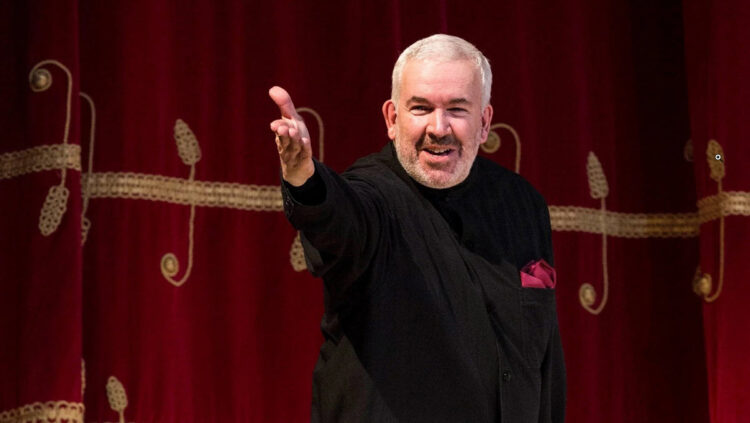
Marc Minkowski, appointed at the end of April to become Boston Baroque’s second-ever music director, is currently in Zurich to conduct Mozart’s La Clemenza di Tito. But he has ideas for Boston — expanding the repertoire, finding new audiences, making a base in America — on his mind.
The Paris-born Minkowski, now 63, has been at the pinnacle of the early-music scene for some 30 years, first as a bassoonist in William Christie’s Les Arts Florissants and, along the way, as a conductor of his own ongoing concern, the period-instrument Les Musiciens du Louvre. He built his international reputation, starting in the 1990s, with a series of best-in-class recordings, including operas by Lully, Handel, and Gluck; symphonies by Haydn and Schubert; operettas by Offenbach; and an uproariously trenchant production of Rameau’s Platée.
For American audiences, it seemed Minkowski was poised to become a major presence after debuts at the San Francisco Opera and with the big orchestras of Cleveland and Los Angeles. In 2017, EMA wrote with anticipation about the early-music maestro’s arrival on these shores.
Although steady U.S. engagements didn’t follow, his European career continued to rise. He didn’t perform again in the U.S. until 2025 with Chicago’s Music of the Baroque and then, five months ago, with Boston Baroque for his audition program, a New Year’s Eve gala of Handel and Mozart (with a surprise ABBA arrangement as an encore).
“We’re really thrilled and really honored, honestly, that he was interested in the position,” says Sarah Radcliffe-Marrs, Boston Baroque’s executive director. “He obviously has a formidable reputation, especially in Europe. The idea of him becoming our partner, and for him to build up his U.S. reputation with us, is an exciting opportunity. With Boston Baroque he can extend the great work he’s doing and for which he’s so well known.”
Martin Pearlman founded Boston Baroque in 1973 (originally named Banchetto Musicale) and retired in 2025. Across five decades, no one else had ever conducted the orchestra. So it was a new experience, earlier this season, when the organization publicly auditioned five candidates, including Minkowski, Christian Curnyn, Bernard Labadie, and David Bates. Their well-liked assistant conductor, Filippo Ciabatti, was also a candidate and was assigned to their annual Messiah. (Ciabatti has been named to the newly created role of principal guest conductor.)
With limited opportunities to work with guests, says Radcliffe-Marrs, “It’s not an accident that all our candidates had founded their own groups. They share a kind of entrepreneurial spirit of discovery and adventure. That was really important to us, in terms of finding a new music director that felt like a good fit.”
For his part, Minkowski puts it this way: “I’ll say I am an ambitious person.” To prove it, he’s ready with a long and detailed list. “The orchestra has magnificent qualities; they already play this music so well. I don’t want to push people too much, but I would like to drive them a bit more into the 19th century — never forgetting their roots but why not go toward Berlioz, this incredible repertoire that sometimes needs bigger forces?
“Maybe we can create an academy for young instrumentalists and young singers, as a kind of laboratory,” he continues, “we’ll work on breathing together — listening and breathing. The orchestra can do ballet and dance programs which is very interesting and they don’t perform very often. Maybe we can mix players from Boston with my orchestra in France [Les Musiciens du Louvre], and they learn from each other.” He adds to the list what is, to most U.S. groups, an expensive and rare activity: regional run-outs as well as national tours and visits to Europe and Asia.
For Boston Baroque’s 2026-27 season, his first as music director, he’ll conduct just three shows, slotted into open dates in his busy calendar: Haydn’s The Seasons (Sept. 20), a New Year’s celebration centered on Beethoven (Dec. 31 and Jan. 1, 2027), and Pergolesi’s Stabat Mater (Feb. 27 and 28, 2027). Two conductors will lead the other main-stage programs: Christoph Koncz for Handel’s Messiah (Dec. 12 and 13) and Lionel Meunier for an opera double-bill of John Blow’s Venus and Adonis and Henry Purcell’s Dido and Aeneas (April 23 and 25, 2027). In future seasons, Minkowski is contracted to conduct all five of Boston Baroque’s main programs. He’ll also get involved with the orchestra’s chamber-music series, the X-Tet.
Recordings plans have not yet been discussed, says Radcliffe-Marrs, but when Pearlman and Minkowski met in December at the New Year’s concerts, the two artistic leaders talked gleefully about each other’s discography. Minkowski, who’s made more than 50 recordings, mostly on major labels, was surprisingly well-versed in Pearlman’s interpretations with Boston Baroque.
‘He really gets the assignment’
Creating a base in the U.S. has long been of interest to Minkowski, for career and personal reasons, and now that goal has an organic path. “I feel my vocation for music comes from my American side, and music for me is always related to my family.”
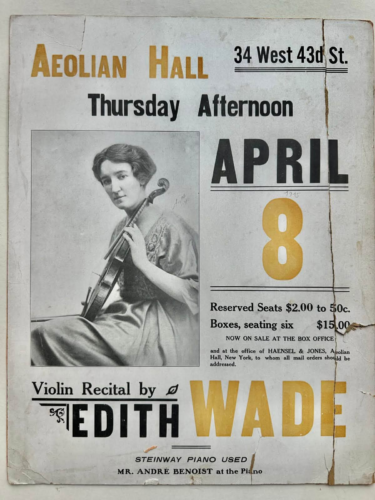
His New York grandmother, Edith Wade, was a violinist who studied in Geneva and Berlin and kept solo Bach in her repertoire. Her ancestors had immigrated from England in the 19th century, including an admiral from the fleet of Queen Victoria. With an American mother and a father born in Paris to Polish parents, Marc was raised as a French speaker. His early studies as a conductor, age 18, were at the Pierre Monteux School in Maine. “It’s a funny way to say it, I don’t want to sound arrogant, but I do feel more like a citizen of the world than a French person.”
As one of the essential ensembles in one of America’s premiere early-music hubs, Boston Baroque shares a vibrant scene — and often some of the same musicians — with the venerable Handel and Haydn Society and with the Boston Early Music Festival, along with many smaller, high-quality groups, all of which already offer some of the same repertoire and audience experiences and which perform in the same handful of venues. Thus it will be fascinating to see how Minkowski and his new band cut a unique profile.
“We can show that we are versatile,” he offers. “We can go very deeply into a dark, powerful program but we can also smile from time to time, reaching for other emotions. We need time to get to know each other, together we need to see where we can go.”
The financial picture will be a factor in the warp and weft of this developing relationship. With an annual budget of $2.2 million, Boston Baroque has no debt but also no endowment. Artistic growth is essential but must be navigated wisely. “We can’t pretend that it’s an easy landscape at the moment,” says Radcliffe-Marrs, in terms of regional philanthropy, government support, the national economy, and political instability. But Minkowski is “realistic about the climate that we’re living and working in right now. He really gets the assignment.”
She adds, “I’ve found he’s an open collaborator and very realistic. He’s faced financial challenges himself with his own ensemble, and he’s had to think carefully about making the most of resources the organization already has.”
Acknowledging the high quality and global respect given to the city’s other top ensembles, she nevertheless notes that Minkowski “brings something no one else in Boston has — a stellar reputation as a titan of the global early-music world. He’s eager to build something in Boston.”
Pierre Ruhe is publications director of Early Music America.