by Anne E. Johnson
Published April 12, 2026
Early Medieval Wind Instruments in England, c. 5th-11th Century by Lucy-Anne Taylor. BAR Publishing, 2025. 160 pages.
Anything that helps us understand what Medieval music really sounded like is useful information
“If a man from afar, or Stranger, quits the road, and neither shouts nor blows a horn, he shall be assumed to be a thief…and may be either slain or put to ransom.”
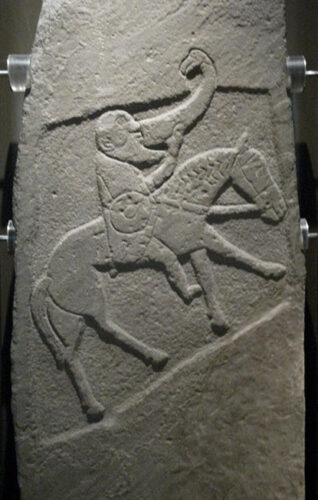
Musical archeologist Lucy-Anne Taylor uses this striking edict from an English legal manuscript as proof of something most of us probably take for granted: that the human use of animal horns in early Medieval England was not limited to drinking from them but included making sounds by blowing through them. No physical examples of horns with airholes survive from that period in England, but this law makes their existence clear.
Whether it’s through fascinating literary or iconographic evidence or elaborate experiments of her own, Taylor has created a reference book that not just early-music wind players, but anyone interested in the Middle Ages will get hooked into. It’s impossible not to learn something amazing in these 160 pages and the 22 video demonstrations Taylor made of the instruments she recreated.
BAR Publishing specializes in academic archeology. Early Medieval Wind Instruments in England is its second book about the music of Britain (the first being The Sounds of Stonehenge, quite a different topic). Taylor takes the “academic” aspect seriously, manifested in her depth of detail and explanation, although never by using jargon or making her writing inaccessible to non-experts.
The table of contents is, at first, intimidating because of its outline-like complexity, but soon it becomes apparent that this is a gift to the reader. Having an index (which this book does, of course) is only helpful if you know what to look up. The multi-layered contents pages, on the other hand, show you every intriguing sub-topic on offer, making it easy to read around and satisfy your curiosity.
Taylor has organized the chapters by instrument type: Horns and trumpets, bagpipes and hornpipes, bone pipes, panpipes, and the organ. Her research is presented according to her methodology, describing how she found and analyzed physical items and extra-musical evidence, what she has determined about how each instrument was constructed, and how (or whether) she was able to create a reconstruction.
Organs presented a particular challenge for Taylor. There are no surviving exemplars, so she relied on literary descriptions, mainly a poem by Wulfstan, cantor at Winchester, from c. 990. She also looked to contemporaneous art from Europe, including the 9th-century Utrecht Psalter.
It was not practical for Taylor to build an entire organ from scratch. Instead, she and woodworker Jim Oliver recreated a section of the Theophilus windchest, an organ’s inner workings, “a series of tubes or channels which fed the air — pumped into the organ from the bellows — to the pipes.” Rather than make the whole thing, they settled on a sample block with holes for eight pipes, enough to demonstrate how reed- and flute-sounding mechanism could work. They sealed in the mechanisms with cork instead of the beeswax that was commonly used at the time.
It’s instructive and inspiring to read about Taylor’s practices in instrument reconstruction: “For the bone pipes,” for example, “the same types and species of bones were used as in the originals.” In fact, she charts 15 specific types of bone, distinguishing the different parts of the skeleton: goose humerus vs. goose ulna, or deer metacarpal vs. deer tibia.
She carved her flutes with a knife and used melted wax to create a duct. She made reeds of “reed and swan-feather shafts,” depending on the instrument. She sought out elderwood or boxwood for recreating panpipes, which were crafted by boring into single pieces of wood, not from reeds bound together as was true in Latin America and elsewhere.
A recurring topic is the so-called Hungate instrument, a rare physical exemplar from the period 866-1066 C.E., found in York. It’s a broken wooden pipe that “seems to have been a type of hornpipe,” a reed instrument with a horn cap at the mouthpiece end and a horn bell at the sounding end — closely related to a bagpipe chanter. In fact, Taylor reconstructed the instrument in both versions, since it’s not known which it was.
Arguably the most original chapter is the one called “Instrument Range and Audibility.” The concept is that winds were often played outdoors — or always, in the case of horns and bagpipes — so Taylor did an in-depth analysis of how the instruments’ sounds traveled in an open field and in a wooded area. Her approach is thoroughly scientific, taking into account the wind speed and direction, the humidity, and even (for some reason) the visibility and how those factors affected the instruments’ frequency and decibels.
Granted, these acoustical charts may at first seem impractical and purely academic, but perhaps they will open whole new sound worlds for both performers and fans of early music. Anything that helps us understand what Medieval music really sounded like at the time is potentially useful information. Maybe some ambitious period-instrument band can apply these findings in performance.
In her final chapter, Taylor includes a surprising subheading: “The Way Forward.” Incredibly, after this seemingly exhaustive exploration of her topic, she believes there’s more to be discovered about early Medieval wind instruments in Britain, particularly about craftsmanship and acoustics of the time. She also looks forward to the day when someone recreates a full, working organ. And once you spend some time with this book, you’ll be eager for that day too.