by Ken Meltzer
Published January 26, 2026
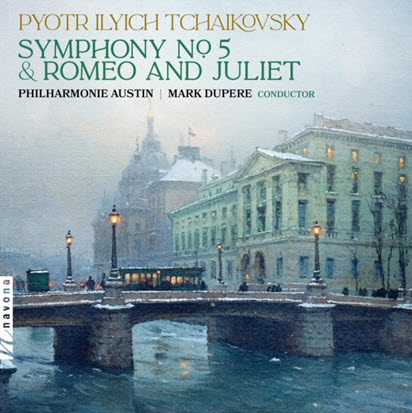
Tchaikovsky: Symphony No. 5 and Romeo and Juliet. Philharmonie Austin, conducted by Mark Dupere. Navona NV6781
Mahler: Das Lied von der Erde. Les Siècles with alto Marie-Nicole Lemieux and tenor Andrew Staples, conducted by François-Xavier Roth. Harmonia Mundi HMM 902740
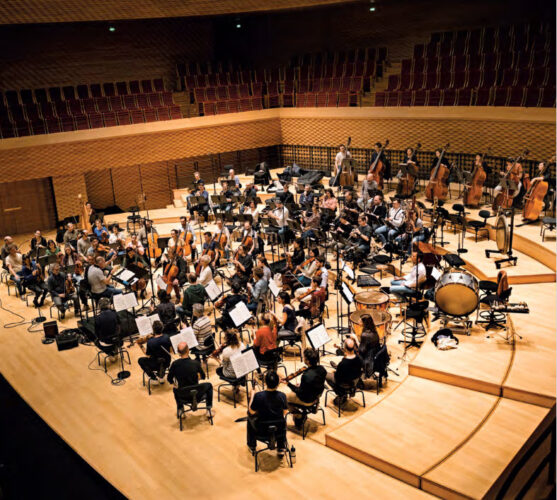
Two new period instrument recordings of big symphonic repertoire, by Tchaikovsky and Mahler, offer satisfyingly fresh perspectives. In recent decades, historical performance practice has expanded from “early music” repertoire to the high Romantics and into the 20th century. Ken Slowik’s Schoenberg and Roger Norrington’s Bruckner held unexpected revelations, and the catalogue now includes period instrument recordings of such masterworks as Debussy’s Pelleas et Mélisande, Stravinsky’s Le sacre du printemps, and Ravel’s Boléro. Nikolaus Harnoncourt made historically informed recordings of not just Verdi and Dvořák but also Gershwin’s Porgy and Bess.
Historically inspired attitudes and interpretations of pre-Romantic and pre-modernist repertoire often differ significantly from those of music more recent to our times. For one thing, Tchaikovsky and Mahler orchestral pieces do not include the practice of improvisation and ornamentation. Further, by the time Tchaikovsky composed his Fifth Symphony and Mahler his Das Lied von der Erde, the symphony orchestra bore a sonic resemblance to the ensembles of today. For example, valve and rotary instruments had replaced natural horns and trumpets. With the exception of spare deployment of string vibrato, the orchestral profile of these new Tchaikovsky and Mahler recordings don’t sound dramatically different from “standard” modern-instrument versions.
And unlike the Baroque and Classical periods with its treatises, painting, and letters, there is a wealth of recorded material by performers of Tchaikovsky’s, and especially Mahler’s, time. We can begin with a series of four Welte-Mignon piano rolls Mahler made in November, 1905 of his own compositions. These include two songs, the finale from his Symphony No. 4, and the opening movement of his Fifth Symphony. These priceless recordings suggest a preference for fleet tempos, coupled with a liberal flexibility of phrasing.
Mahler’s disciple Bruno Walter conducted the 1911 world premiere of Das Lied von der Erde and, in 1936, Walter and the Vienna Philharmonic made a live concert recording for EMI. Vienna’s concertmaster, Arnold Rosé, served in that position for a half-century and was Mahler’s brother-in-law. Both the 1936 Das Lied and Rosé’s solo and ensemble recordings document a sparing use of string vibrato, and once again, a marriage of sprightly tempos and generous rubato. As for the vocalists’ use of vibrato, recordings of numerous singers from around the time of Das Lied’s premiere reflect that it was already a foundational aspect of tonal production. In 1928, alto Sara Jane Cahier, who sang in the first performance of Das Lied, made a recording of an excerpt from Meyerbeer’s opera Le Prophète that reflects a similar approach.
The new Harmonia Mundi recording of Das Lied von der Erde by Les Siècles and conductor François-Xavier Roth bears many similarities with the historic 1936 EMI version from Walter and Vienna. Traditionalists may find Roth’s choices of tempos, and a total performance time of 57:43, as inappropriately fast. But Walter’s 1936 recording lasts 57:54. The timings of the various movements in Walter’s and Roth’s versions are also similar. And like the Vienna Philharmonic, Les Siècles is a superb ensemble, executing Mahler’s challenging score with arresting synchronicity and tonal beauty. In both recordings, the economy of string vibrato allows the winds, brass, and percussion to emerge with arresting impact. And, of course, the sound quality of Harmonia Mundi’s digital recording surpasses the scratchy 1936 Vienna concert version. I do find Walter’s omnipresent use of rubato, at once subtle and masterful, to be more convincing than Roth’s more straightforward approach. And Walter’s soloists, Charles Kullman and Kerstin Thorborg, are more vocally secure than Roth’s singers, tenor Andrew Staples and contralto Marie-Nicole Lemieux. All told however, this new Das Lied is an accomplished and compelling recording. If you are seeking a period instrument rendition of Mahler’s end-of-life masterpiece, Roth and Les Siècles’ new recording will do very nicely.
Like Roth and Les Siècles, conductor Mark Dupere and Philharmonie Austin, in their live recordings of the Tchaikovsky Fifth Symphony and Romeo and Juliet Fantasy Overture (final version), mostly abstain from string vibrato, thereby lending greater presence and impact to the remainder of the orchestra. This is much to the music’s advantage, and sometimes revelatory. I’m not sure I’ve ever heard a recording that better conveys the melancholy expressed in the slow-tempo introduction to Romeo and Juliet. On the evidence of this recording, Dupere is a passionate and convincing Tchaikovsky interpreter. In contrast to Roth, Dupere freely explores a wide range of tempos and rubato. He has a keen grasp of the architecture of the works, with each proceeding inexorably from start to finish, which makes for thrilling performances.
If the Philharmonie Austin does not embody the precision and aural sheen of Les Siècles, the Texas orchestra’s intensity and vibrant, powerful, and somewhat rough-hewn sonority strike me as entirely appropriate for this music. Navona’s in-performance recorded sound is excellent. The Texans next project is rumored to be Haydn Symphony No. 104 and Beethoven’s First. I will seek out that recording with great interest.
Ken Meltzer has served as program annotator for the Pittsburgh and Atlanta Symphony Orchestras. He currently authors program notes for several U.S. orchestras, and reviews recording for various publications. For EMA, he recently reviewed Play, Music! Songs from Shakespeare’s plays.