by Ken Meltzer
Published August 25, 2025
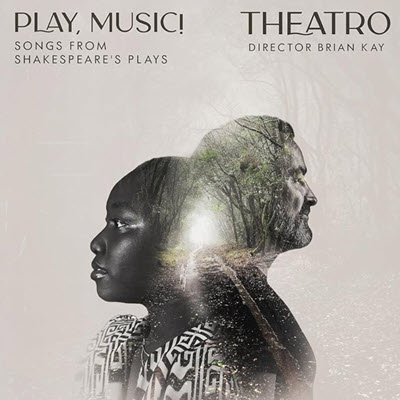
Play, Music!: Songs from Shakespeare’s Plays. Theatro, directed by Brian Kay. Avie AV2787
“In Shakespeare’s lifetime,” as the liner notes for this wonderful new Avie release explains, “there would have been a small band of six or seven musicians, including a trumpet, drums, lutes and recorders, at the Globe Theatre. Many of the actors would have been trained in music, have played an instrument, or at the very least have been able to carry a tune.”
Yet Shakespeare’s manuscripts and folio editions lack musical notation. Nonetheless, the Bard’s plays include numerous references to popular songs of the era that were often the subject of textual or musical variation and elaboration, “breathing new life into well-loved melodies. This practice has allowed ‘lost’ songs to be rediscovered within the text of Shakespeare’s works.”
Play, Music!: Songs from Shakespeare’s Plays is a creation of Theatro, a company dedicated to historically informed productions of stage works, both theatrically and musically, billing themselves as as covering Medieval to Renaissance to the High Baroque and beyond. Theatro’s director, Brian Kay, is a tenor, instrumentalist, and actor who is prominent throughout Play, Music!
The recording encompasses 33 tracks of both vocal and instrumental music that appear in Shakespeare’s works. There are occasions when Shakespeare’s poetry is recited, rather than sung. Excerpts are from All’s Well that Ends Well, Twelfth Night, Henry VIII, The Taming of the Shrew, Hamlet, Two Gentlemen of Verona, Much Ado About Nothing, As You Like It, The Two Noble Kinsmen, The Merry Wives of Windsor, The Tempest, Othello, and A Midsummer Night’s Dream. The music is the creation of mostly 16th-century composers, credited to John Dowland, King Henry VIII, Richard Tarleton, and Shakespeare himself (along with the prolific and ubiquitous Anon).
Play, Music! is crafted as a whirlwind survey in which the excerpts are performed with little or no pause, with many of the arrangements by Theatro director Kay and Shakespearean music scholar Ross Duffin. Period instruments are heard throughout the recording, both solo and in various combinations. The vocalists employ vibrato in a tasteful fashion with a sparkling clarity of diction. Indeed, while the recording booklet includes full sung or recited texts, they are rarely necessary, such is the precision of the singers’ articulation and their affinity for the meaning and flow of Shakespeare’s writing is evident throughout. These are marvelously sensitive and affecting renditions. In addition to Kay, vocalists include sopranos Ashlee Foreman and Anna O’Connell, tenor Damian Wilson, and bass Peter Walker.
Recorded over a period of four years that included the COVID pandemic, the recording process involved “the magic of remote collaboration,” in which various engineers captured the performances of more than 20 international instrumentalists and singers. The default acoustic is both more closely miked and resonant than what we might usually encounter in a classical recording. I wonder if this soundstage was employed to reconcile the source materials recorded from so many different locations? In any event, this beautifully performed and charming recital has much to offer.
Ken Meltzer was program annotator for the Pittsburgh and Atlanta Symphony Orchestras. He currently authors program notes for several U.S. orchestras, and reviews recording for various publications.