by Tina Chancey
Published June 21, 2026
Thanks to Munrow, “‘authentic’ performances were no longer scholarly affairs of main interest to academics, but popular concerts eagerly attended by the general classical music audience.”
The Art of David Munrow: The Complete Warner Edition, a 21-CD boxed set. Warner Classics B0GKPVF8G6 (Not currently available on streaming services)
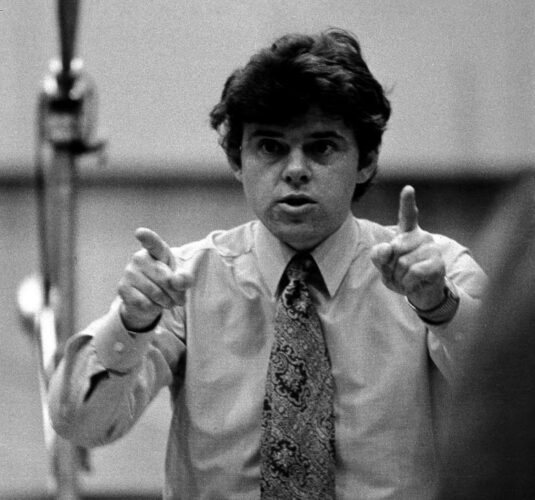
Anyone curious about the phenomenal growth of early music in the last decades of the 20th century is bound to run across the name David Munrow. In his short but ebullient career, 1967-76 — with his radio and TV program, movie scores, abundant recordings, and concert tours — the English musician, scholar, and entrepreneur arguably did more than anyone to create the early-music scene we know today.
And fifty years after his death, at age 33, people are still grateful: while researching this article, I found dozens of players and listeners who say that it was one of Munrow’s recordings, or programs for radio or television, that sparked their interest in historical performance.
Knowing that Munrow was what we call now “bipolar” — marked by periods of intense creativity alternating with periods of profound depression — gives us some perspective on the source of his remarkable, seemingly indefatigable drive. But this doesn’t invalidate the truth of his own impressive performance chops, his excellent scholarship, good communication skills, and overall vision. It’s that drive and vision that led him to orchestrate a growing movement for early music that, even a half-century later, still supports our early-music careers.
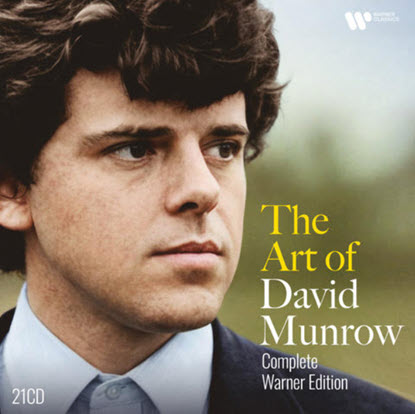
Last month, to mark the 50th anniversary of his death, Warner Classics gathered 21 CDs — 426 individual tracks, pulled from a variety of labels now under Warner’s corporate umbrella — of Munrow recordings. All include Munrow; 17 of them include the five-member Early Music Consort of London; two feature the David Munrow Recorder Consort and various EMCL members; and for the rest he collaborated with such partners as the Academy of St. Martin-in-the-Fields, the Menuhin Festival Orchestra, and the London Philharmonic. (Note that this is a partial discography; Munrow’s lengthy discography includes many additional labels.)
‘He could play them all’
As co-director of HESPERUS (a group with its own bi-polar recorder virtuoso), I was amused to find that Munrow’s initial enthusiasm for early music, like that of my late husband, Scott Reiss, was spurred by an interest in folk music and traditional instruments. Munrow had a strong, if conventional, musical background. As a child he played piano and bassoon and was a chorister at his hometown Birmingham Cathedral. In 1960, when he was 18 and taking a gap year before university, he taught English in Peru and became entranced by South American wind instruments. He brought back a bag full of pan pipes and end-blown and transverse flutes.
As quoted in the Warner collection’s liner notes, Munrow credits that year-long immersion in folk cultures for his growing interest in wind music: “I dimly realized that this was all mixed up with instruments and traditions mostly dead in Western Europe. For instance, when the Spaniards came to South America the Indians copied their instruments and incorporated them into their music. I found Renaissance flutes and recorders, cylindrical of course, because they were made of bamboo. The Indians had gone on using them ever since without altering them a scrap.”
The next year, an English major at Cambridge, he spied a crumhorn hanging on Professor Thurston Dart’s wall. Surprised that he could just pick it up and play it, Dart expressed his approval and support, which further inspired Munrow to launch an independent study of early winds and their (Medieval and Renaissance) music. Collecting modern prototypes and commissioning others, he taught himself how to play by studying treatises, as well as endless practice and experimentation. From 1965-68 he consolidated his ideas and technique, putting them into practice as a member of the Royal Shakespeare Company’s wind band. He was originally hired as a bassoonist, but the director ended up using his facility with historical winds to spice up the ensemble’s sound.
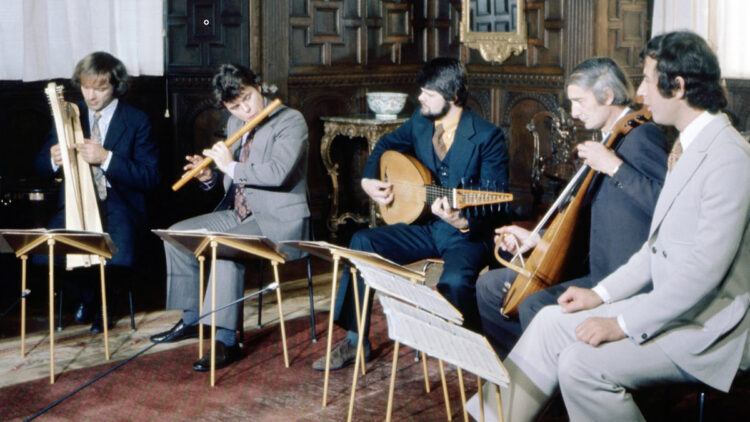
In 1967, he founded the Early Music Consort of London, a five-person group of virtuosic instrument jocks, happy to master whatever instruments Munrow asked them to play, acting as an expandable core when the need came up for other players and singers. (Perhaps the EMCL’s best know line-up included Munrow, Christopher Hogwood, Oliver Brookes, James Tyler, and countertenor James Bowman, whose vocal timbre, Munrow said, matched that of early winds.)
As the consort began to tour internationally, Munrow ransacked foreign marketplaces for exotic instruments and commissioned careful reconstructions of unplayable antiques: cornettos, rackets, kortholts, and more. Estimates of how many instruments he owned varied, but everyone agreed that no matter how many he had, he could play them all.
Worldwide recognition came to Munrow when he created and recorded the scores for the two outstanding BBC TV series, “The Six Wives of Henry VIII” (1970) and “Elizabeth R” (1971), widely televised and still available online. Between 1971-76 he presented 655 episodes of the BBC Radio 3 children’s program, “Pied Piper,” talking about all sorts of music, from Medieval to jazz. (Originally intended for children, a BBC poll determined that the average listening age was 29).
In 1976 he wrote a comprehensive book, Instruments of the Middle Ages and Renaissance, with two accompanying recordings and six half-hour TV programs on “Early Musical Instruments.” His final TV project was a five-part series, “Ancestral Voices,” where he and his friends played early and traditional music on a variety of instruments, from Chinese flute, lute and zither, pibgorn, didgeridoo, racket, shawm, dulcian, and trumpet on “When the Saints Come Marching In.”
Amidst all this, Munrow stayed focused on his idea of good early-music performance practice. Nigel North told me an anecdote that demonstrates what made Munrow such an effective, vital group director. “I was about 20 when I worked with David. He was so English; he was very quick-thinking, had brilliant ears. And he could hear everything, he just knew what he wanted, what he thought was good. He did his TV series on musical instruments for independent television, and I took part in two or three episodes.
“At the end of the recorder episode,” North continued, “they did a Schmelzer piece for six recorders and continuo, and up until then not many people improvised continuo from the bass line in England. Most of the people I know wrote everything out. I improvised, playing it from the bass line, it wasn’t that difficult. At the party that night, David came up to me and said, ‘I’ve got to ask you a very important question. Did you have a prepared part or were you reading from the bass?’ Of course, I read from the bass and after that he just asked me to do everything that needed continuo realization. At that young age, I got to meet lots of other musicians, and it helped me establish a career. So, his great thing was he had good hearing and if he saw somebody he thought had some talent, he would encourage them. He was known to take instruments off the wall and hand them people and say, ‘give this a try.’”
This quest for spontaneity, coupled with excellent performers and plenty of rehearsal, gave Munrow’s concerts a combination of appealing freshness and an impressive professionalism that hadn’t been true of earlier groups. “Their approach was entertaining, attractive and exuberant, even brash, without traducing the boundaries of what was known to be authentic,” one listener told me recently. “Suddenly, ‘authentic’ performances were no longer scholarly affairs of main interest to academics, but popular concerts eagerly attended by the general classical music audience.”
Before Munrow, early-music programs often spanned several centuries, typically arranged chronologically. The Early Music Consort of London’s then-innovative approach to programming — gathering a series of short, contemporaneous works to create a longer narrative — was another factor in the group’s appeal. “I believe the most important thing to remember is that medieval and Renaissance music was not intended for concert performance, let alone broadcast or recording,” Munrow said. “Its sudden popularity in the concert hall today testifies how much it has to offer. But a long succession of short pieces can leave a normal concertgoer feeling as if he’s been feeding on tasty morsels at a cocktail party instead of having eaten a square meal. I try to find a framework for each concert or recording, a connecting idea, and give it a colorful title like The Art of Courtly Love and The Art of the Netherlands.”
Speaking in 1992, Chris Hogwood, a founding EMCL member and later a celebrated conductor, recalled that “the big push came towards making Medieval music respectable concert repertoire with David Monrow, not only being adept at a vast number of instruments with only a small number of players, but also programming the repertoire so that a lot of the smaller pieces formed part of bigger units, big groups of pieces, and so it became much easier to organize on stage, and it was a much slicker sort of presentation.”
Murrow’s repertoire gave the impression “that the main attraction of Medieval and Renaissance music was fancy instrumental colors, which of course is quite wrong.”
Another reason why Munrow’s approach to performance had such audience appeal: his group was one of the first to use historic instruments, and to make them central to the show — something we take for granted today. “Playing the recorder, playing the crumhorn, singing, these are all parts of the sort of circus act for holding together really a vast amount of music with only a small number of people, and therefore a group that was useful for touring purposes,” Hogwood continued. “It did, I think, give the impression to a lot of the public that the main attraction of medieval and Renaissance music was fancy instrumental colors, which of course is quite wrong. Ninety percent of the music is sacred vocal music, and only later, with some of the recordings that concentrated on music from the Netherlands and so on, does it become quite clear what music history really should be doing, which is investigating a lot of the neglected religious repertoire.”
The Warner Collection
In all, Warner Classic’s The Art of David Munrow is a treasure: the performance quality is uniformly good, many of the pieces are new to me, and it sounds so fresh it could have been recorded last week. They use minimal vibrato, excellent tuning and ensemble, clever percussion, comfortable melodic improvisation. The fine playing is complemented by excellent engineering: good blend, clear and well-balanced sound for each performer, just enough reverb.
The set is loaded with highlights, many curiosities and, to my ears, a few misfires.
On CD 1, Pleasures of the Royal Courts, Munrow doesn’t always score his medieval music as imaginatively as he might, but it avoids the three pitfalls of 1960s performances: slow tempi, ill-advised ficta, boring articulation. In Henry VIII (CD 3), Munrow’s own “Ethiop Masque” is a modal treasure. There are two The Art of Courtly Love discs: the first, Machaut and other 14th-century music, is a little less interesting and certainly less in tune; in the second, from the 15th-century, I was getting a little tired of countertenors and wishing for less brass and more strings.
This collection is billed as the “complete” Warner Classics recordings, which explains the two different versions of Brandenburg Concerti 2 and 4; I prefer the Menuhin Festival recording, where the strings use lively articulations and less vibrato and, since there are fewer on a part, the balance with the solo instruments is better. Disc 10 is a surprisingly pleasing combination of Praetorius dances and his sacred motets. The motets were done with pomp and sparkle, the dances were scored with variety, and I liked the famous Bourrée on low crumhorns. The recorder consort disc (13) is great: Munrow created his own orchestra with members of the Early Music Consort of London and the balance and style was the best match yet. Disc 17 includes the Holborne “Fairy Round” that was included in the gold-plated LP record sent into space on Voyager 1 to represent the music of planet Earth.
The Art of the Netherlands, on two discs, lives up to the praise showered on them by musicians today. It’s well played and beautifully sung, although I’m confused by the mournful “Allegez-moi.” Disc 20, Greensleeves to a Ground, has music on the beloved theme as heard from Renaissance through 20th-century sources. I particularly liked the Vaughan Williams. The final disc, Monteverdi’s Contemporaries, had been praised as the wave of the future, had Munrow only lived. It’s another mix of Renaissance dances and motets. The performers are superb, particularly in the Alessandro Grandi motet, “O Vos Omes.”
This massive The Art of David Munrow compendium will likely boost interest in his recorded legacy and add to his formidable reputation as an innovator and an essential founder of our early-music movement.
Pretty good for a nine-year career.
Tina Chancey is director of HESPERUS and a member of Trio Sefardi, Trio Pardessus, Wiggle Room, and Passio. She plays early bowed strings, teaches, writes, and produces recordings. For EMA, most recently, she wrote how Good Musicians Borrow, Great Musicians Steal.