by Anya B. Wilkening
Published May 15, 2026
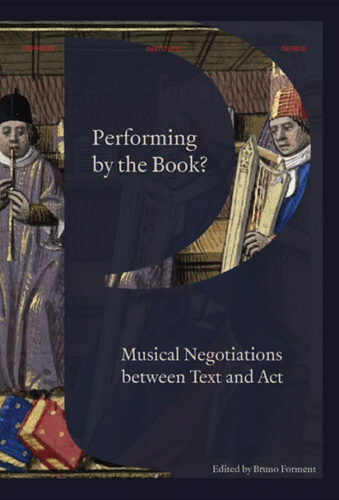
Performing by the Book? Musical Negotiations between Text and Act, edited by Bruno Forment. Leuven University Press, 2024. 208 pages. Available as a free, downloadable open source or from Cornell Univ. Press.
The process of moving from page to stage — transforming the graphic scribbles of musical notation into audible, meaningful sound — is a familiar, if daunting, process for musicians. The task, on the surface, seems simple: Performers are charged with creating living translations of what they see encoded on paper. But this project is fraught, extending beyond merely playing or singing the correct pitches and rhythms, and often transcending even the score itself. A performance may be informed by myriad “texts, contexts, and subtexts,” as Performing by the Book? editor Bruno Forment writes, both musical and otherwise. It is to this often-murky interpretive space — between the “Text and Act” of the subtitle — that the authors of this volume turn.
This premise, and many of the book’s motivating questions, will be familiar to practitioners and scholars of historically informed performance. While it begins with Forment’s account of his own encounter with the stylistic performance conventions of Bach, the collection incorporates repertoires not often considered in this manner and covers an enormous temporal range. It is not, of course, exhaustive — but moving chronologically from the 15th century to the 21st yields interesting comparisons.
Questions about the creative process are explored across the volume. Whether reconstructing medieval polyphony (Niels Berentsen) or performing one of Cage’s indeterminate works (Clare Lesser), the authors highlight the openness of the music and redefine the relationship between composer and performer. Explorations of the textual corollary also run throughout: Authors consider to what extent notated music (be it from the Renaissance or the 19th century) represents a discrete, autonomous entity, versus one that exists within a network of sources. Putting the music of these disparate genres and eras in dialogue with one another creates stimulating parallels, and offers a range of methodologies and models for scholarship.
The majority of the essays are written from the perspective of practitioners. Several highlight performance as research, drawing upon the author’s personal experience: In his discussion of improvised chorale partitas, Jonathan Ayerst not only describes the process of becoming a proficient improviser, but also provides audio examples of the compositional possibilities on the volume’s companion website. Xiangning Lin similarly focuses on her own interpretation of Ravel’s “Oiseaux tristes” (from Miroirs), which is informed by Edgar Allan Poe’s “Philosophy of Composition” and “The Raven.” She offers a multimedia performance (also available on the companion website) that captures the structural and narrative features revealed by her intertextual study.
Many others begin with the score itself, foregrounding the musical text in different ways. Elizabeth Dobbin addresses the materiality of late 17th-century collections of airs sérieux, suggesting that their format (e.g., size, mise en page, notation) impacted musical interpretation. She frames the use of these anthologies within the larger context of salon culture, exploring how codes of conduct interacted with and informed the performance of song. Nir Cohen-Shalit examines annotated 19th-century performance materials, including orchestra parts and conducting scores; he creates a taxonomy of these annotations that allows him to chart changes in the autonomy of performers and the role of conductors. Cohen-Shalit finds a shift from “practical” to “expressive” markings, and also an increase in annotations intended to ensure consistency across an ensemble.
Though not intended to be read as a pair, the chapters by Kate Bennett Wadsworth and Camilla Köhnken collectively comment on the enshrinement of the Werktreue concept — central to today’s historical performance aesthetic. Wadsworth analyzes the differences witnessed by contemporary versions of Schumann’s Cello Concerto. The variation across editions, cadenzas, and annotations found in performance scores, she argues, implies a performance practice of personalization; she suggests that modern performers could adopt this tradition of flexibility in order to engage more deeply and creatively with canonic works that otherwise may seem static. Köhnken, meanwhile, discusses how the canonization musical works occurred. Taking Beethoven as a case study, she charts the changing opinions and performance approaches of Czerny and Liszt, proposing that they presage the eventual emphasis on faithful adherence to and interpretation of the score.
Some authors examine the project of performance through a more philosophical lens. Björn Schmelzer, director of the Antwerp-based vocal ensemble Graindelavoix, turns to the work of Aby Warburg (1866-1929) to suggest a new mode of music-making. He adapts the art historian’s concept of Nachleben (often translated as afterlife/survival), exemplified through Warburg’s library, suggesting that performances of early music should not merely attempt to “offer us ‘knowledge of the past’ but rather provide enjoyment.” This pleasure, he writes, comes from reveling in the strangeness of the music, and our recognition that each performance reimagines the past in new, challenging ways. George Kennaway, meanwhile, uses religious and legal models to theorize two modes of performance for music of the 19th century. In so doing, he questions the very idea of an urtext, examining the extent to which additional sources may intervene in editions and interpretations.
This is a rich set of essays, and they are all the more thought-provoking because of the way that they resonate with one another. It is worth noting that the collection is open access; should you only be interested in a single chapter, it is readily available. One might wish for the contents to be slightly more balanced: Contributions focusing on the 19th century alone comprise nearly half the volume. Nevertheless, the collection offers readers multiple ways of not only conceptualizing musical interpretation from the medieval to the modern, but also navigating it in practice, making this volume useful to a wide range of performer-scholars.
Anya B. Wilkening is a postdoctoral scholar at Florida State University, where she serves as the director of the Early Music Ensembles. Her research focuses on new analytic approaches to musical borrowing and other processes of reuse in medieval and early modern vernacular song. For EMA, she reviewed The Media of Secular Music in the Medieval and Early Modern Period (1100-1650), edited by Vincenzo Borghetti and Alexandros Maria Hatzikiriakos.