by Andrew J. Sammut
Published May 25, 2026
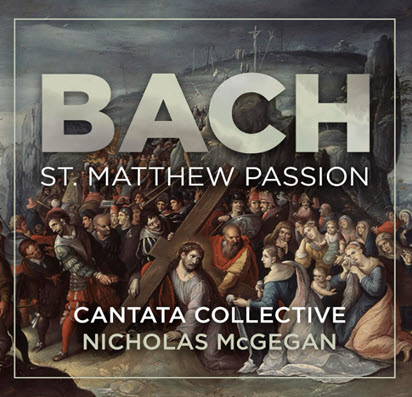
Bach: St. Matthew Passion. Cantata Collective Orchestra and Chorus, conducted by Nicholas McGegan, with soprano Sherezade Panthaki, countertenor Reginald Mobley, tenors Thomas Cooley and James Reese, baritone Harrison Hintzsche, and bass-baritone Paul Max Tipton. Avie AV2840.
The St. Matthew Passion was especially significant to Bach as a devout Christian and an innovative composer, portraying Christ’s betrayal and martyrdom through ornate vocal writing and instrumental scoring for a double chorus and double orchestra. Biblical passages and traditional chorales meld into original recitatives, arias, and choral sections based on texts by his frequent collaborator, Picander, making it Bach’s longest sacred work and among the most important pieces in European music. At the same time, Bach’s antisemitism, and the silence that often surrounds it, troubles many listeners and performers. It can create an uncomfortable balance of artistic awe and emotional distress.
But you knew all that, didn’t you? This probably isn’t the first time you’re reading about another recording of this piece. Labels issue plenty of Bach — and ensembles want to record it — for a variety of legitimate musical and financial reasons, even if many of them are destined to get lost in a sea of similar recordings. While safe or risk-adverse programming is perhaps understandable when neither the market nor the artistic industry feels welcoming, another opportunity to hear a St. Matthew Passion might make some classical consumers stifle a yawn.
Yet fans of a favorite ensemble and vocal soloists will be eager to hear their new interpretation. For example the Bay Area-based period instrument ensemble Cantata Collective is dedicated exclusively to Bach’s sacred works, and the esteemed conductor and Baroque specialist Nicholas McGegan has a long history with the composer. This new St. Matthew Passion is their third recording of Bach’s extended sacred works on the Avie label, following cantatas on Centaur (with EMA reviewing Vol. 1 in the series, plus their B-minor Mass, St. John Passion, and Easter Oratorio).
This is an emotionally subtle Passion, with moderate — not necessarily “slow” — pacing and a generous berth for Bach’s contrapuntal lines and antiphonal effects. Some performances opt for lush solemnity (for example, Otto Klemperer), concise emotional impacts (John Eliot Gardiner), stark surfaces (Hermann Max), fast and lean theatrics (Paul McCreesh), inroads into opera (Rene Jacobs), or an urgent physicality (Raphaël Pinchon). For their part, McGegan and Cantata Collective craft an introspective atmosphere. Along the way, they highlight musical details that amplify both the narrative and Bach’s invention. A promotional trailer touts their many strengths and their excitement.
The Passion’s two well-known choral bookends exemplify their approach. In the introduction, with its procession of believers climbing to witness the crucifixion, McGegan sculpts a convincingly labored journey and a vividly transparent choral-orchestral sound. Each musical line reveals its own character: the oboes are tentative against the strings’ assertiveness, the bass voices are doleful echoes beneath the shocked, throbbing sopranos. In the finale, hushed dynamics at a gradual tempo bring the story to a tearful close with a hopefulness in the gentle but palpable sarabande rhythm soothing the savior to rest. These tracks also introduce the rich, well-balanced sound of Cantata Collective’s choral and orchestral forces (16 strings and 18 choral singers plus woodwinds and, for the opening movement, the well-matched San Francisco Girls Chorus).
Tenor Thomas Cooley, as the Evangelist, and bass-baritone Paul Max Tipton, playing Jesus, make Bach’s dry recitatives and sustained string “halos” gripping. Cooley is an involved and attentive vocalist-narrator, underscoring the seriousness of scenes like Jesus breaking bread and practically spitting out the name “Caiaphas.” Tipton reveals the human side of the divine lead, quickening and darkening his voice to underscore Jesus’s impatience when he finds his sleeping disciples, and offering warm, coppery tones at other points.
Countertenor Reginald Mobley brings refined singing-acting to Bach’s alto arias. The beloved aria “Erbarme dich” becomes a softly smoldering, gradually hair-raising portrayal of horror at one’s own deceitfulness through calibrated dynamics and a slight but telling vibrato. Sherezade Panthaki’s soprano excels in arias like “Ich will dir mein Herze schenken.” Here it’s a youthful declaration of faith that never turns frivolously bright; her voice’s colorful edges pair especially well with Cantata Collective’s winds.
Clear-toned tenor James Reese stands out as a somber presence. His pensive, almost hypnotic recitative “Mein Jesus schweigt…” turns especially powerful as two oboes and gamba stab downbeats, capturing what’s broiling beneath as he watches Jesus remain silent. Harrison Hintzsche’s mahogany baritone also brings a sense of gravity and sensitivity. This Passion’s overall pensive feel allows him to bring a tender reading to “burying Jesus in my heart,” with resonance on lines like “fur und fur (ever and ever)” and a bittersweet edge on “welt” (world) to suggest something the speaker now rejects.
The meditative air sometimes overbalances the musical momentum. In the choral fantasia ending part one, entrances and contrapuntal lines are smoothed out of focus. In the bass aria “Gerne will ich mich bequemen,” more rhythmic definition might have clarified the melodic shape and underlying meaning (for example, Jacobs’s recording adds a light undulating feel for firmer shape and a sense of being pulled between disgust at Jesus’s suffering and relief at the salvation it brings).
More direct outpourings of emotion create vivid characterizations, such as the conspirators’ voices ricocheting plans to capture Jesus at lightning speed. When two false witnesses testify against Jesus as a duet in the middle of a dry recitative, they drop in chattering atop a suitably greasy bassoon — contrasted by Tipton’s plaintive high notes describing the Messiah remaining silent amidst it all. At Jesus’s arrest, choral thunderclaps interrupt floating descriptions from Panthaki and Mobley, evoking an incensed crowd versus stunned witnesses. The effect is especially startling over headphones: this Passion’s engineering serves Bach’s writing and the performers’ well (though more insight into their interpretive choices in the liner notes would be welcome).
Listeners can decide whether this performance will cure their potential Bach-fatigue; it’s why we keep listening (not why we keep checking reviews). It’s definitely outside these musicians’ job description, which is to keep making music with expertise and conviction. Imagine telling them there’s a surplus of Bach on the market?
Andrew J. Sammut covers music for Early Music America, the Syncopated Times, Vintage Jazz Mart, and his blog, the Pop of Yestercentury. He has also written for All About Jazz, Boston Classical Review, and Boston Musical Intelligencer. For EMA, he recently reviewed a fresh Goldberg Variations from Colorado.