by Karen M. Cook
Published May 10, 2026
Call for the Wailing Women: Laments and Lamentations in Italian Convents. Cappella Artemisia, directed by Candace Smith. Brilliant Classics 97603. 78:00. Available on streaming services or a CD from Cappella Artemisia.
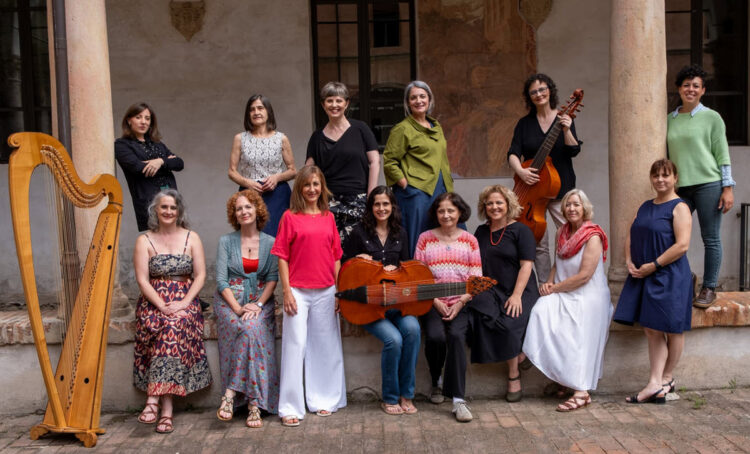
That music played a central role in the convents of early modern Italy is, thankfully, no longer news. Musicologists such as Craig Monson and Laurie Stras, and ensembles such as Musica Secreta and, of course, Cappella Artemisia, have done wonders for introducing the marvels of nuns’ music to modern-day audiences. Some nuns have even started to become recognizable names — Isabella Leonarda, for example, possibly Chiara Margarita Cozzolani, or Lucrezia Orsina Vizzana, all of whom have seen a flurry of recent interest.
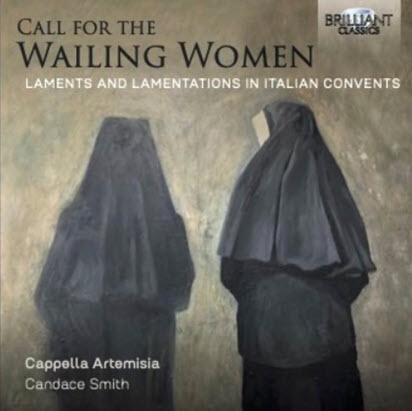
On this latest recording by Cappella Artemisia, the ensemble’s attention turns toward the tragic. Director Candace Smith notes that both laments in general and the Lamentations of Jeremiah, traditionally utilized for the office of Tenebrae, might have held particular appeal for nuns: laments were traditionally held to be a female genre, but nuns might also have seen their convents as a metaphor for Jerusalem, in which they were closed off to the world to mourn the death of their “husband” Jesus Christ.
The album comprises ten selections which have some relationship to conventual musicianship: in some cases, nuns were the dedicatees; in others, they were the composers themselves. The mournful tone of the record is set from the get-go with “Morior misera” (“I will die wretched”), a motet by Carlo Donato Cossoni which was later dedicated to a nun at S. Maria del Cappucio in Milan. The contrasts here between the solo and small group voices and the larger ensemble are attention-grabbing, and the accompaniment, in particular the lovely driving viola da gamba bass line, is quite solid.
Next come the two selections from the Lamentations proper: Alessandro Della Ciaia’s and Giovanni Matteo Asola’s settings of the First Nocturn for Maundy Thursday. The Della Ciaia, a monody for soprano beautifully sung by Silvia Vajente with lush organ, harpsichord, and plucked string continuo, contrasts superbly with the Asola’s more prima pratica style. Cozzolani’s own “Quid miseri, quid faciamus?” follows, a dialogue between Mary and the faithful featuring some delightfully chromatic passages.
The vocal works are here interrupted by the pleasant surprise of a violin sonata, Agostino Guerreri’s 1673 Sonata malinconica, dedicated to Giovanna Francesca Raggi at the convent of S. Leonardo. Vizzana’s 1623 “Usquequo oblivisceris me in finem?” follows; though brief, it is punchy, possibly addressing the church authorities who sought to dominate her convent through threats of starvation and excommunication. The simpler “Deh, chef ai, anima mia” by Giovanni Battista Strata, written for some of Raggi’s ancestors at the same convent, provides a nice contrast in style.
Maria Francesca Nascimbeni — a new name for me — comes next, with her lengthy trio “O trafitto mio Dio.” The penultimate work is a particular favorite; the anonymous narrator (and composer) of “La Monaca Musica” bewails that her voice is no longer appreciated in her convent. The album ends with Della Caia’s whopping “Lamentatio virginis in deposition Filij de Cruce,” a sixteen-minute dialogue between a grieving Mary and a double choir of angels.
Throughout the album, the voices are warm, the text audible, and the emotion clearly centered. I particularly appreciate how the lower voices are so delightfully foregrounded and resonant throughout — the Asola is a real standout for this reason, as is the subsequent Cozzolani. Surprising, however, is the lack of text and translation, either in liner notes or on the ensemble’s website. I would have enjoyed hearing exactly what our nun protagonist had to say about her voice in “La Monaca Musica,” for example! That small but meaningful quibble aside, it’s a stunning new release, and I look forward to their next already.
Karen M. Cook is associate professor of music history at the University of Hartford. She specializes in late-medieval music theory and notation, focusing on developments in rhythmic duration. She also maintains a primary interest in musical medievalism in contemporary media, particularly video games. For EMA, she recently wrote about two ensembles doubling up for Nova Cantica in France, c. 1100-1300.