by Pierre Ruhe
Published October 20, 2025
‘Zeng’s Bach spoke profoundly, and with an immediacy made more palpable by the unforced resonance of her Baroque instrument.‘
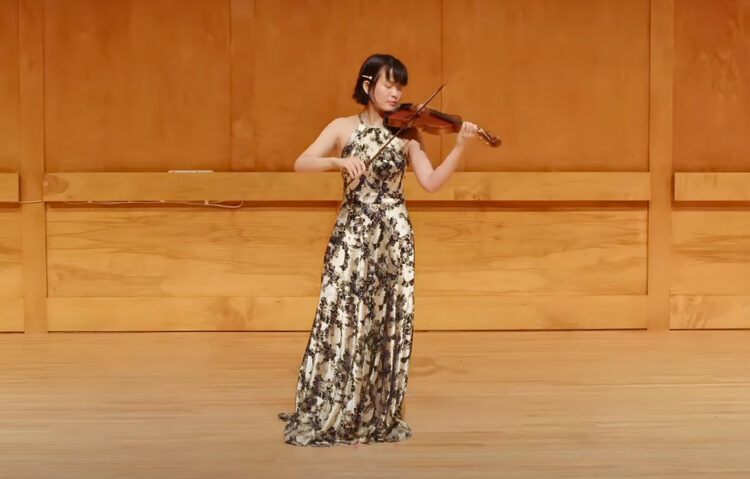
Playing a Baroque-style violin with guts strings and a Baroque bow, Danqi Zeng won the 2025 Lillian and Maurice Barbash J.S. Bach Violin Competition. The final round was held Oct. 16 at Stony Brook University’s Staller Center Recital Hall on Long Island, New York.
Zeng’s first place earned her $10,000 plus several performance dates in the coming seasons, including with the Washington Bach Consort, GEMS in New York City, and the Bach Choir of Bethlehem, Penn.
Born in Guangzhou, China, Zeng is steeped in historical performance (HP) yet is also an accomplished modern violinist and has been a repeat competition winner over the past decade. She is currently a student at Indiana University, pursuing two doctoral degrees — in violin with Mauricio Fuks, and in historical performance with Ingrid Matthews — while also working as an associate instructor of music theory.
This year’s second prize (plus $2,500) went to New Jersey-born Coco Mi, a Juilliard grad in modern violin performance and now living in New York City.
Zeng is the second Baroque violinist to win the Barbash Competition, following Rachell Ellen Wong’s triumph at the inaugural 2019 event. (For that, Wong used a hybrid set up: a modern violin with gut strings and a Baroque bow.)
Although more than 100 string players applied for this year’s Barbash, few played with a historical performance approach. Susan Barbash, the competition coordinator, hopes that “Danqi’s win will encourage more HP musicians to enter.”
The 2025 Barbash jury included two recent winners of EMA’s Howard Mayer Brown Award for Lifetime Achievement in Early Music: harpsichordist Arthur Haas, who teaches at Stony Brook, and cellist-conductor-viol player Kenneth Slowik, artistic director of the Smithsonian Chamber Music Society.
Asked to describe the playing and the competition, Slowik replied:
“The public final round of the Barbash Competition highlighted the four performers, of course, but also gave fresh proof (as if any was ever needed) of the stupendous complexities and beauties of Bach’s unaccompanied string music. Each of the contestants played stylishly enough in their own way, but both the prizewinners showed, in the opinion of the majority of the jury members, particular affinity for the language and rhetoric of the works they performed. Coco Mi’s rendition of the G-minor Sonata (BVW 1001), for which she used a modern setup of bow and instrument, was highly convincing.”
Slowik continued: “But it was Danqi Zeng’s C-Major Sonata (BWV 1005) performance that riveted several of us from its first quiet notes. She used her Baroque instrument and bow to draw us into her sound world, which seemed to be an extension of an imagined Bachian one. Non udite lo parlare? Arcangelo Corelli is said to have once asked a pupil — Don’t you hear it speak? Zeng’s Bach spoke profoundly, and with an immediacy made more palpable by the unforced resonance of her Baroque instrument. Her firm grasp of the structural underpinnings of the Bach sonata was very much on display in her performance, particularly in the notoriously difficult Fuga.”