by Anne E. Johnson
Published May 4, 2026
I Melt Like Snow in the Sun of Your Beauty. Baroque Music Montana. Black Bear Records, BMM 02. Total time: 1:09. Available on CD, vinyl LP, and all major streaming services.
Don’t assume that all the important American period-instrument recordings are coming from big cities and the expected early-music hubs. Look and listen no further than the great Rocky Mountain states, where Carrie Krause and her Baroque Music Montana are up to some very interesting things. (EMA profiled BaMM and other Mountain West ensembles in 2023.)
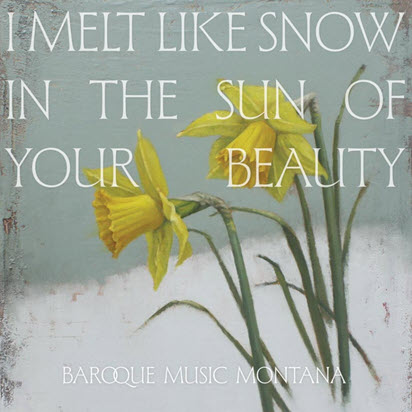
Along with familiar names like Monteverdi and Palestrina, BaMM’s newest album, I Melt Like Snow in the Sun of Your Beauty, offers works by composers not so well remembered. This enchanting collection explores both instrumental and vocal music, both sacred and profane, not to mention songs reimagined for instruments.
The ensemble in this case includes Krause on violin, Nate Helgeson on dulcian (a double-reed bassoon-like instrument), John Lenti on lute and theorbo, and soprano Arwin Myers. That combination makes for a refreshingly unusual sound that sets this recording apart.
The woody timbre of Helgeson’s dulcian is featured on many tracks. He demonstrates the instrument’s surprising potential for both expressivity and virtuosity in the Fantasia et correnti per fagotto solo by Bartolomé de Selma y Salaverde (c. 1595-c. 1638), a short, charming work demanding impressive technical prowess and delicacy.
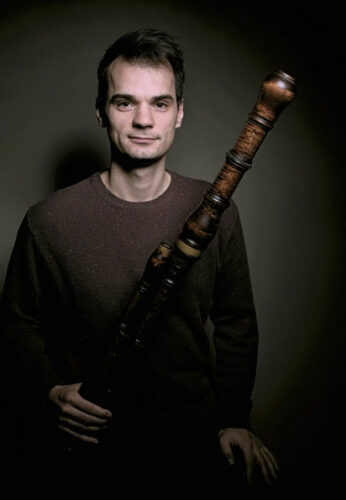
The dulcian shares solo duties in two “bastardi” — instrumental versions of vocal works — by Tarquinio Merula (1595-1665). “La Viscontea,” from a collection of polyphonic pieces called Pegaso, finds the dulcian in conversation with Krause’s violin. The second Merula example, “La Pighetta,” orchestrated from his Canzoni, takes a fetching Spanish turn with syncopated lute strums.
The music of the church is represented by Paolo Paolo Cima (1570-1622), whose Capriccio comes from his book Concerti Ecclesiatici. It is, in effect, a trio sonata, here played by dulcian, violin, and theorbo.
The first vocal selection is also religious in nature, the spiritual madrigal “Herr, wenn ich nur dich habe” by Johann Hermann Schein (1586-1630) on a text from Psalm 73 that would later be set by Schütz, Buxtehude, and Bach. Soprano Myers has a deeply colored sound and the confidence to free herself from the page in phrase-driven rhythm, ornate yet flowing decoration, and slight but effective alterations of pitch. Lenti and Helgeson provide continuo while Krause plays an appropriately flowery obbligato.

Myers sings music requiring quite a range of styles. Among these is a particularly pleasant discovery: a set of love-themed solo madrigals by Brescia-born Biagio Marini (1594-1663), whose jobs included playing with Monteverdi in Venice. “Vieni licori” is a passion-filled pastoral, with Krause providing a highly textured interlude between sections. Myers’ voice floats through a wistful song to the moon, contrasting with the elegant call to lovers that follows. The lively “Hor che l’alba hor che l’aurora” celebrates the dawn, finishing the set.
Lenti and Myers seem to be transported to a world of beautiful heartbreak in Palestrina’s 5-voice madrigal “Io son ferito ahi lasso” arranged as a lutesong by Giovanni Battista Bovicelli (1550-1594). At over seven minutes, it’s mesmerizing; Myers’ exquisite ornamentation swirls like fairy wings in a summer’s dusk.
The album ends with Myers singing Monteverdi’s “Ed è pur dunque vero” from Scherzi musicali — a sprightly and delightful close to a recording that shows the breadth of talent that is flowering across the country.
Anne E. Johnson is EMA Books Editor and frequent contributor to Classical Voice North America. She teaches music theory, ear training, and composition geared toward Irish trad musicians at the Irish Arts Center in New York and on her website, IrishMusicTeacher.com. For EMA, she recently reviewed Vinci’s ‘Artaserse’ from Chicago’s Haymarket Opera.