
Gabriela Guadalajara is perhaps NYC’s only luthier who works exclusively on period instruments
‘She knows how to make wood sing’
This article was first published in the May 2026 issue of EMAg, the Magazine of Early Music America
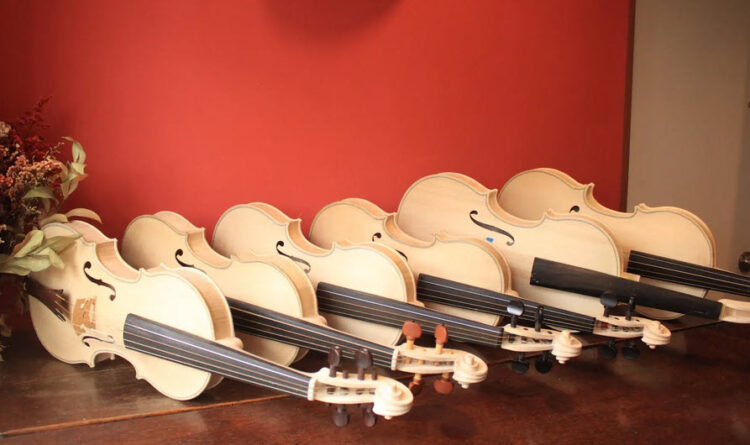
Perhaps the best way to understand the essential role that Gabriela Guadalajara plays in the early-music community is to look at the creation of the Congreso Latinoamericano de Laudería Barroca — the Latin American Congress on Baroque Luthiery.
Rewind to 2021, when cellist David Esteban Escobar, an alum of Cleveland’s Case Western Reserve Univ., founded the Academia de Música Antigua de Medellín in his native Colombia. As an independent music school for college-age students, the academy’s importance in the region is hard to overstate: It’s one of a few programs in all of Latin America that teaches historical performance. Now with some 30 students, the academy’s rapid growth and strong reputation make it an enviable success. (For this project, Escobar received EMA’s 2025 Thomas Binkley Award, which recognizes an influential leader of collegiate ensembles.)
Escobar had the vision, the Academia students had the talent. But they were missing quality instruments on which to play.
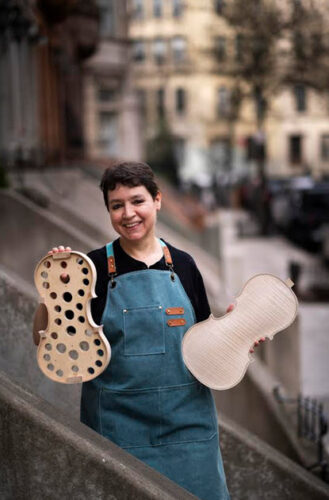
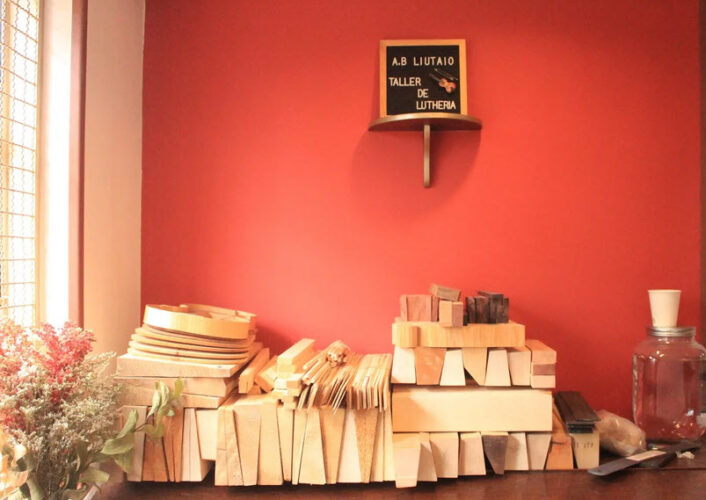
Enter the New York-based Guadalajara. Now 59, born in Mexico and today working in her small atelier in Harlem, she hatched a plan with Escobar a few years ago to gather luthiers from across Latin America and teach them the finer points of making Baroque-style stringed instruments. It took 15 months of preparation and countless hours of volunteer work, and it all came together for about $20,000, mostly for travel and materials.
In Oct. 2025, at that inaugural Congreso Latinoamericano de Laudería Barroca, nine violin makers gathered in Bogotá for the two-week, groundbreaking event. Hailing from Colombia, Mexico, and Brazil, the luthiers made Baroque instruments to donate to the Academia de Música Antigua de Medellín, growing its small collection. (EMA again: The Congreso received a 2025 Engagement Award grant as seed money.)
“Music-making and instrument-making are interconnected disciplines,” Guadalajara told me recently. “They should go hand in hand, and there is the need for creating an ecosystem that allows musicians to have well-made instruments they can afford, made in our countries, instead of having to import them from the U.S. or Europe. One of the Academia’s goals is to connect music and instrument-making as we all learn together. This is a long-term plan, obviously, but we have to start somehow.”
News of the project spread. “Gabriela has a big social heart,” says Dutch violinist and bowmaker Pieter Affourtit. He calls her participation in the Congreso “astounding” since she is doing it all practically “for free, just to help, and because she finds it important to bring something good to this world.”
Magical Objects
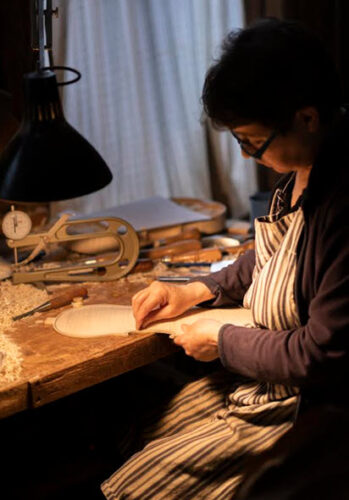
Growing up in Mexico City, Guadalajara’s mother taught her an appreciation for making art with your hands. Drawing and painting has been a creative release most of her life. As a child, Gabby’s father played the guitar and traditional Mexican and Latin American instruments. Early-music records were often on the family stereo. She fell in love with the cello, but initially didn’t have access to a playable instrument. Her father suggested she could one day make a cello herself, and that building instruments might even be a career path.
But at 18, the free-spirited Guadalajara had visions of building much bigger things, and she entered a university architecture program. But with too many interests, she quit school without a degree. After a year in Italy as an au pair, including studying cello in Rome, she returned home to Mexico to figure things out.
One day her mother, who owned a yarn and knitting shop, came across a newspaper ad for a violin-making school, Mexico City’s Escuela de Laudería. Young Gabby toured the school and immediately “knew that was what I wanted to do.”
Although it was the middle of the semester, the school’s director, French viol maker Luthfi Becker, appreciated Guadalajara’s enthusiasm and allowed her to keep visiting and, eventually, to start making her first violin. The deep background he gave her in period instruments had a lasting effect.
She recalls vividly the first time she completed an instrument: “Curiosity, expectation, wonder — I get a similar feeling every time I hear one of my instruments for the first time. I still find it magical that an object can produce sounds like that.” Soon after Guadalajara formally enrolled, the Mexico City Escuela de Laudería moved to Querétaro, a colorful town filled with Spanish colonial Baroque architecture. That, too, made a deep impression.
America beckoned. With a degree in luthiery and her life trajectory set, Guadalajara apprenticed at a shop in New Jersey, but her desire to work in the Baroque style led to an apprenticeship with New York’s renowned William Monical & Son. Within a year she was offered a full-time job — “the best thing that could ever happen to me.” Although Guadalajara was increasing her technical knowledge, one of the most valuable lessons she learned at the Monical shop was how they treated people: “It could be Yo-Yo Ma or a five-year-old renting their violin, everyone got the same respect and attention.”
Guadalajara also picked up Monical’s emphasis on fresh ideas and resourcefulness. Luthiers were encouraged to “solve problems by thinking in different ways — more than just following strict numbers or rules. To understand what that particular instrument or musician needed, thinking out of the box, coming up with creative solutions.”
Along the way, she bolstered her training by writing “real letters, not emails” to viol and Baroque violin makers across Europe. After a bit of correspondence, English luthier Jane Julier invited Guadalajara to her workshop in Devon — one of many points of encouragement. (According to the venerable British magazine The Strad, some 90 percent of luthiers are men.)
Finally, after a decade with Monical & Son and in keeping with age-old luthier tradition, Guadalajara set out on her own. She opened an independent shop, Gabriela’s Baroque.
Like most new businesses, Gabriela’s Baroque had an arduous launch. “I’m not a good businessperson! Managing time is very difficult for me,” she admits. “When you start an instrument, it takes time to finish and then sell it.” In your new shop, “people don’t know you yet as a maker, and you don’t have a salary anymore.” Soon her husband, David Thompson Fairchild, a classical guitarist and photographer, took charge of the business aspects, including the lucrative online gut-string sales.
In New York City, she is known as the only luthier devoted exclusively to Baroque and other period instruments. At this point, in addition to repair and restoration work, she’s been making instruments continuously for almost three decades, “a little bit of everything but mostly violins and viols. I know that many of my colleagues work faster and have made many more in that time frame.”
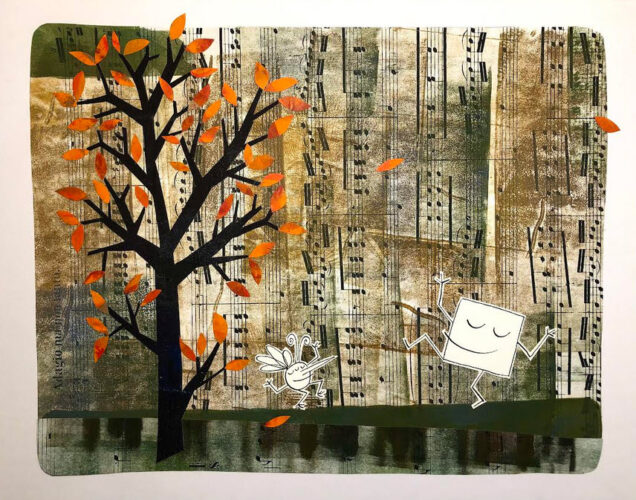
Her hands-on art-making continued during the pandemic, too. She saw no drop in new instrument orders but still found time to illustrate a children’s book, Fabemol Hears the Heart, with text by Mary Ann Domanska, an educator and experienced author. “In a world of swirling colors and musical trees, Fabemol is a quiet soul who doesn’t speak much — but he hears more than most” is how the publisher describes it. The illustrator says, “There are nods to music, but it’s a book about empathy.”
Physics and Creativity
A key aspect of Guadalajara’s craft is her refusal to make copies of famous instruments, although it’s not from a lack of respect for the old Cremona and Paris masters. “I don’t see the point of making over and over the same models,” she admits. “Makers in the Baroque were exploring their own shapes and styles and learning from others, yes, but not necessarily repeating another maker’s work. Copies will never be identical to the original anyway. They will not sound identical either.”
She continues, “I find it more interesting to try to make what pleases me aesthetically and try to make the instruments as easy to play as possible, as well as looking for a good sound using my knowledge and experiences. Many musicians would not be interested in my work just because I don’t make copies, and that’s ok. I am happy to work with the ones who understand my point. Even with all the rules of physics, there is room for creativity.”
‘Gabriela doesn’t copy historic models but instead creates her own, and they reflect her personality’
John Phillips, a harpsichord maker from Berkeley who plays on a Guadalajara seven-string bass viol, credits her skills in accomplishing dual goals: creativity and historical accuracy. This results in “instruments which stand on their own without relying on an historical label as a crutch. She knows how to make wood sing.” (She just finished a six-string viol for another prominent harpsichord maker, Owen Daly.)
Viola da gamba player Arnie Tanimoto, living in New York and playing a Guadalajara cello, relays that “a friend described Gabriela as more of a cook than a baker — she approaches building with creativity and intuition rather than rigid replication. Gabriela doesn’t copy historic models but instead creates her own, and they reflect her personality.”
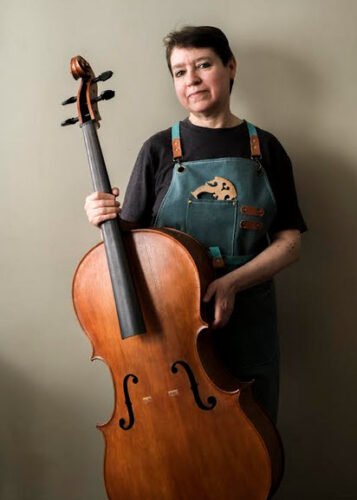
By choice, she deals with unique obstacles compared to her “modern” luthier colleagues, many of whom, for example, buy pre-cut blanks for bridges and then adapt them. Guadalajara urges luthiers to experiment with making bridges from scratch, allowing you “total control of what you would like to accomplish.” Luthiers need to be able to “make what the instrument is asking for, not being limited by what the bridge blank is determining.”
Another challenge in the historical performance category is the price difference between Baroque and modern instruments. Modern luthiers are often able to raise prices based on market trends. It is lamentable, says Guadalajara: “I would argue that there is more work involved on a Baroque instrument since we make almost every part from scratch.”
Even though the process is laborious, Guadalajara takes the time to listen attentively to what musicians desire. Jeremy Rhizor, who plays one of her Baroque violins, recognizes the skill in how Guadalajara understood his detailed vision for his violin and how her own personality spilled into his violin. “I believe that Gabriela is a unique soul and a good person,” Rhizor says. “It’s a blessing to play on a violin made by someone whose inner life matches the quality of their craftsmanship.”
‘It’s a blessing to play on a violin made by someone whose inner life matches the quality of their craftsmanship’
After Rhizor played a few concerts on his lovely new instrument, several musicians rushed to commission Guadalajara for their own. Bolivian violinist Karin Cuéllar Rendón, living in Montréal, added her name to the luthier’s two-year waiting list. “It was a fun process,” recalls Cuéllar, who helped pick out the wood to be used for the violin — “which I only chose out of a feeling and nothing scientific. But it was exciting to imagine that those blocks of wood would turn into an instrument.”
After an initial breaking-in period, Cuéllar brought her new violin to its maker’s Harlem atelier for some adjustments. To her surprise, Guadalajara “really changed its sound. My — Gabriela’s — violin is very beautiful, easy to play, and with a bright sound. It is still in its infancy phase, still learning about colors and nuances, but with lots of potential.” (Disclaimer: Cuéllar is currently president of the EMA board of directors.)
For more than a decade, Guadalajara has also worked on historical instruments from the Metropolitan Museum of Art’s vast collection, often preparing them for concerts. She recently rebuilt a bridge for a priceless Stradivari violin — one that had been reconverted, in the 1970s, to its original Baroque style — for a recital by Rachell Ellen Wong.
Bogotá and Beyond
Of the nine participants at the inaugural Latin American Congress on Baroque Luthiery, in Bogotá in October, seven were, to some degree, professional luthiers who typically make modern-style instruments and were asked to bring a violin or viola they’d prepared in advance.
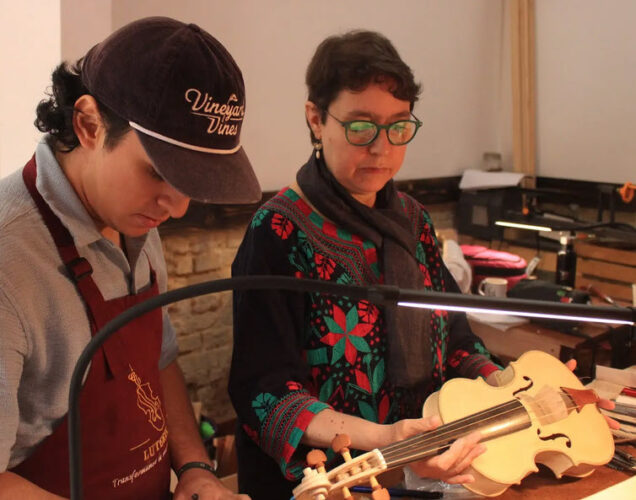
Guadalajara then walked them through the finishing process of a Baroque set-up, including how to shape the neck and fingerboard and how to attach it to the body of the instrument. They worked on bridges and tailpieces as well as interior essentials. “There were almost no standards back then,” she says, “and you see in books and museum collections that bass bars and soundposts were all over the place. We should do what the instrument tells us to do.”
Of the participants, all young adults, two were still just aspiring luthiers, attempting to make their very first violin. Some of the luthiers had to embrace new (or old-fashioned) skills, such as drawing by hand instead of using a computer program. But as hoped, the experienced artisans began helping the novices; soon a sense of shared purpose kicked in, and everyone at the congress began assisting, and learning from, each other.
Their hosts made the project all the more welcoming and cost-effective. Augusto Beltrán and Marly Torres, musicians and instrument builders, accommodated everyone in their Bogatá home, with space for tables and an impromptu workshop. They’d bring snacks and fruit, with their Siamese cat, Lilu, always present in a supervisory role. “For more than two weeks they were incredibly nice to us,” Guadalajara says, “and that built a sense of teamwork and communication between us all. That surprised me. We didn’t know each other at the start, and now we’re all friends.”
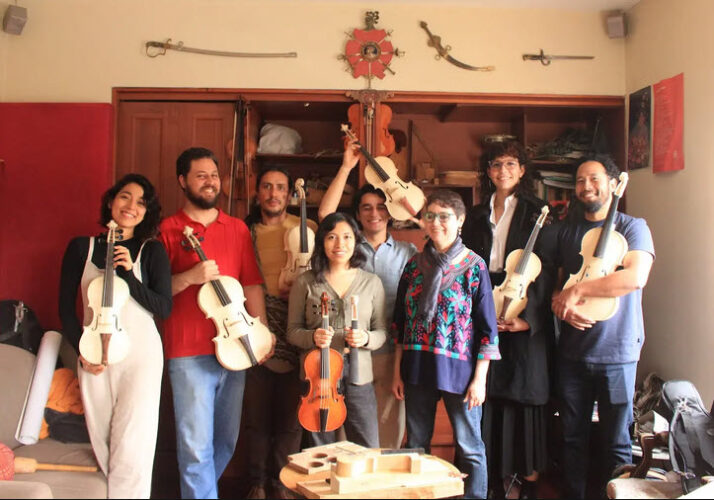
Although the initial congress was supported by the generosity of many people, the hope is to find funding to continue their groundbreaking work. Escobar, in Medellín, wants to boost the budget to $35,000. “We are a bunch of dreamers,” Guadalajara offers, “but we need to figure out a sustainable system to keep going.”
‘We are a bunch of dreamers, but we need to figure out a sustainable system to keep going.’
Guadalajara believes that there is untapped talent outside of the U.S. and Europe, but not the resources for string players to have good instruments or even maintenance of their instruments. “Not that long ago, at least in Mexico, they played with whatever they had, and many musicians were used to fixing their own instruments — badly in many cases,” she says. Yet she believes that “things are changing.”
With time and funding in short supply for an Oct. 2026 edition, the current proposal is to recruit a Baroque bow maker, possibly from Latin America, to lead specialty workshops. Instruments and bows are essential, but the congress has already succeeded in one key ambition: establishing connections with a variety of people and institutions across Latin America who are interested in developing an ecosystem to support the entirety of historical performance — from teachers and instrument makers to players and the concert stage.
To that end, Guadalajara encourages someone who is thinking of becoming a luthier to develop patience. “We don’t see results immediately. The process takes a lot of time. Learning and starting to make money from this profession also takes a lot of time.” Still, she reflects, “it’s a very rewarding craft.
“School is one part of the process. But aspiring makers need to understand that just school training is not enough to open a shop. Luthiers need to work in someone else’s shop and get experiences in the real world.”
Sophie Genevieve Lowe is a Baroque violinist based in Virginia where she lives with her husband, Baroque cellist Ryan Lowe. She is the artistic director of Williamsburg Baroque and is in the pianoforte trio Assai Ad Libitum. For EMA, she recently wrote an America250 article about a Monster in This Part of the World — the rise of public concerts in colonial America.