by Derek R. Strykowski
Published August 16, 2026
Forgery in Musical Composition: Aesthetics, History and the Canon by Frederick Reece. Oxford University Press, 2025. 256 pages.
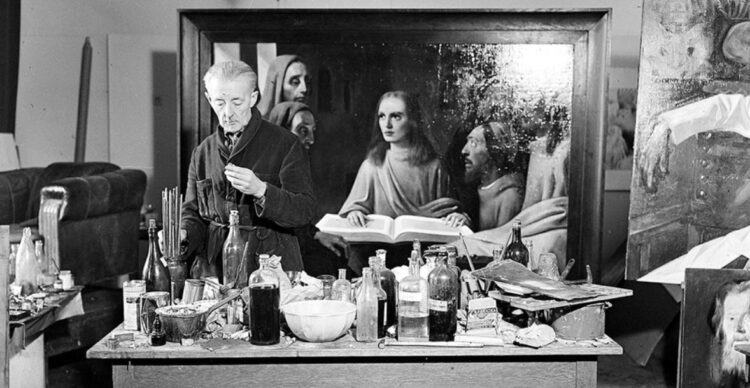
When one author plagiarizes the work of another, the crime is clear: The first — whether through greed or laziness — is trying to earn credit for words written by the second. When a painter adds the signature of a famous artist to the corner of the canvas, we likewise understand that the painter is seeking to make a quick buck through the sale of a forgery. But when the conversation turns to similar forgeries in the world of music, the value of the deception is not always so obvious. What is the purpose of such musical mischief?
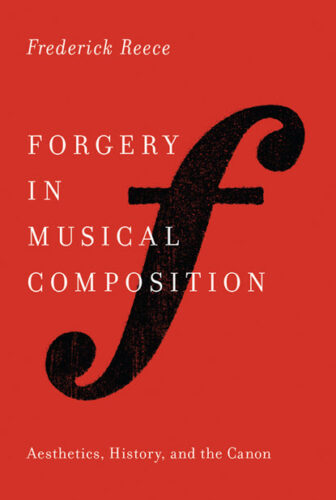
This is where Frederick Reece, author of Forgery in Musical Composition, steps in. Reece’s aim in this fascinating book is to understand the “inventive” musical forgery: not a counterfeit, per se, but a newly created composition that is falsely attributed to someone else. He investigates not only why forgers may be attracted to such deceptions but also why the rest of us are so repulsed when the truth is revealed.
To demonstrate what is at stake, Reece guides readers through four “genuinely fake” case studies. The first considers how (and why) vast portions of Mozart’s unfinished Requiem Mass were completed by Franz Xaver Süssmayr in the months following the original composer’s death. The second introduces us to a beloved 20th-century violinist, Fritz Kreisler, who performed and eventually published music that he claimed had been written by a series of forgotten Baroque masters. In reality, Kreisler himself was the composer.
In the third case study, we learn how a small-time journalist “rediscovered” the score to an unknown Schubert symphony in 1975, just in time for the 150th anniversary of the composer’s death. Finally, the fourth case study traces a similar attempt to dupe some of the world’s leading Haydn scholars with a fake collection of lost keyboard sonatas in 1993.
Reece takes pains to address readers who may be confused as to why the chapters on Mozart and Haydn appear at opposite ends of the book despite the composers being such close contemporaries. Yet the reason turns out to be obvious: The author is presenting the forgers — not the composers — in chronological order of appearance, the better for us to trace how our ideas about musical forgery have changed over the decades.
Until about 80 years ago, Reece explains, music operated within a culture of presumptive authenticity. This meant that audiences and critics generally expected musical works to be genuine. Following World War II, a marked shift to presumptive inauthenticity meant that listeners (especially professional musicologists) no longer trusted what they were seeing or hearing.
Musical forgeries are indeed everywhere, as Reece asserts in the book’s preface. It is therefore a testament to his powers as a writer that the four chosen case studies feel so utterly distinct from one another. Each raises its own uncomfortable truths about the nature of musical authenticity.
When Süssmayr undertook to complete roughly half of the unfinished Mozart Requiem in 1792, the dead composer’s signature miraculously appeared on the final manuscript. Süssmayr’s was nowhere to be found. The fiction that he had merely worked out Mozart’s original ideas satisfied not only the patron who had commissioned the music but also the critics who soon showered it with praise. “Time and again,” Reece explains, “unusual musical features judged to be brilliant and ingenious in a piece assumed to be by a well-known master become evidence of technical incompetence” when their lesser-known author is revealed. For one of the first times in history, the authorship of a musical work mattered.
A century later, Kreisler attempted to dodge that very issue (perhaps subconsciously) by returning in his Baroque forgeries to a time when musical virtuosos — much like Kreisler himself — reigned supreme. With such an emphasis on performance, the question of compositional authorship had been far less important.
Schubert, by contrast, possessed one of the strongest authorial voices of the early Romantic era. The 1970s forgery of an entire “Schubert” symphony, in a voice seemingly his own, therefore prompted a fundamental shift in how newly discovered scores were authenticated. After a study of the music itself convinced at least one prominent scholar that the symphony was genuine, a chemical analysis of the paper on which it was written proved otherwise.
And with that, Reece argues, source criticism (examination of a document’s provenance) overtook style criticism (examination of the notes themselves) in establishing the authenticity of a work.
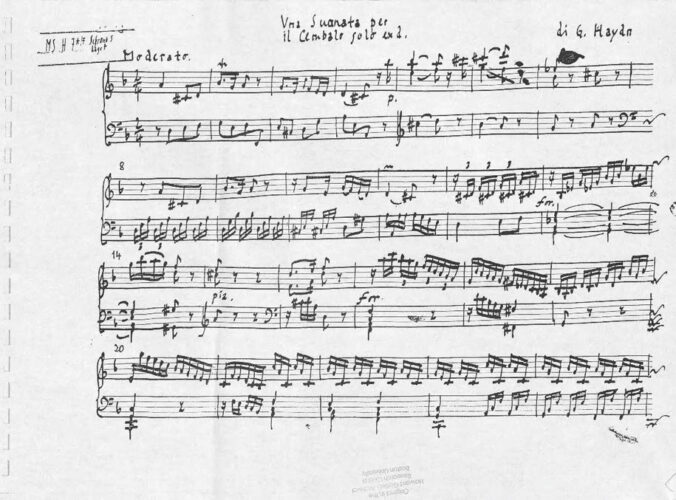
First page of the forged Sonata in D min “Hob, Xvi:2a,” from the so-called Westphalian Manuscript. (H.C. Robbins Landon Collection, Howard Gotlieb Archival Research Center at Boston Univ.)
The trend continued with the so-called Haydn keyboard sonatas. The forger had provided only photocopies of the scores, which were ultimately confirmed as fakes through handwriting analysis. Stylistic expertise was no longer enough to establish authenticity. Yet what to make of the celebrated (albeit hoodwinked) Haydn scholar who spoke so effusively about the “timeproof treasures” he had discovered?
This, it turns out, becomes the central question of the book. If much of what is valuable in music now depends on its backstory, its historical pedigree, then a pleasant-sounding forgery threatens to recall our attention to the virtues of the music itself. Reece concludes that such fakes are so roundly despised because they threaten our contemporary beliefs about artistic genius and linear historical progress in the arts. Still, and as Reece himself acknowledges, we are only able to study the forgers who are clumsy enough to be caught!
Derek R. Strykowski is an associate teaching professor in the Department of Music at the University at Buffalo (SUNY). As a historical musicologist, his research explores the economic history of music with a particular focus on the 19th-century music publishing industry.